


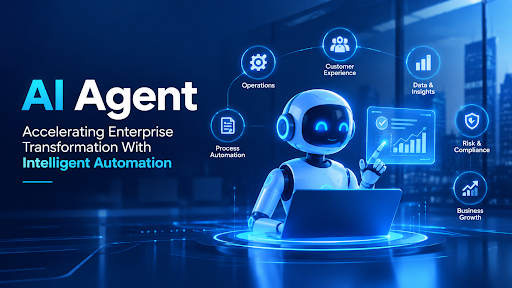
AI is moving beyond simple automation and predictive analytics. AI agents are enabling organizations to create intelligent systems that can understand objectives, make decisions, execute tasks, and continuously improve outcomes. For businesses pursuing digital transformation, agentic technologies offer a powerful path toward faster, smarter, and more scalable operations.
What Are AI Agents?
Understanding AI Agents
AI agents are intelligent software systems designed to perceive information, reason through problems, make decisions, and take actions with limited human intervention. They can connect with enterprise applications, analyze data, complete workflows, and support employees across complex business processes.
How Agentic AI Works
Agentic AI combines artificial intelligence, reasoning capabilities, enterprise data, and workflow automation to enable systems that can independently determine the steps required to accomplish defined objectives. Unlike traditional automation, agents can adapt their actions based on changing information and business conditions.
Why Businesses Need AI Agents
Accelerating Digital Transformation
AI agents can become a strategic foundation for digital transformation by connecting disconnected processes, applications, and data. Organizations can use intelligent agents to streamline operations, improve employee productivity, accelerate service delivery, and create more responsive business models across functions.
Advancing AI Transformation
AI transformation requires more than implementing individual AI tools. Organizations need intelligent capabilities embedded into everyday operations. AI agents can help finance, procurement, HR, IT, supply chain, and other functions move from isolated AI use cases toward scalable enterprise-wide transformation.
AI Agent Development for Enterprise Use
Building Purpose-Driven AI Agents
Successful AI agent development begins with clearly defined business objectives. Organizations can design agents around specific workflows such as financial analysis, procurement support, employee assistance, customer service, or research, ensuring every implementation delivers measurable operational and strategic value.
Preparing for AI Readiness
AI readiness evaluates whether an organization has the data, technology, processes, governance, skills, and operating model required to implement intelligent systems effectively. Assessing readiness early helps businesses identify capability gaps and establish a practical roadmap for successful AI adoption.
From Intelligent Automation to Autonomous Workflows
Enhancing Intelligent Automation
Intelligent automation combines AI capabilities with automated workflows to handle increasingly complex business activities. AI agents can interpret unstructured information, determine appropriate actions, and execute multi-step processes, helping organizations reduce manual effort while improving speed, consistency, and operational efficiency.
Enabling Smarter Business Transformation
AI agents can support business transformation by redesigning how work gets performed rather than simply automating existing tasks. Organizations can create new operating models where humans focus on strategic decisions while intelligent systems manage repetitive, data-intensive, and process-driven activities.
Making AI Agent Deployment Successful
Creating a Scalable Deployment Strategy
Successful AI agent deployment requires more than selecting technology. Organizations need clear use cases, appropriate governance, secure data access, integration capabilities, performance measures, and change management. A structured deployment approach helps organizations scale successful agents while controlling operational and technology risks.
Integrating Agents Across Enterprise Functions
AI agents become more valuable when they operate across connected business processes. Organizations can integrate agents with enterprise applications, knowledge repositories, analytics platforms, and workflow systems to create connected experiences that improve decision-making and enable faster execution across multiple business functions.
How AI Agents Create Business Value
Improving Productivity and Efficiency
AI agents can reduce the time employees spend searching for information, preparing reports, handling repetitive requests, and completing routine workflows. By taking responsibility for defined tasks, agents allow employees to focus on higher-value activities requiring expertise, judgment, creativity, and collaboration.
Supporting Better Business Decisions
AI agents can bring together information from multiple sources and provide relevant insights at the point of decision. This enables business leaders and functional teams to identify opportunities, respond to emerging issues, evaluate scenarios, and make faster, more informed decisions.
Building an Enterprise AI Agent Roadmap
Identifying High-Value Use Cases
A successful agent strategy starts by identifying processes where AI can create measurable value. Organizations should prioritize opportunities based on business impact, process complexity, data availability, implementation feasibility, and scalability to ensure investments deliver meaningful transformation rather than isolated experimentation.
Establishing Governance and Human Oversight
Responsible AI agent adoption requires appropriate governance, security controls, monitoring, and human oversight. Organizations should establish clear boundaries around autonomous actions, data access, decision-making, and escalation. This creates confidence while enabling agents to operate efficiently within defined business and compliance requirements.
Partnering for AI Agent Transformation
Accelerating Enterprise AI Adoption
Organizations do not need to navigate AI transformation alone. The Hackett Group® can help businesses assess AI readiness, identify high-value opportunities, define transformation priorities, and develop practical strategies for deploying AI agents that align technology investments with measurable business outcomes.
Turning AI Potential Into Business Results
The real value of AI agents comes from moving beyond experimentation toward measurable enterprise outcomes. A focused strategy can connect agentic AI with business priorities, intelligent automation, and operating model improvements, helping organizations achieve sustainable productivity, agility, and competitive advantage.
Conclusion
AI agents are becoming an important component of modern enterprise transformation. By combining Agentic AI, AI agent development, intelligent automation, and enterprise data, organizations can redesign processes, improve productivity, and create more adaptive operating models.
However, successful adoption requires more than deploying an AI agent. Businesses need AI readiness, strategic planning, governance, integration, and measurable objectives. Organizations that approach AI agent deployment as part of a broader digital transformation and business transformation strategy can move beyond isolated AI experiments and build scalable capabilities.
The opportunity is significant: from automating repetitive workflows to supporting complex decisions, AI agents can help organizations create faster, smarter, and more connected operations. With the right roadmap and implementation approach, enterprises can turn AI investment into tangible business value and accelerate their next stage of transformation.
