


Introduction
Technology is changing how businesses operate make decisions and compete in modern markets.
Data science artificial intelligence AI and machine learning ML are three important areas driving this transformation.
Although these terms are often used interchangeably they represent different concepts with distinct purposes capabilities and business applications.
For enterprise leaders understanding these differences is essential when evaluating technology investments developing digital strategies and managing organizational risks.
At the same time companies operating in or serving customers across Europe must understand the European Union’s regulatory framework for artificial intelligence.
The EU AI Act introduces requirements that affect how organizations develop deploy and manage AI systems.
Leaders must therefore balance innovation with responsible technology adoption and regulatory compliance.
Understanding Data Science Artificial Intelligence and Machine Learning
Data science is a broad discipline that combines statistics mathematics programming, and analytical methods to extract meaningful insights from structured and unstructured data.
Organizations use it to understand customer behavior identify business trends forecast demand and improve operational efficiency.
Artificial intelligence is a broader concept focused on developing computer systems capable of performing tasks that traditionally require human intelligence.
These tasks include understanding language recognizing images solving problems and supporting complex decisions.
Machine learning is a specialized branch of artificial intelligence that allows computer systems to learn patterns from data and improve their performance without being explicitly programmed for every individual task.
For business leaders understanding data science vs AI vs machine learning for enterprise leaders helps clarify how these technologies work together and where each can deliver measurable business value.
How These Technologies Work Together in Business
Although data science, AI, and machine learning have different objectives, they frequently operate together within enterprise technology environments.
For example, a retail company might use data science to analyze purchasing patterns and identify seasonal demand. Machine learning models could then predict future sales based on historical information. An AI-powered recommendation system could use those predictions to suggest relevant products to individual customers.
Financial institutions offer another example. Data science helps analysts understand transaction patterns, machine learning identifies unusual activities, and AI-powered systems can support fraud detection and risk management.
These technologies can also improve:
* Customer relationship management and personalization.
* Supply chain planning and demand forecasting.
* Financial reporting and operational analysis.
* Automated customer support.
* Predictive maintenance and resource management.
* Business intelligence and strategic decision-making.
However, successful implementation requires more than selecting advanced software. Organizations need reliable data skilled professionals appropriate infrastructure, and clear performance objectives.
Why Enterprise Leaders Must Understand AI Governance
As AI adoption increases, businesses face new challenges involving transparency privacy security accountability and operational risk.
An AI system may produce inaccurate predictions, expose confidential information, or generate decisions that negatively affect customers and employees.
Without appropriate governance, these issues can create financial losses, reputational damage, and legal complications.
Enterprise leaders should establish clear responsibilities for AI development and deployment.
This includes evaluating potential risks, documenting system capabilities, monitoring performance, and ensuring that employees understand how automated decisions are used.
Organizations should also establish human oversight where necessary, particularly when AI systems influence important business decisions.
Good governance does not prevent innovation. Instead, it provides a structured environment in which businesses can adopt emerging technologies responsibly.
Understanding the EU AI Act and Its Compliance Timeline
The European Union Artificial Intelligence Act introduces a risk-based regulatory framework for AI systems.
Its purpose is to encourage trustworthy AI development while protecting fundamental rights, safety and consumer interests.
The regulation distinguishes between different categories of AI applications according to their potential risks. These include prohibited AI practices high-risk systems limited-risk applications and minimal-risk applications.
For organizations understanding the EU AI Act compliance timeline and enterprise requirements is important when preparing internal policies assessing existing AI tools and planning future technology investments.
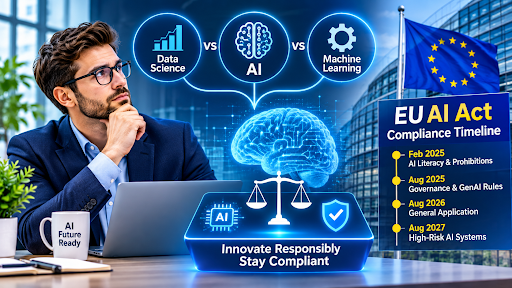
The regulation entered into force on 1 August 2024, with its requirements becoming applicable in stages.
Important implementation milestones include:
2 February 2025: Prohibitions on certain AI practices and AI literacy obligations began applying.
2 August 2025: Governance provisions and obligations relating to general-purpose AI models began applying, subject to the regulation’s specific transitional provisions.
2 August 2026: The general application date for most provisions of the EU AI Act including many requirements concerning high-risk AI systems.
2 August 2027: Certain obligations for high-risk AI systems embedded in products regulated under specific EU harmonisation legislation become applicable.
Businesses should monitor the official regulatory framework for applicable transitional provisions and any subsequent amendments or implementation changes.
Practical Steps for Enterprise AI Compliance
Preparing for regulatory requirements should be an ongoing business activity rather than a last-minute exercise.
Organizations can begin with several practical steps.
1.Identify Existing AI Systems
Businesses should create an inventory of AI tools and applications currently used across departments.
This includes internally developed systems and third-party software.
2.Assess Risk Categories
Each system should be evaluated according to its intended purpose and potential impact. Particular attention should be given to applications that may qualify as high-risk under the regulation.
3.Improve Data Governance
Companies should establish processes for data quality security access management and documentation.
Reliable data management supports both AI performance and regulatory accountability.
4.Establish Human Oversight
Employees should understand when automated outputs require human review. High-impact decisions should have appropriate supervision and escalation procedures.
5.Train Employees
AI literacy is increasingly important. Staff members should understand the capabilities limitations, and risks associated with the AI systems they use.
6.Monitor and Document Performance
Organizations should maintain appropriate technical documentation monitor system behavior and establish procedures for addressing unexpected outcomes.
Bringing Innovation and Compliance Together
Data science, artificial intelligence, and machine learning can deliver significant competitive advantages when implemented with clear business objectives. However, enterprise leaders must recognize that technological capability and regulatory readiness are equally important.
A company that invests in predictive analytics without considering data quality may struggle to achieve reliable results. Similarly, an organization that introduces AI automation without appropriate governance may face unnecessary compliance and operational risks.
The most effective approach combines technical understanding, business strategy, employee training, and regulatory awareness.
Leaders should involve technical teams, legal professionals, compliance specialists, and business stakeholders throughout the AI adoption process. This collaborative approach helps organizations identify potential problems early and develop systems that are both useful and responsible.
Conclusion
Data science, AI, and machine learning are closely connected but serve different purposes in modern enterprises. Understanding their distinctions allows business leaders to make better technology decisions, identify valuable opportunities, and build effective digital strategies.
Meanwhile, the EU AI Act makes regulatory awareness an essential part of enterprise AI planning. Businesses must understand their obligations, assess system risks, improve internal governance, and prepare for applicable compliance deadlines.
Ultimately, successful AI adoption is not simply about using the latest technology. It is about combining innovation, responsible decision-making, and regulatory preparation to create sustainable business value.
