


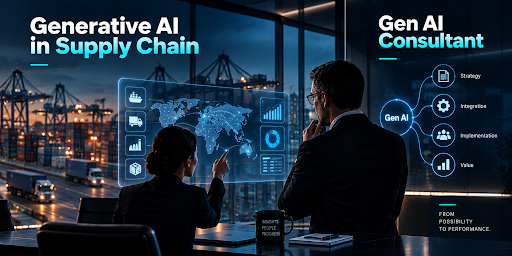
Supply chain leaders are managing volatile demand, supplier risks, inventory pressures and increasingly complex global networks. Traditional planning and analytics remain essential, but organizations also need faster ways to interpret operational information and respond to exceptions. Generative AI in Supply Chain is creating new opportunities to improve knowledge access, planning support and decision-making across end-to-end operations.
Implementing these capabilities successfully requires more than adding a generative AI tool to existing systems. A Gen AI consultant can help organizations identify high-value use cases, assess data and technology readiness, establish governance and connect AI investments with measurable supply chain outcomes.
This article explores how Generative AI in Supply Chain is changing operations, the role of a Gen AI consultant, key applications, business benefits and priorities for successful implementation.
What is Generative AI in Supply Chain?
Generative AI in Supply Chain refers to the use of generative artificial intelligence across planning, sourcing, manufacturing, inventory, logistics and supply chain decision support.
These capabilities can understand natural language, summarize complex operational information, generate reports and help employees interact with enterprise knowledge conversationally.
For example, supply chain professionals can use generative AI to summarize forecast changes, investigate inventory exceptions or retrieve relevant supplier information.
Unlike traditional reporting tools, generative AI can synthesize information and present it in a form that helps employees understand complex operational conditions more quickly.
What does a Gen AI consultant do?
A Gen AI consultant helps organizations determine where generative artificial intelligence can create meaningful business value and how those capabilities should be implemented.
The work can include AI strategy, use-case identification, data readiness, technology architecture, integration planning, governance and value measurement.
Within supply chain management, a Gen AI consultant can evaluate processes across plan, source, make and deliver to identify knowledge-intensive activities where generative AI may improve productivity or decision support.
This approach keeps AI implementation focused on business performance rather than technology novelty.
Why supply chains need generative AI
Supply chains generate enormous volumes of information across planning platforms, ERP systems, supplier records, manufacturing applications and logistics networks.
Employees often need to combine information from several sources before understanding why performance has changed or how they should respond.
Generative AI in Supply Chain can reduce this analytical friction by summarizing relevant information and making enterprise knowledge easier to access.
For example, a planner investigating an inventory exception could use AI to retrieve related demand, supply and operational information rather than manually searching multiple reports.
The employee still makes the decision, but the information required to make it can become easier to obtain.
Core technologies supporting intelligent supply chains
Several technologies work together with generative AI.
Large language models
Large language models enable natural-language interaction, summarization and contextual interpretation of supply chain information.
Machine learning
Machine learning can identify patterns across demand, supplier, inventory and logistics data.
Predictive analytics
Predictive models help organizations anticipate demand changes, supply constraints and potential operational risks.
Intelligent automation
Automation can execute repetitive workflows, while generative AI supports activities requiring interpretation and knowledge retrieval.
AI agents
AI agents can potentially coordinate multistep workflows across supply chain systems while escalating strategic or high-risk decisions for human review.
A Gen AI consultant can help determine how these technologies should be combined for specific operational requirements.
Key applications of Generative AI in Supply Chain
Organizations can apply generative AI across multiple supply chain processes.
Demand planning
Generative AI can summarize forecast changes, explain relevant demand signals and help planners understand potential drivers.
Inventory management
AI can summarize inventory positions, highlight exceptions and make relevant operational information easier to investigate.
Supplier management
Generative AI can synthesize supplier information, contracts and performance data to support faster supplier analysis.
Manufacturing
AI can summarize production information, technical documentation and maintenance knowledge for operational teams.
Logistics
Generative AI can synthesize transportation information, explain delivery exceptions and help employees investigate potential disruptions.
Supply chain risk management
AI can summarize supplier, market and operational information to provide a clearer view of emerging risks.
These applications demonstrate how Generative AI in Supply Chain can complement established planning and analytical capabilities.
Business benefits of generative AI
When implemented against clearly defined supply chain priorities, generative AI can improve several dimensions of performance.
Greater employee productivity
AI can reduce time spent searching for information, preparing summaries and investigating routine exceptions.
Faster decision support
Generative AI can synthesize relevant information more quickly, helping employees evaluate operational conditions.
Better knowledge accessibility
Conversational interfaces can make supply chain policies, procedures and operational knowledge easier to retrieve.
More scalable operations
AI-enabled workflows can help supply chain teams manage increasing complexity without proportional increases in manual analysis.
Faster exception management
AI can gather and summarize relevant context so employees can focus on evaluating and resolving important exceptions.
How a Gen AI consultant identifies high-value opportunities
Not every supply chain activity requires generative AI. The starting point should be identifying material performance problems.
A Gen AI consultant can assess where employees spend significant time on information retrieval, documentation, exception investigation or other knowledge-intensive activities.
Potential use cases can then be evaluated according to business impact, technical feasibility, implementation cost, risk and time to value.
For example, a supply chain organization with significant planning complexity may prioritize AI-supported exception analysis, while another may find greater value in supplier knowledge management.
This disciplined approach prevents organizations from implementing AI where simpler technology could solve the problem more effectively.
Building the data foundation
Generative AI in Supply Chain depends on relevant and reliable enterprise information.
Supply chain data is often fragmented across planning, ERP, procurement, manufacturing and logistics platforms. Different systems may also use inconsistent product, supplier or location definitions.
A Gen AI consultant can help organizations determine which data and knowledge sources each use case requires and whether those sources are sufficiently reliable.
Organizations may need to improve data governance, integrations or knowledge repositories before advanced applications can scale.
Strong foundations increase the likelihood that generative AI provides relevant and useful information.
Best practices for implementing Generative AI in Supply Chain
Organizations can improve implementation outcomes by following several principles:
- Start with clearly defined supply chain problems and desired outcomes.
- Establish performance baselines before implementation.
- Prioritize use cases based on value, feasibility, risk and time to value.
- Improve demand, supplier, inventory and logistics data quality.
- Integrate generative AI with existing planning and execution workflows.
- Establish strong access controls for sensitive supplier and commercial information.
- Maintain human accountability for strategic and high-risk decisions.
- Test AI outputs against realistic operational scenarios.
- Measure realized outcomes rather than technology usage.
- Scale successful applications while redesigning or discontinuing those that underperform.
A Gen AI consultant can help organizations apply these principles consistently throughout implementation.
Governance and human oversight
Supply chain AI can influence decisions involving inventory, suppliers, production and customer commitments. Appropriate governance is therefore essential.
Organizations need to define which information generative AI can access and which outputs require employee validation.
Human oversight should remain particularly strong when decisions have significant financial, supplier or customer consequences.
AI-generated summaries should also distinguish between verified enterprise information and generated interpretation.
As Generative AI in Supply Chain evolves toward agentic capabilities, organizations will need increasingly precise rules governing which actions intelligent systems can initiate independently.
Measuring the value of generative AI
Generative AI should be evaluated through improvements in supply chain performance rather than adoption metrics alone.
Relevant measures can include planning productivity, exception resolution time, information retrieval time, inventory performance, service levels and operational costs.
For example, an AI assistant supporting planners should demonstrate that employees can investigate exceptions faster or manage greater workloads effectively.
A Gen AI consultant can help establish baseline performance and connect each use case with specific operational and financial measures.
This enables leaders to determine which AI investments should receive additional funding.
Common implementation challenges
Data fragmentation is one of the most significant barriers to Generative AI in Supply Chain. Without reliable context, AI-generated outputs may be incomplete or misleading.
Legacy technology can also create integration challenges when AI applications need information from multiple operational platforms.
Organizations may additionally underestimate implementation costs related to integration, security, governance and ongoing model management.
Employee trust is another consideration. Supply chain professionals need to understand how AI outputs are produced and when their own expertise should override or challenge a recommendation.
A Gen AI consultant can help organizations address these dependencies as part of the implementation roadmap.
The future of Generative AI in Supply Chain
The next stage of Generative AI in Supply Chain will increasingly involve AI agents capable of coordinating activities across planning and execution systems.
An agent could identify an inventory exception, retrieve demand and supply information, summarize potential causes and initiate an approved analytical workflow. More consequential actions could then be escalated to supply chain professionals.
Multiple agents may eventually coordinate activities across planning, procurement, manufacturing and logistics.
As these capabilities mature, the role of a Gen AI consultant will increasingly include agent architecture, workflow redesign, governance and operating model transformation.
Organizations will need to determine where increased autonomy creates sufficient business value relative to its additional cost and risk.
Conclusion
Generative AI in Supply Chain can improve knowledge access, exception management and decision support across increasingly complex supply networks. However, sustainable value depends on selecting the right use cases and integrating AI with reliable data, established workflows and appropriate governance.
A Gen AI consultant can provide the strategic and implementation expertise required to identify high-value opportunities, strengthen foundational capabilities and measure realized results.
Organizations that take a disciplined approach will be better positioned to move beyond AI experimentation and build intelligent supply chain operations that improve productivity, responsiveness and enterprise performance.
