


Urban planners and facility managers are facing a critical turning point in infrastructure management. For decades, traditional lighting solutions like halogen and metal halide lamps dominated commercial spaces. However, these outdated systems are now recognized as massive liabilities.
The primary pain points are undeniable: astronomical electricity bills and disproportionately high carbon emissions. As energy costs continue to surge globally, maintaining legacy grids drains operational budgets. Facilities are forced to constantly replace burned-out bulbs, adding heavy maintenance costs.
This financial drain has triggered a massive shift toward sustainable infrastructure. The transition isn’t just about eco-friendly optics; it is a fundamental restructuring of facility economics. Upgrading to advanced, energy-efficient lighting is now a strategic necessity for large-scale operations.
Core Standards for Industrial-Grade LED Lighting
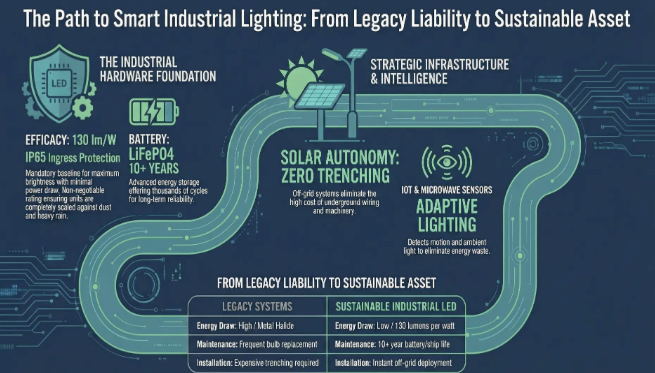
When evaluating lighting upgrades for large-scale projects, procurement managers must look beyond basic illumination. Today’s baseline for commercial facilities requires high-efficiency output—typically around 130 lumens per watt—combined with robust weatherproofing.
For instance, reputable Wosen engineers their street and flood lighting solutions with rigorous IP65 ratings and advanced heat dissipation, ensuring longevity even in the harshest industrial environments.
This level of engineering is what separates consumer-grade bulbs from industrial powerhouses. Sourcing sub-standard fixtures inevitably leads to premature failures, voiding any initial cost savings and causing severe operational disruptions.
Luminous Efficacy and Weather Resistance
To ensure a viable return on investment, facility managers must mandate strict technical parameters during the procurement phase. The absolute minimum requirements for outdoor and industrial environments include:
- Luminous Efficacy: A minimum baseline of 130 lm/W is required to guarantee maximum brightness with minimal wattage draw.
- Ingress Protection: An IP65 rating or higher is non-negotiable for floodlights and streetlights, completely sealing the unit against dust and heavy rain.
- Heat Dissipation: Advanced aluminum heat sinks must prevent LED chip degradation during prolonged operation.
- Surge Protection: Built-in defenses against voltage spikes ensure the lighting grid remains stable during extreme weather or grid fluctuations.
The Financial Impact of Solar-Integrated Systems
Solar-integrated systems are revolutionizing the financial models of large industrial parks and municipal projects. The integration of off-grid solar street lights completely bypasses traditional grid dependency. This removes one of the most significant barriers to new infrastructure development.
The most profound financial advantage is the elimination of trenching costs. Laying underground wiring across massive commercial campuses requires heavy machinery, labor, and significant downtime. Off-grid solar units are standalone investments that can be deployed instantly.
Furthermore, advancements in energy storage have drastically improved battery cycle life. Modern LiFePO4 (Lithium Iron Phosphate) batteries offer thousands of charge cycles, ensuring reliable performance for over a decade. This dramatically flattens the long-term total cost of ownership (TCO).
Smart Controls and IoT in Modern Facilities
True energy efficiency is achieved when modern hardware is paired with intelligent software. The integration of the Internet of Things (IoT) transforms standard fixtures into an interconnected, responsive network. Lighting is no longer static; it adapts to its environment.
Microwave radar motion sensors play a critical role in this ecosystem. Unlike older infrared sensors, microwave technology can accurately detect movement across vast warehouse floors or parking lots, illuminating areas only when necessary.
Additionally, ambient light sensors automatically dim or deactivate fixtures during daylight hours. This prevents the system from burning unnecessary watts. By completely eliminating non-essential energy waste, facilities can maximize their overall ROI and extend the lifespan of every unit.
Key Takeaways
| Area | Key Takeaway | Impact/Data |
| Specs | Mandate 130 lm/W and IP65 ratings | Prevents premature failure and downtime |
| CAPEX | Deploy off-grid solar systems | Eliminates massive underground trenching costs |
| TCO | Utilize LiFePO4 battery technology | Secures reliable performance for >10 years |
| OPEX | Integrate microwave radar and light sensors | Eliminates non-essential energy waste |
| Funding | Standardize smart IoT lighting grids | Satisfies ESG criteria to attract investors |
Aligning with Global ESG Goals
The transition to smart lighting is no longer merely a cost-cutting measure; it is a corporate mandate. Implementing energy-efficient infrastructure is one of the most immediate ways for companies to meet strict Environmental, Social, and Governance (ESG) criteria.
In fact, recent business analyses by Forbes consistently highlight that upgrading commercial building infrastructure through smart IoT systems is a foundational step toward achieving net-zero emissions.
Meeting these global standards not only satisfies regulatory bodies but also attracts eco-conscious investors. By standardizing high-efficiency LED and smart solar grids, businesses effectively future-proof their operations and solidify their commitment to a sustainable global economy.
