


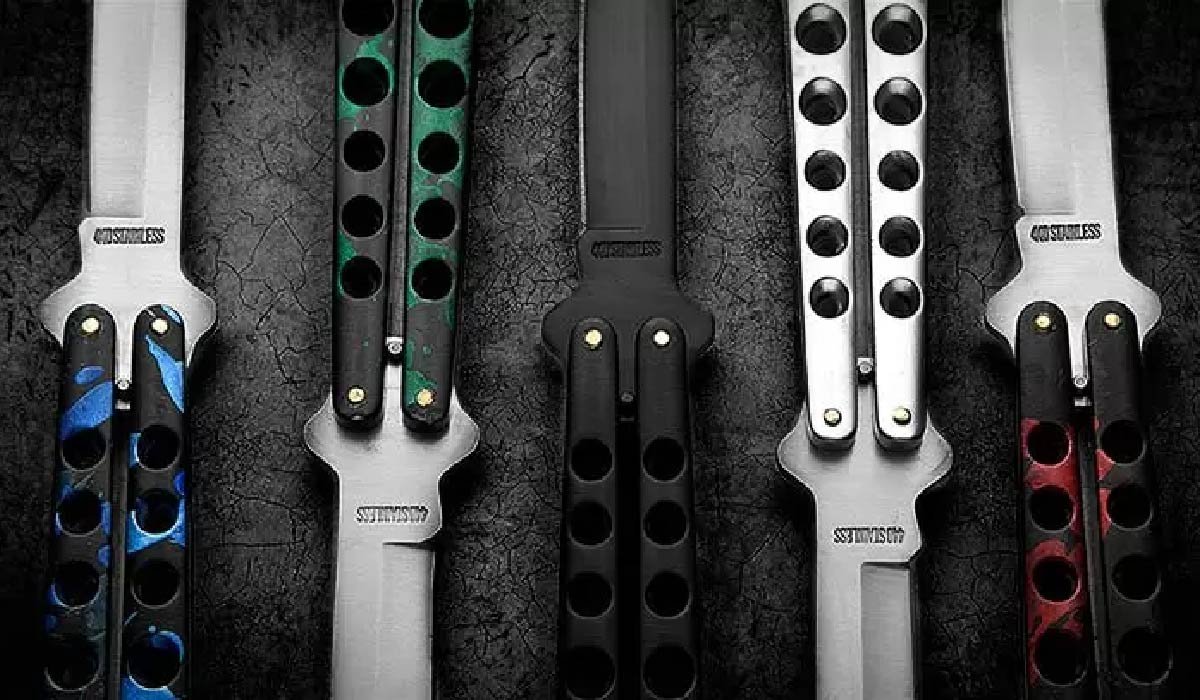
OTF knives have gained popularity as a discussion among knife collectors, tactical gear users, and individuals interested in modern knife engineering. They stand out of the ordinary folding knives due to their unique blade mechanisms, small sizes and the selection of finishes they have. Expertise in the workings of one or another type of knife can be gleaned by those who collect knives, whether it is the design or the artisanship that went into making them. Balisongs or butterfly knives are also given the same attention due to the pivoting design and the two-part handles.
Custom OTF knives are another field of interest to collectors, retailers and businesses creating their own lines of products. Depending on the capabilities of the manufacturer, customisation can involve handling materials, surface finishes, blade styles, colours, branding, and packaging. In cases where the company is interested in creating unique products, there is an opportunity to collaborate with a specialized manufacturer, like OTF Factory, and consider manufacturing and individual design.
Understanding the Design of OTF Knives
OTF is an abbreviation that refers to a knife where the blade slides directly out of the front of the handle. This contrasts with the design of a conventional folding knife with a blade that swivels around a pivot point on the side.
OTF mechanisms are of various types. Single-action designs typically use a fully automated deployment of the blade, but a manual action is still needed to retract the blade. The same control is used in double-action designs to deploy and retract the blade. These mechanical variations affect the construction of the knife, its maintenance needs and the overall user experience.
The internal mechanism may be of great interest to the collector as well as the outward appearance. The accuracy of the moving parts, the fit of the handle and the quality of the finish are all part of the overall design.
What Makes Butterfly Knives Unique?
Butterfly knives are constructed in a different way. They are also known as balisangs, and are characterized by two handles which are rotated around the blade. When closed, the handles close around the blade, which makes a small shape.
The unique design has made them the interest of collectors who value mechanical objects and the craftsmanship of the traditional knives. When comparing various models, enthusiasts can compare handle materials, pivot construction, weight, balance and finishing details.
OTF and butterfly knives are both folding knives, but their mechanisms are highly disparate. OTF knives have a blade that slides up the middle axis of the handle and Butterfly knives are based on rotating handles. This difference makes collectors appreciate the engineering in each style.
Materials and Manufacturing Quality
The material of a knife affects the weight, look, the durability, and the maintenance required. Manufacturers can use various grades of steel in blades and different handles can be made of aluminium, stainless steel or modern composite.
When considering knife construction, there are several factors to consider:
– Blade material: Hardness, edge retention and corrosion resistance depend on the composition and heat treatment of steel.
– Handle construction: The quality of material and the surface finish affect grip, weight, and comfort.
– Mechanical accuracy: predictable size and properly fitting parts contribute to the smooth operation of moving mechanisms.
– Surface finish: Coatings, colours, and polishing add to looks and potentially affect the maintenance needs.
– Quality control: Inspection, during production, can be used to locate defects and ensure uniform product quality.
Knives that have moving parts especially require precision machining and assembly. Even a graphically appealing design must have a solid construction and proper testing to reach the desired quality.
Customisation Opportunities for Knife Brands
Tailor-made manufacturing enables companies to come up with products whose design is based on a particular brand name instead of depending on a total reliance on the standard catalogue designs. Customisation can include blade profiles, handle designs, colours, finishes, logos and retail packaging, depending on the project.
The businesses need to find out the target audience, the price range they are targeting, the kind of materials they need and the volume of production they expect, before commencing a project. They will also need to enquire on the quality inspection, prototype development, lead times, minimum order quantities, and documentation.
OTF Factory is a company providing information to businesses interested in producing OTF and butterfly knives. Its site gives a point of departure when it comes to the knowledge of its product line and manufacturing services. Businesses can find it beneficial to review the existing specifications, as well as to talk directly to a manufacturer about the project requirements, to determine the suitability of a given design.
The prototypes are especially useful since the design specifics can be checked prior to starting larger production series. This action can be used to detect dimension, material, visual, or general building problems at an early stage.
OTF and Butterfly Knives in Outdoor and Hobby Communities
Many outdoor activities, such as camping, hiking, fishing, and overall equipment preparation are related to knives. But not all knives are useful in all outdoor activities. Depending on the work that the camping or utility knife is supposed to do, the environment that the knife is likely to be used in, and the intended-use instructions given by the manufacturer, a specific camping or utility knife must be chosen.
Practical issues to outdoor enthusiasts would be corrosion, easy to handle, safe storage, easy cleaning, and durability. A knife that has a complex automatic design will also need a little more attention to maintenance than a design that is simple.
Collectors on the other hand can be more interested in odd mechanisms, finishes, materials or the workmanship used to produce the item. The two groups will be advantaged by researching the specification of products and knowing the limitations of a specific design.
Knives must be kept locked away, kept in a safe place and children should never be left in their presence. Depending on the area, automatic and butterfly knives can also be limited with respect to ownership, carrying, importation or transportation.
How to Choose a Suitable Knife Design
The decision between OTF and butterfly knives is based on individual interests and the purpose. When deciding, put into consideration the following:
- 1. Purpose: Decide whether the knife is to be used as a collection tool, as a tool of lawful utility or otherwise.
- 2. Building: Check the materials, mechanism, dimensions and specifications of the manufacturer.
- Maintenance: Understand the cleaning and care requirements for the particular model.
- 4. Quality assurance: Search appropriate product information and signs of proper quality checks.
- Legal considerations: Check to ensure that the ownership, purchase, importation, and carrying are in accordance with local laws.
In the case of businesses, other factors are production capacity, branding alternatives, availability of samples, quality-control process and capabilities of the supplier to deliver as per the agreed specifications.
Final Thoughts
OTF knives and butterfly knives are two unique ways of designing knives. Their mechanisms, materials, and finish choices render them intriguing collector items, hobby, outdoor and business subjects when discussing specialised knife products.
It becomes easier to assess the construction of these designs and their intended uses by understanding the differences between them. A specialist designer like OTF Factory could be a company to consider by businesses interested in product development when it comes to a comparison of customisation and production.
Regardless of the motive of the exploration of these knives, it must be handled responsibly, with proper research of the products, proper maintenance and adherence to the local laws.
