


The most common source of dissatisfaction with commercial cleaning services isn’t poor performance. It’s misaligned expectations. A business signs a contract, the cleaning happens, and six months later someone is frustrated that certain things aren’t being done. When they raise it with the cleaning company, the answer is almost always: that’s not in your contract.
Understanding what commercial cleaning services typically include, what requires separate specification, and what falls outside the scope of a standard contract entirely is the kind of knowledge that prevents those conversations. It’s also the knowledge that allows you to build a specification that actually covers what your workplace needs, rather than discovering the gaps after the fact.
What a Standard Commercial Cleaning Contract Covers
Standard commercial cleaning services, the kind of contract most businesses sign when they engage a cleaning company for office or commercial premises, cover routine maintenance cleaning. What that means in practice is reasonably consistent across the industry, even if the quality of execution varies considerably.
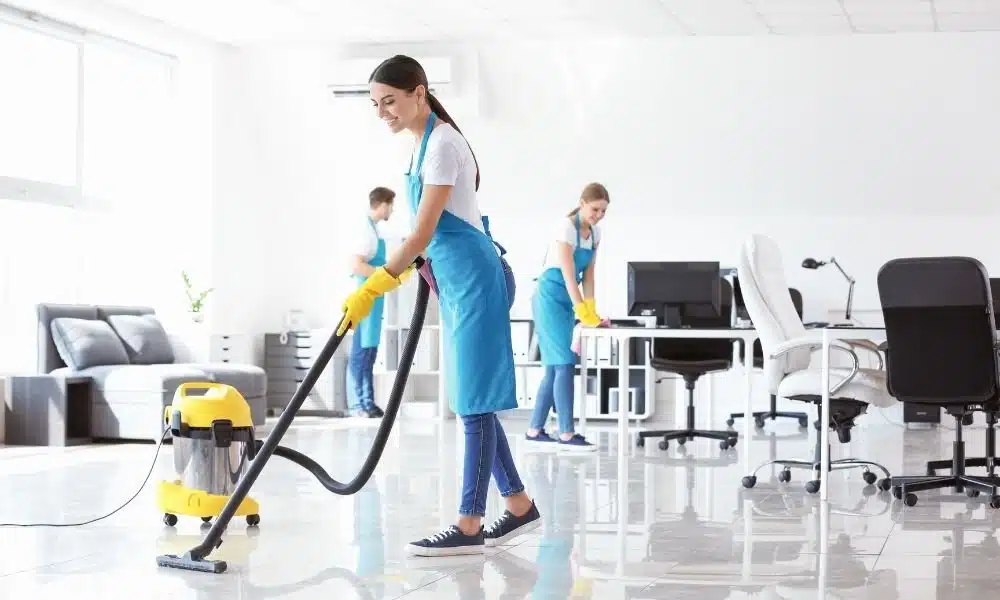
Floor care is the most visible component. Vacuuming of carpeted areas, mopping of hard floors, and spot-treatment of visible marks and spillages is standard daily or agreed-frequency activity. What’s usually not included in routine floor care is periodic deep cleaning of carpets, stripping and resealing of hard floors, or specialist treatment of stone, marble, or other surfaces that require specific products and methods. Those are periodic services, separately specified and priced.
Surface cleaning covers desk surfaces, communal tables, windowsills, skirting boards within reach, and general horizontal surfaces throughout the space. High-contact surfaces, specifically door handles, light switches, shared equipment like printers and coffee machines, and lift buttons, should be part of the specification but aren’t always explicitly listed in standard contracts. Getting specific about high-contact surface disinfection in the contract avoids the situation where it’s assumed to be covered and turns out not to be.
Kitchen and welfare area maintenance is included in most commercial cleaning contracts: cleaning and sanitising of sink areas, exterior of appliances, worktops, and removal of waste. What typically isn’t included is interior cleaning of appliances, descaling of equipment, or deep cleaning of extraction hoods and ventilation systems. These are usually periodic tasks specified separately.
Bathroom and WC cleaning to a hygiene standard is standard. Toilet cleaning, sanitary fittings, mirror cleaning, replenishment of consumables where the cleaning company supplies them. The specification should define what “to a hygiene standard” actually means in practice, because without that definition it’s a phrase that provides no accountability.
Waste management, specifically emptying bins and removing waste to agreed collection points, is standard. What varies is who supplies bin bags, what happens to recyclables, and whether there’s any separation of waste streams. Environmental sustainability requirements around waste have become more specific for many Dublin businesses, and if your business has commitments around recycling or waste diversion, these need to be explicitly in the specification rather than assumed.
What Requires Separate Specification
The category of commercial cleaning services that creates the most confusion is periodic or specialist cleaning that sits outside the routine maintenance scope but isn’t a complete specialist service.
Window cleaning is the clearest example. Interior window cleaning is sometimes included in routine contracts; exterior window cleaning almost never is. The method, frequency, and access requirements for window cleaning typically require separate specification and pricing. For multi-storey buildings, exterior window cleaning involves equipment and safety considerations that are categorically different from routine cleaning work.
Deep cleaning is distinct from maintenance cleaning in scope, method, and resource. A periodic deep clean, the kind that addresses the build-up in areas that routine cleaning maintains but doesn’t eliminate, should be scheduled and specified separately. The frequency depends on the type of premises and intensity of use. Office spaces in normal use might be deep cleaned quarterly. Kitchen and food preparation areas, food service environments, and heavily trafficked spaces need more frequent deep cleaning. Defining what a deep clean includes in your specific environment, and at what frequency, should be part of the overall cleaning programme rather than something arranged reactively.
Carpet and upholstery cleaning requires specialist equipment and chemicals that differ from routine cleaning methods. Periodic carpet cleaning to address the soil load that vacuuming maintains but doesn’t remove is a separate service with separate pricing. The interval between professional carpet cleans depends on traffic and use, but for most commercial offices, annual or bi-annual professional carpet cleaning is a minimum.
Post-construction cleaning after fit-outs, refurbishments, or building works is a specialist service that addresses the particular types of dust and debris that construction creates. Construction dust penetrates surfaces in ways that routine cleaning doesn’t address, and post-construction cleaning before reoccupation requires specific methods and a different level of thoroughness than maintenance cleaning. This is always a separate service and should be planned and costed at the project stage rather than approached as something the regular cleaning team will handle.
What Falls Outside Commercial Cleaning Services Entirely
There are tasks that businesses sometimes expect their commercial cleaning services to cover that are genuinely outside the scope of what cleaning companies do, and being clear about these prevents both the expectation and the resulting frustration.
Pest control is a separate service category. Cleaning companies maintain environments in ways that reduce the conditions conducive to pests, particularly in food preparation areas, but pest identification, treatment, and control is specialist work requiring different training, certification, and products. If there’s a pest issue, it requires a pest control specialist.
Plant and landscaping maintenance, both interior plants and exterior grounds, is outside cleaning scope. Interior plant maintenance, including watering, feeding, and replacing plants that are past their best, is managed by specialist plant maintenance companies. External grounds maintenance, including grass cutting, shrub care, and path maintenance, is facilities management or grounds maintenance.
HVAC system cleaning is specialist work that requires qualified engineers rather than cleaning operatives. The build-up of dust, mould, and biological material in air handling units, ductwork, and ventilation systems is a genuine hygiene and air quality issue, but it’s not addressable by surface cleaning. Specialist HVAC cleaning requires access to equipment that isn’t part of a standard cleaning operation, and in many cases requires shutdown and recommissioning of the ventilation system.
Biohazard cleanup, including the aftermath of incidents involving blood or other bodily fluids, or situations involving hazardous materials, requires specialist training, specific personal protective equipment, and prescribed disposal methods. Standard commercial cleaning operatives are not trained for or equipped to handle biohazard situations, and expecting them to do so creates both a safety risk and a liability issue.
The Specification Conversation You Should Be Having
The point of understanding what commercial cleaning services include and don’t include is to be better positioned to have a proper specification conversation with your cleaning provider, or any provider you’re considering.
A specification that doesn’t define what’s included leaves gaps that will be filled either by assumption, which usually means the cleaning company assumes less than the business expects, or by interpretation, which produces inconsistency. A specification that defines what’s included, at what frequency, to what standard, and measured how, leaves no room for that gap.
The specification should also define what happens when the standard isn’t met. Escalation processes, complaint handling, and performance review mechanisms that are written into the contract create accountability that good-faith expectations don’t. Cleaning companies worth working with welcome this kind of specification because it protects them from unreasonable complaints as much as it protects the client from underperformance.
The question of how periodic services, those that aren’t part of the routine maintenance schedule, are managed and priced deserves explicit discussion. Are they included in an annual contract price? Separately quoted on a case-by-case basis? Bundled at a discount for contract clients? The commercial model varies between providers and between contract structures, and knowing it before you need a periodic service avoids the surprise of finding out on the day.
Commercial cleaning services are more straightforward than they sometimes appear once the scope is clearly defined. The clarity is worth the conversation.
