


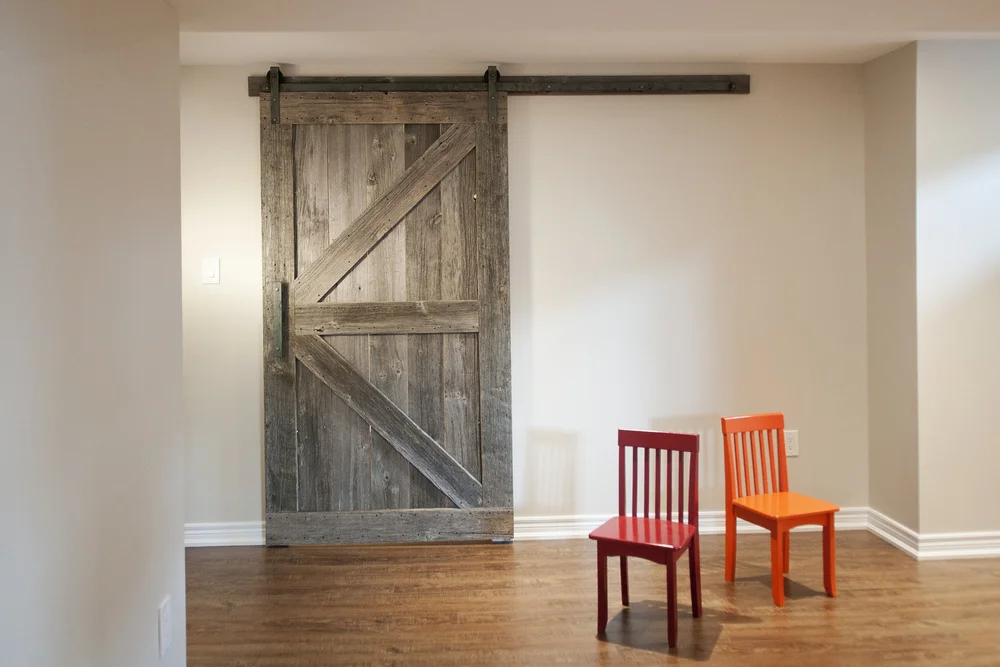
Most people encounter barn door hardware in living rooms or as a statement piece between open-plan spaces, which is fine but slightly misses the point. The rooms where a sliding barn door actually outperforms a hinged door aren’t always the ones people photograph for design content. They’re the rooms where the geometry of a swinging door creates daily friction that everyone has quietly accepted as part of how the space works.
Barn doors don’t work better everywhere. They have genuine trade-offs, particularly around the gap between door and frame that affects both sound and privacy. But in the right rooms, they solve problems that hinged doors create, and those rooms aren’t always the obvious candidates.
Small Bathrooms
This is probably the strongest functional case for barn door hardware in a residential setting, and it’s the most consistently underused application.
A standard bathroom door opens into the room or into the hallway, and in both cases the swing arc consumes space that the room can’t really afford. In a small en suite or compact bathroom, a door that opens inward fights with the toilet, the vanity, or anyone standing at the sink. A door that opens outward into a narrow hallway does so at roughly the height of someone walking past. Neither situation is comfortable, and it’s a compromise that millions of bathrooms are built around because the alternative wasn’t obvious.
A sliding barn door on bathroom hardware removes the swing entirely. The door travels parallel to the wall, the floor space it previously swept through is just floor space, and the bathroom immediately becomes more usable. For a small en suite where every square foot matters, this is a genuinely significant functional improvement.
The trade-off to be honest about is the gap. A barn door doesn’t seal against the frame the way a hinged door with a proper latch and door stop does. There’s a visible gap at the edge, and there’s a gap between the bottom of the door and the floor. For a powder room off a main living area, where someone wants reasonable acoustic privacy, this gap is a real consideration. For an en suite used primarily by the room’s occupants, most people find it acceptable in practice even if it sounds concerning in theory.
The privacy issue can be partly addressed by using a door that’s slightly wider than the opening, which reduces the visible gap at the edge, and by ensuring the barn door hardware allows the door to sit as close to the wall as the roller system permits.
Laundry Rooms and Utility Closets
Laundry rooms and utility closets are typically narrow spaces where the door is opened frequently, often with hands that are occupied with laundry baskets, cleaning supplies, or other objects that make navigating around a swinging door awkward.
A hinged door on a laundry room that opens outward creates an obstacle in the hallway every time it’s opened. One that opens inward restricts access to the interior and is immediately in conflict with anyone standing in front of the washing machine or dryer. The solution most builders have defaulted to is a bifold door, which solves the swing problem but has its own issues: limited opening width, hardware that jams, and a track at the floor that collects dust and creates a trip hazard over time.
Barn door hardware provides a full-width opening without the swing and without the floor track. The entire width of the opening is accessible without the door being in the way, which makes a real difference when manoeuvring a laundry basket or accessing shelving at the sides of the closet. The door slides to one side and is completely clear of the opening rather than folding halfway across it.
For utility closets housing a boiler, electrical panel, or meter access, this matters more than it might seem. Equipment that needs to be accessed for maintenance, inspection, or emergency shutoff is better accessed through an opening that isn’t partially blocked by a folding door.
Home Offices
The shift toward working from home has changed how people use dedicated home office spaces, and barn door hardware has become a more relevant solution for office spaces that need to function as both work environments and occasional social spaces.
A home office that’s completely closed off during work hours needs to be genuinely closed: visually, and to a reasonable degree acoustically, during video calls and focused work. A barn door handles this adequately for most home setups, though it won’t achieve the sound isolation of a solid-core hinged door in a properly fitted frame.
The more specific advantage is in how the space transitions. A home office with a hinged door is either open or closed. One with a barn door on quality hardware can be left partially open in a way that allows air circulation and maintains some connection with the rest of the house without being fully open to foot traffic and visual distraction. It’s a more gradual boundary than a hinged door provides, and for people whose work patterns involve moving between focused work and less intense tasks, the ability to position the door at different points in its travel is genuinely useful.
The aesthetic argument for barn doors in home offices has also become more relevant as home offices appear in the background of video calls. A barn door with quality hardware reads differently in a background than a standard hollow-core door on basic hinges. Whether that matters to a specific person is entirely subjective, but it’s a real consideration for people whose professional image is partly formed by what appears over their shoulder.
Bedrooms in Older Homes With Awkward Door Positions
Older homes, particularly Victorian and Edwardian terraces in the UK, often have bedroom door positions that don’t work well with modern furniture layouts. A door positioned in a corner of a bedroom, or one whose swing arc conflicts with a wardrobe, chest of drawers, or the foot of the bed, creates a permanent layout constraint that determines where every piece of furniture can go.
Converting to barn door hardware doesn’t move where the opening is, but it eliminates the swing arc entirely. The wall on either side of the opening becomes usable for furniture placement in a way it isn’t when a door swings across it. For a bedroom where the current layout is dictated by the door swing rather than by preference, this can be a meaningful change.
Period homes also tend to have the door opening characteristics that suit barn door hardware well. Thicker walls with deeper reveals, higher ceilings, and heavier solid doors that make the barn door proportionally appropriate rather than undersized. Quality barn door hardware on a solid Victorian panel door in an older property is a sympathetic combination in a way that the same hardware on a hollow-core door in a new build often isn’t.
Walk-In Wardrobes and Dressing Rooms
Walk-in wardrobes and dressing rooms are spaces where the door is used frequently but briefly, typically opened to access the space and left open while it’s being used. The hinged door’s swing arc is at its most pointless in this context: the door swings open, gets pushed out of the way, and sits awkwardly against the wall or, worse, against a hanging rail.
Barn door hardware on a walk-in wardrobe door solves this cleanly. The door slides open to a wall beside the opening and sits flush rather than projecting at an angle into the bedroom. When the wardrobe is in use, the door is out of the way without needing to be held or propped. When it’s closed, it closes cleanly without requiring precise positioning to avoid catching on anything.
For larger walk-in wardrobes with wider openings, a bypass system using two doors that slide past each other is the standard barn door hardware solution. This gives access to either half of the opening at a time without requiring wall space for a single door that spans the full opening width.
The Rooms Where It Doesn’t Work as Well
Barn door hardware performs best where the gap isn’t a critical issue and where the space saved by eliminating the swing is significant. It performs less well in rooms where sound isolation matters, where privacy between spaces is essential, or where the available wall space beside the opening is too limited to accommodate the door in its open position.
Main bathrooms used by multiple household members, rooms where noise needs to be contained, and spaces where there simply isn’t clear wall space for the door to travel into are situations where a hinged door remains the better choice. The applications above work because the specific characteristics of each room align with what barn door hardware is good at. In rooms that don’t match those characteristics, the trade-offs outweigh the advantages.
Getting barn door hardware right in the rooms that suit it is worth doing properly. Quality hardware, correctly specified for the door weight and opening size, mounted into solid framing, with a floor guide that keeps the door tracking straight. The rooms that benefit most from it are rooms people use every day, and a door mechanism that works smoothly and reliably every day is worth the installation care it takes to achieve.
