


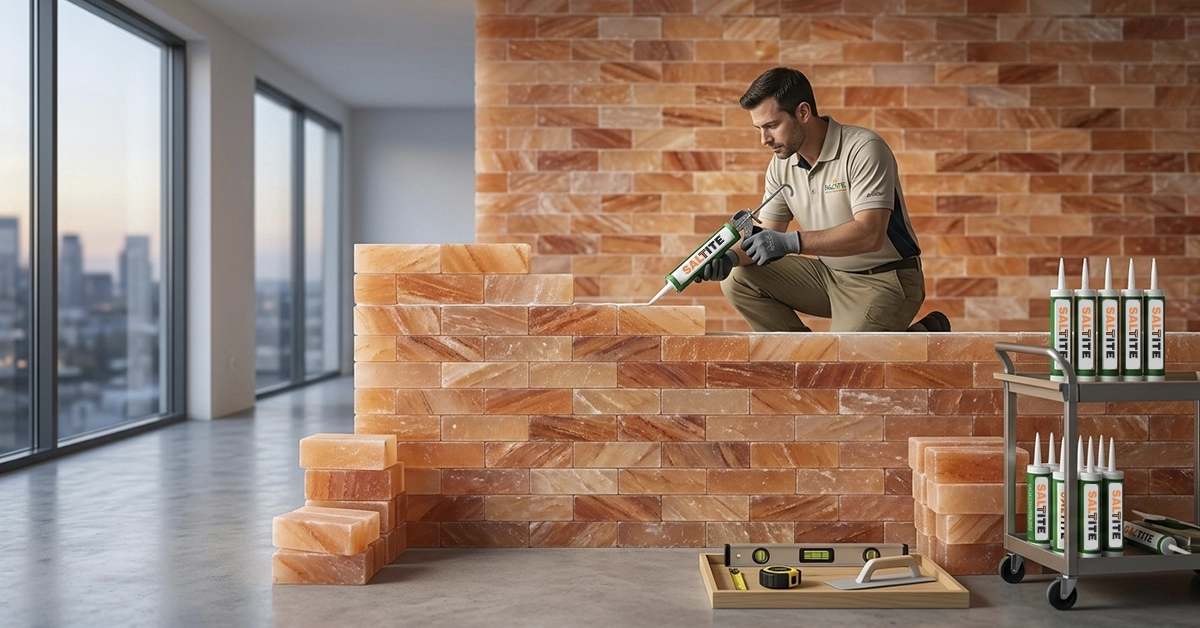
Salt adhesive is one of those materials that doesn’t get much attention at first, but it plays a very important role in how salt walls actually hold together over time, observe N Property Group experts. On the surface, a salt wall might look like it’s just about placing bricks and finishing the design. But in reality, what keeps everything in place is not the salt itself. It is the adhesive behind it. And this is where most problems begin.
People often assume that regular construction glue can handle salt bricks just like it handles tiles or stone. At first, it seems fine. The wall looks stable. Everything feels properly installed. But salt doesn’t behave like normal building materials. It reacts with moisture in the air and slowly changes the condition of whatever is holding it.
That slow change is what leads to failure. This is exactly why salt adhesive exists because of this problem.
What Salt Brick Glue Actually Does
The reason why salt brick glue is developed is one unique thing, i.e, to stick salt bricks and salt tiles on the various surfaces without the adhesive weakening with time.
This may seem to be easy, though salt is not a material that can be easily dealt with. It takes the moisture of the air and has a rough and uneven surface. That combination creates a problem for normal glue. Regular adhesives depend on stable, dry, and smooth surfaces to work properly. Salt does not offer that.
So what usually happens is this. The glue sticks at first, but it doesn’t stay strong for long. It slowly starts weakening without any immediate visible warning.
Salt brick glue works differently. It is made to handle moisture interaction and uneven texture from the beginning. That difference is what makes it reliable for salt installations.
Why Salt Installations Fail Over Time
Most salt wall problems don’t happen instantly. They develop slowly. This is what contributes to their difficulty picking up at the start.
Moisture is considered one of the chief causes. Salt has the tendency to draw water to the atmosphere. The same process occurs even in an indoor space that is under control. When that moisture reaches regular adhesive, it starts affecting the bonding strength.
At first, nothing looks wrong. The wall stays in place. But inside, the bond begins to weaken.
Another issue is surface mismatch. Salt bricks are not uniform. Some parts are slightly rough, others slightly uneven. Standard glue struggles to grip such surfaces properly. It creates weak contact points that don’t last long.
And then there is the timing issue. Failures don’t happen in the first few days. They appear and sometimes even months later. The delay can always cause people to believe that the installation process was done properly when, in fact,t the bonding process was less robust in the first place.
What Actually Happens When the Wrong Adhesive is Used
When regular glue is used instead of Salt brick glue, the effects are gradual but predictable.
The first thing that usually happens is minor movement in salt bricks. It is not noticeable right away. A slight shift here and there. Most people ignore it at this stage.
After that, small gaps start forming between bricks. This happens because the adhesive is losing grip in certain areas faster than others.
Once those gaps appear, moisture starts entering those weak points more easily. That speeds up the damage.
In many cases, the wall still looks acceptable from a distance. But up close, the structure is no longer stable. At that point, maintenance becomes frequent, and repairs become unavoidable.
In worse situations, parts of the wall may loosen completely and require reconstruction.
How Salt Adhesive Changes the Outcome
The difference in salt wall adhesive is not immediate in appearance. It is long-term stability.
Instead of reacting poorly to moisture, salt brick glue is built to remain stable even when conditions change slightly. It holds its structure instead of breaking down slowly.
Problem with Regular Glue:
Moisture → weak glue → loose bricks → failure
Solution with Salt Adhesive:
Moisture → controlled reaction → stable bonding → long-term structure
That shift is the real value.
Another important point is consistency. Salt wall adhesive helps maintain even bonding across all bricks. This reduces weak points that normally develop in Himalayan salt walls when standard glue is used.
Over time, this leads to a structure that does not require frequent correction or repair.
Where Salt Adhesive is Commonly Used
Salt wall adhesive is used in different types of spaces, but the purpose remains the same everywhere.
It is commonly employed in decorative salt walls in residential projects or in interior design. They tend to be long-lived installations, and thus, stability is more important than anything.
The application is further crucial in business situations. Salt walls are used not only the appearance of salt therapy rooms, wellness centers, interior of spa and hotel designs, but also in the consistency of the structure. It is commonly employed in decorative salt walls in residential projects or in interior design. They tend to be long-lived installations, and thus, stability is more important than anything.
The application is further crucial in business situations. Salt walls are used not only for the appearance of salt therapy rooms, wellness centers, interior of spa and hotel designs, but also for the consistency of the structure.
Salt brick glue helps ensure that once the installation is done, it remains stable for a long period without major adjustments.
Benefits That Come from Proper Installation
When Salt brick glue is used correctly, the benefits are mostly long-term rather than immediate.
The most important benefit is stability. The structure remains firm, even when environmental conditions change slightly over time.
Another benefit is reduced maintenance. Since the bonding is stronger, there is less need for repairs or adjustments later.
It also improves overall safety. Loose salt bricks can become a risk in poorly installed walls, but a proper adhesive reduces that risk significantly.
There is also a visual benefit. When bonding is stable, the wall maintains a clean and consistent appearance without gaps or uneven shifting.
Simple Cause and Effect Understanding
It is easy to understand once broken down.
If the wrong adhesive is used, the result is slow weakening and structural instability.
If salt adhesive is used, the result is long-term strength and stable installation.
This is not a design choice. It is a technical requirement for working with salt-based materials.
Conclusion
Salt wall adhesive is not just another construction material. It is a necessary part of any salt brick or salt tile installation. Without it, even well-designed salt walls can fail over time due to moisture interaction and surface incompatibility.
The issue does not tend to manifest itself right away. It is an incremental process, and therefore, it is even more crucial to get the process of installing it right at the start.
Stability of the structure, minimization of the maintenance problems in the long run, and facilitation of the sustainability of the salt-based structures in both residential and commercial settings are ensured by the use of salt adhesive.
FAQs
What is the purpose of using salt adhesive on salt bricks?
Due to salt reaction with moisture and uneven surface, it needs a special bonding material in order to be stabilized.
What would occur in the case of normal glue?
It is weakened as time passes by by taking in water, resulting in loose bricks and structural problems.
Where can we use Salt brick glue?
It finds application in homes, spas, wellness centers, hotels, and other salt wall applications.
