


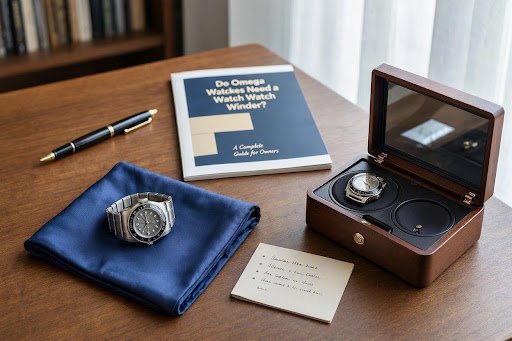
If you own an Omega Seamaster, Speedmaster, or Constellation, you’ve probably asked yourself this question the first time your watch stopped after a weekend off your wrist. The short answer is: no, an Omega doesn’t strictly need a winder to function. But for most owners, a good winder solves a real, everyday problem, and it does so in a way that protects both the watch and your time.
This guide walks through exactly why that is, when a winder actually earns its keep, and how to choose one that suits an Omega movement specifically.
Why Omega Watches Stop When You Take Them Off
Every automatic Omega runs on a self-winding mechanical movement. A rotor inside the case spins as you move your wrist, and that motion winds the mainspring, which stores the energy that powers the watch. Take the watch off, and the rotor stops moving. The mainspring slowly unwinds, and once it runs out of stored energy, the watch stops.
Most Omega calibres, including the Co-Axial Master Chronometer movements used in current Seamaster and Speedmaster models, hold a power reserve of roughly 55 to 60 hours. That’s a little over two days. So if you wear your Omega most days but take the odd day off, it’ll usually still be running when you pick it back up. It’s when a watch sits untouched for three, four, or more days that it stops.
That’s where the annoyance starts. Restarting a stopped automatic isn’t just a matter of putting it back on. You need to manually wind the crown to get the movement running again, then reset the time, and on models with a date or day-date complication, you often need to cycle through the date wheel one day at a time. For a Speedmaster with a chronograph function, or a Constellation with a date and moon-phase display, that reset process can take several minutes of fiddly crown-turning.
What a Watch Winder Actually Does
A watch winder holds the watch and rotates it on a set schedule, mimicking the motion of your wrist. This keeps the rotor turning and the mainspring wound, so the watch keeps running and keeping accurate time even while it sits in a box or drawer.
For Omega owners specifically, this matters for a few practical reasons:
You skip the reset routine entirely. If your Omega never stops, you never have to reset the time, date, or any secondary complications. You just pick it up and put it on.
Lubrication stays evenly distributed. Mechanical movements rely on tiny amounts of oil at each pivot point. When a movement sits still for long stretches, that oil can pool or thicken in one spot. Keeping the movement gently in motion helps the lubrication stay distributed the way it was designed to.
Rotating between multiple watches becomes effortless. If you own more than one automatic watch and rotate through them during the week, a winder means each one is ready to wear the moment you pick it up, rather than sitting there stopped and needing a reset.
Do You Actually Need One?
Here’s a direct answer: if you wear your Omega daily or near-daily, you probably don’t need a winder. Your own wrist is doing the winding for you.
A winder becomes genuinely useful in a few specific situations:
- You own multiple automatic watches and wear each one only occasionally.
- You travel often and leave your Omega at home for stretches longer than its power reserve.
- Your Omega has a complicated date, day, or moon-phase display that’s tedious to reset.
- You want to store the watch safely while keeping it ready to wear at a moment’s notice.
If none of that describes you, a simple manual wind-and-reset every so often works perfectly well. There’s no mechanical requirement that says an Omega must run continuously. It’s entirely a matter of convenience.
Choosing a Winder That Suits an Omega Movement
Not every winder is built the same way, and getting the settings wrong can either under-wind the watch or, in rare cases, over-work the movement over time. A few things matter more than others when you’re shopping specifically for an Omega.
Turns Per Day (TPD)
Omega movements generally wind efficiently and don’t need an aggressive rotation count. Most Omega calibres do well with a winder set somewhere between 650 and 900 turns per day, though it’s worth checking the specific number for your model, since Speedmaster, Seamaster, and Constellation calibres can vary slightly. Too few turns and the mainspring won’t stay fully wound; too many doesn’t damage a modern movement, but it’s unnecessary wear on the winder’s motor.
Rotation Direction
Some Omega calibres wind bidirectionally, while others favour one direction. A quality winder should let you choose clockwise, counterclockwise, or bidirectional rotation so you can match the setting to your specific movement rather than guessing.
Build Quality and Motor Noise
Because a winder runs continuously, cheaper models with basic motors can be noisy enough to notice in a quiet bedroom, and lower-quality clamps can be too tight or too loose for a heavier Seamaster case compared to a lighter dress watch. For anyone shopping around, it’s worth taking a look at the world of watch winders for Omega specifically, since fit and cushion design vary quite a bit between models built for different case sizes and weights.
Luxury Winders vs Budget Winders: What’s the Real Difference?
This is where a lot of buyers get stuck, because the price range for watch winders is enormous. You’ll find options anywhere from under £50 to well over £1,000.
The differences usually come down to four things: motor quality, programmability, materials, and longevity.
A budget winder typically offers one or two rotation settings, a basic motor, and a simple case. That’s often perfectly fine for a single Omega that you’re not too precious about. It’ll do the job of keeping the watch wound.
A higher-end winder tends to offer precise TPD control, quieter Japanese-made motors rated for years of continuous use, better cushioning that protects the watch case and strap from friction marks, and often a lockable, presentable case if you’re storing something valuable. If you’re winding a watch that represents a meaningful investment, the extra cost buys peace of mind as much as performance.
If you’re weighing up which route makes sense for your own collection, it’s worth taking the time to browse Aevitas’ luxury vs budget watch winders comparison, which breaks down where the price difference actually goes and where you can safely save money without compromising your watch.
Storing an Omega Long-Term Without a Winder
If you’re not ready to invest in a winder, or you’re only storing the watch for a short period, there are still a few habits worth following:
- Wind it manually before storing it. Most Omega crowns can be manually wound even though the watch is automatic. Give it 20 to 30 turns before putting it away.
- Store it face-up in a stable position if it has a date function, since some movements handle date-change mechanics more smoothly in certain orientations.
- Keep it away from strong magnets. Modern Omega Co-Axial movements are highly resistant to magnetism, but it’s still good practice to store watches away from speakers, phone cases with magnetic closures, and similar items.
- Avoid extreme temperature swings, which can affect the lubricants inside the movement over long periods.
Where to Start If You’re Buying Your First Winder
If this is your first time buying a winder for an Omega, it helps to start with a retailer that specialises in watch accessories rather than a generic gadget store, since fit, TPD accuracy, and build quality vary so much between models. The Aevitas UK store carries a curated range built around real movement requirements rather than one-size-fits-all settings, which makes it easier to match a winder to your specific Omega calibre instead of guessing.
Final Thoughts
An Omega doesn’t need a winder to survive or function correctly. It’s a convenience purchase, not a maintenance requirement. But if you own more than one automatic watch, travel regularly, or simply want to skip the reset routine every time you pick your Seamaster or Speedmaster back up, a well-chosen winder makes daily life with a mechanical watch noticeably easier.
The key is matching the winder to the movement rather than buying the first one you find. Get the turns per day and rotation direction right, and you’ll get years of reliable use out of it.
FAQs
Does an Omega Seamaster need a watch winder? No. A Seamaster’s power reserve of roughly 55 to 60 hours means it keeps running through a few days off the wrist. A winder is useful mainly if you rotate between multiple watches or leave it unworn for longer stretches.
How many turns per day does an Omega watch winder need? Most Omega calibres wind well at 650 to 900 turns per day, though it’s worth checking the exact figure for your specific model since this can vary between collections.
Can a watch winder damage an Omega movement? A properly set, good-quality winder won’t damage a modern Omega movement. Movements are designed to be worn on an active wrist for years, so gentle daily rotation is well within their tolerance. Problems only tend to arise from cheap winders with inconsistent motors or incorrect TPD settings.
Is it bad to let an Omega watch stop? No, it’s not harmful to the movement. Letting it stop simply means you’ll need to manually wind it and reset the time and date when you pick it back up. Automatic movements are built to be started and stopped repeatedly over their lifespan.
What direction should an Omega watch winder rotate? It depends on the calibre. Some Omega movements wind in both directions, while others favour one. Checking the winding direction for your specific model, or choosing a winder with a bidirectional setting, avoids under-winding the mainspring.
Do I need a different winder for each Omega model I own? Not necessarily one winder per watch, but if your collection includes multiple calibres with different winding requirements, look for a winder that lets you adjust TPD and direction per slot rather than one fixed setting for the whole unit.
