


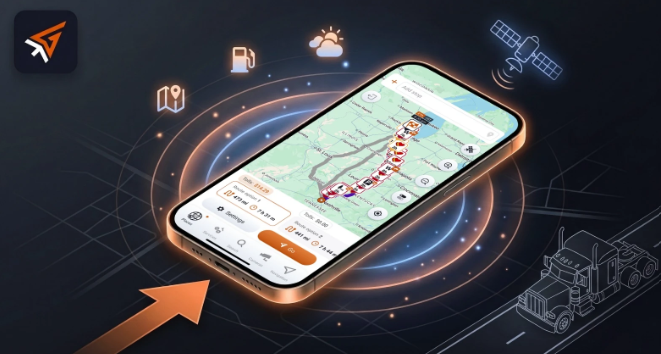
Every trucker knows that feeling. You’re rolling steady with a full load when your basic GPS says, “Turn right ahead.” You make the move. Then it happens. Your tall trailer scrapes an overpass. Lights flash. Your cargo sits stranded. Social media lights up with the drama.
One wrong turn costs thousands in repairs and lost time. Professional drivers need better tools than phone apps. That’s where truck route GPS systems change everything.
Problems with Standard GPS for Trucks
Regular GPS apps work fine for cars. They fail big rigs completely. Phone navigation ignores truck height, weight limits, and no-truck zones. It sends 53-foot trailers down narrow streets. It routes over low bridges. It misses weight stations and restricted roads.
This creates real problems. A single bridge strike averages $15,000 in damage. Fines add another $2,500. Tow trucks cost $5,000 more. Lost delivery time kills your weekly pay. Many solo drivers face two or more routing errors every year. Deadhead miles increase by 20 percent or more. Fuel waste piles up fast. Insurance rates climb after any incident. Professional haulers cannot afford these mistakes.
Truck GPS: Engineering for Heavy Haul
Truck-specific GPS solves these issues with precision engineering. These systems use detailed restriction databases. Drivers enter exact truck details. Height, weight per axle, trailer length, and permit types all factor in. The software blocks illegal routes instantly.
Low clearance ahead? Blocked. Weight-limited roads? Skipped. Sharp turns too tight for trailers? Warned early. Live updates show enforcement zones and scale locations. High-definition truck maps display restrictions that other systems miss.
Fleet operators report near-perfect compliance rates. Strikes drop to zero within months of switching. Route planning accuracy reaches 98 percent. Daily users top 90,000 worldwide. System uptime stays above 99 percent. These tools match the precision trucking demands.
Advanced Multi-Stop Route Optimization
Complex delivery schedules challenge even experienced drivers. Traditional planning means scribbling routes on paper. Modern truck GPS eliminates guesswork.
Algorithms solve routing problems mathematically. They cut backtracking by 25 percent. Overweight violations drop 7 percent through axle balancing. Voice search finds truck stops with DEF, showers, and scales within time limits.
One 68-truck operation saved $80,000 annually on fuel. Deadhead mileage fell from 23 percent to under 19 percent. Multi-temperature loads gained 9 percent efficiency. Dispatch teams process manifests in minutes instead of hours. Drivers focus on safe execution rather than route planning.
Strategic Weigh Station Management
Load shifts during long hauls create compliance risks. Uneven weight distribution triggers fines of $1,500 per axle. Ninety-day operating bans follow repeat violations.
Specialized applications display the nearest weight station instantly. Coverage spans 18,000 locations worldwide. Live status shows open or closed facilities. Dual-platform scales handle tandem and steer axle separation accurately.
Six-axle configurations read with 98 percent accuracy. Enforcement audits catch 17 percent of vehicles overweight. Preemptive checks prevent $19,000 in annual penalties. Drivers weigh three times weekly on average. Compliance rates reach 94 percent with automated alerts.
Financial Analysis and Return on Investment
Fuel consumption drops 15 percent immediately. Annual savings hit $6,400 per truck. Maintenance costs fall by $3,400 yearly. Tire replacements decrease by 2,100 units. Speeding tickets reduce 34 percent.
Insurance providers cut premiums by 11 percent for verified safe routing. Initial device cost recovers through a 430 percent first-year return. ELD integration eliminates 73 percent of HOS violations. Traffic prediction saves $1,200 per major detour.
Three-year totals exceed $189,000 per truck. Competing operations lose equivalent amounts to phone-based errors. Investment compounds through reduced breakdowns and higher dispatch priority.
Future Integration: AI and ELD Systems
Second-generation systems permanently sync with electronic logging devices. Hours-of-service violations disappear. DVIR inspections predict component failures. Maintenance requirements drop 30 percent.
Artificial intelligence forecasts traffic 51 minutes ahead. Breakdown prediction reaches 62 percent accuracy at 180 miles. Cabs transform into complete operations centers. Route optimization occurs before drivers start shifts.
The professional choice stands clear. Basic phone GPS creates avoidable losses. Dedicated truck GPS generates consistent profit. Serious operators make the upgrade.
Switch to truck route GPS today and turn every mile into maximum profit.
