


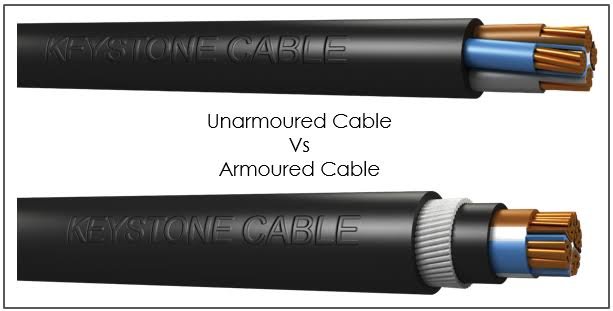
Choosing the right cable for a given electrical installation will always be crucial from the point of view of ensuring safety, compliance, and longevity.
There are two broad categories of cables that householders and engineers alike can expect to come across: unarmoured and armoured cables.
Armoured cables are most commonly Steel Wire Armour, or “SWA”, cables. Examples of unarmoured cables, meanwhile, include standard twin and earth (T&E) and PVC-insulated varieties.
Why Is It So Important to Use the Right Cable Type?
Your decision on whether to use armoured or unarmoured cable for your latest project will, of course, be imperative from a safety perspective.
However, there is also the matter of ensuring compliance with relevant legislation. If you’re undertaking an electrical installation in the UK, for instance, your choice will be dictated by the IET Wiring Regulations (BS 7671).
This decision must be based on where the cable will be installed, as well as the risk of mechanical damage.
An Introduction to Armoured Cable
As we touched on above, armoured cables are typically SWA. They tend to comprise such elements as:
- Copper (or sometimes aluminium) conductors
- XLPE (thermosetting) or PVC insulation
- A bedding layer
- Steel wire armour (which can serve as the circuit protective conductor or “CPC”)
- An outer PVC or LSZH (Low Smoke Zero Halogen) sheath
Armoured cable can be counted on to provide high mechanical protection and strong weather resistance.
However, this form of cable is relatively heavy and rigid compared to unarmoured varieties. It also (predictably) costs more.
When To Use Armoured Cable
Here are some of the circumstances in which you can expect the use of armoured cable to be the optimal choice:
- Underground installations. This form of cable is mandatory (or highly recommended) for cables buried directly in the soil. This guards against the risk of mechanical damage from digging (for example, a spade hit) and soil pressure.
- Outdoor power. Armoured cable is often the standard choice for supplying power to garden sheds, garages, or external lighting.
- Industrial settings. It is customary to use armoured cables in parts of factories and workshops where there is judged to be a high risk of machinery or heavy foot traffic causing cables to be crushed.
- Public buildings. LSZH versions of this cable, such as those adhering to BS 6724, are used in hospitals and schools for fire safety.
An Introduction to Unarmoured Cable
Unarmoured cables, like the common T&E, lack a metal armour layer. The following elements are generally present in these cables:
- Copper conductors
- PVC insulation
- An outer PVC sheath
You might be particularly inclined to choose unarmoured cable for an electrical installation if you require an affordable, lightweight, and flexible option that is relatively easy to install in tight spaces.
The absence of a metal armour layer, though, means it is necessary to provide additional protection for unarmoured cable (such as a conduit or trunking) if it is to be used in vulnerable locations.
When To Use Unarmoured Cable
You may reasonably decide to use unarmoured cable in situations like the below:
- Indoor domestic wiring. It is standard practice to use unarmoured cables for lighting circuits and socket outlets behind plasterboard or under floorboards.
- Appliances. Unarmoured cable is often used for flexible connections to portable devices or fixed appliances within a building.
- Conduit/trunking. This form of cable can be a feasible option even in more vulnerable areas, if it is housed within a protective conduit (for example, a high-impact PVC or metal pipe) giving the necessary level of mechanical protection.
Final Thoughts on Deciding Between Armoured and Unarmoured Cables
If you’re an engineer or homeowner working on an electrical installation in the UK, the ultimate choice that you make between armoured and unarmoured cable is likely to come down to the risk of damage, as well as requirements under BS 7671.
A good “rule of thumb” is that if the cable could be hit, crushed, dug up, or exposed to the elements, armoured cable will likely be the best choice. For fully protected runs or standard indoor house wiring, unarmoured cable will probably be the more practical option.
Whatever you do, we would urge you to always adhere to current BS 7671 guidance. Moreover, you should only use products from reputable manufacturers, in addition to making sure installations are carried out or inspected by a qualified electrician.
