


You slip into a pair of trainers with enormous foam soles and immediately understand why people love them. They feel wonderfully soft. Ten minutes later, however, you’re walking around the shop wondering why your ankles feel a little unsteady.
Another pair has a firm, contoured insole that promises exceptional arch support. Unfortunately, the raised section presses into the middle of your foot.
Neither shoe is necessarily badly made. They may simply be solving problems you don’t have.
Footwear shopping has become crowded with promises about cushioning, stability, and support. Those terms sound reassuring, but they describe different features. Understanding what each one does can make choosing shoes considerably easier, particularly when ordinary walking starts leaving your feet uncomfortable.
Why the Softest Shoe Isn’t Always the Best One
Press your thumb into the sole of a heavily cushioned trainer. The foam gives way, then gradually returns to shape.
That softness can feel pleasant beneath your heel, especially if you spend hours walking across hard pavements.
But consider what happens when you step sideways onto an uneven surface.
A very soft, tall sole might compress differently beneath the inside and outside edges of your foot. Some people won’t mind that sensation. Others may prefer footwear that feels firmer and more settled.
Cushioning helps manage impact and pressure. Stability concerns how securely the shoe supports movement. Arch support addresses a different part of the foot altogether.
The American Academy of Orthopaedic Surgeons describes walking shoes as footwear that should provide shock absorption alongside stability through the arch and heel.
The balance matters more than whichever feature dominates the product description.
What Does Shoe Cushioning Actually Do?
Imagine spending an entire afternoon wandering around a museum. The floors are hard, there’s plenty of standing, and by closing time your heels feel rather tender.
Cushioning may help make that experience more comfortable.
Most modern walking shoes use foam midsoles, often made from materials such as EVA or polyurethane. Manufacturers vary the density, thickness, and shape to change how the sole behaves under load.
Some feel springy. Others compress slowly and give a firmer sensation underfoot.
But there’s another kind of cushioning that people rarely think about: the natural fatty tissue beneath their feet.
The heel and ball of the foot have specialised fat pads that help protect the underlying bones. With age, those pads may become thinner or less effective at distributing pressure.
The American Podiatric Medical Association identifies heel cups and cushioning inserts among the options that may help people experiencing discomfort associated with thinning heel pads.
A suitable cushioned shoe can therefore be useful without needing an enormous sole.
Can Too Much Cushioning Cause Problems?
There’s a reason people sometimes describe very soft shoes as feeling like marshmallows.
The first few steps can be delightful. Then you walk downstairs or turn quickly and realise the platform feels less predictable than you’d like.
A substantial amount of foam isn’t automatically unstable. The width of the sole, its geometry, and the firmness of different sections all influence how the shoe behaves.
Some highly cushioned designs feel remarkably secure because their broad bases and structured uppers help control movement.
Others may feel awkward to someone who prefers a more direct connection with the ground.
If you already experience balance difficulties, choose carefully rather than assuming maximum softness offers maximum comfort.
Try walking on more than one surface before buying, particularly if you’ll wear the shoes outdoors.
What Makes a Shoe Stable?
Take a new pair of walking shoes and examine the back.
The structured section surrounding the heel is called the heel counter. It helps hold the rear of the foot in position.
Now try gently twisting the shoe.
Some resistance through the middle can help the shoe maintain its shape instead of folding unpredictably.
The American Academy of Orthopaedic Surgeons recommends checking the heel counter and ensuring that ordinary footwear bends near the toes rather than collapsing through the arch.
That’s a useful starting test, although specialist footwear may have different sole constructions.
Stability also depends on how the shoe fits.
A firm heel counter won’t accomplish much if the shoe is so large that your foot moves around inside it.
Likewise, a broad sole doesn’t guarantee a secure feeling when the upper fails to hold the midfoot comfortably.
Does Everyone Need Arch Support?
Walk barefoot across your kitchen floor and look at the inside edge of each foot.
You might have a fairly pronounced arch. Someone else could have almost the entire middle of the foot touching the ground.
Neither observation tells you everything about what support is needed.
People have naturally different foot shapes. Some low-arched feet are flexible and completely comfortable, while certain high arches can also function without problems.
Arch support becomes relevant when the shape of the foot, its movement, or an underlying condition makes additional support useful.
The American Podiatric Medical Association describes arch-support inserts as devices intended to accommodate the natural arch. They’re not automatically necessary for everyone.
An aggressive arch contour can even feel uncomfortable if it sits in the wrong place.
Before deciding that your feet need more support, consider whether the shoes are actually causing pain or whether you’re simply responding to a marketing claim.
Flat Feet, High Arches and the Problem With General Advice
Footwear recommendations often divide people into three categories: flat feet, neutral arches, and high arches.
It’s a convenient system, but actual feet are more complicated.
Someone with a flexible flatfoot might walk comfortably in ordinary trainers. Another person with a similar-looking arch could experience pain because of tendon dysfunction or arthritis.
High arches can present their own challenges, particularly when loading becomes concentrated beneath the heel or forefoot.
The American Podiatric Medical Association’s footwear guidance suggests considering stability-oriented designs for some low-arched feet and more cushioning for certain high-arched feet.
Those are starting points, not instructions that apply to everybody with a particular arch shape.
An assessment of how your foot moves can be more useful than judging its appearance while standing still.
A painful arch that has recently changed shape, especially on one side, deserves professional evaluation.
When Might Orthopedic Footwear Be More Useful?
Suppose you’ve been dealing with stiffness in your big-toe joint. Ordinary trainers feel reasonably comfortable until you push forward during walking.
That last part of the step is where the trouble begins.
A shoe with a carefully designed rocker sole may reduce how much the affected joint needs to bend.
Now consider someone with hammertoes. The middle joints rise upwards, rubbing against the inside of standard footwear.
That person may need additional depth above the toes rather than a different amount of arch support.
These are two separate problems requiring different design features.
For people experiencing such difficulties, orthopedic shoes may offer useful options such as deeper toe boxes, removable footbeds, adjustable uppers, or soles designed around particular movement restrictions.
The label alone doesn’t establish whether a shoe is suitable.
A podiatrist can help identify which features address the actual condition rather than leaving someone to experiment with increasingly expensive footwear.
Why Arch Support and Insoles Aren’t the Same Thing
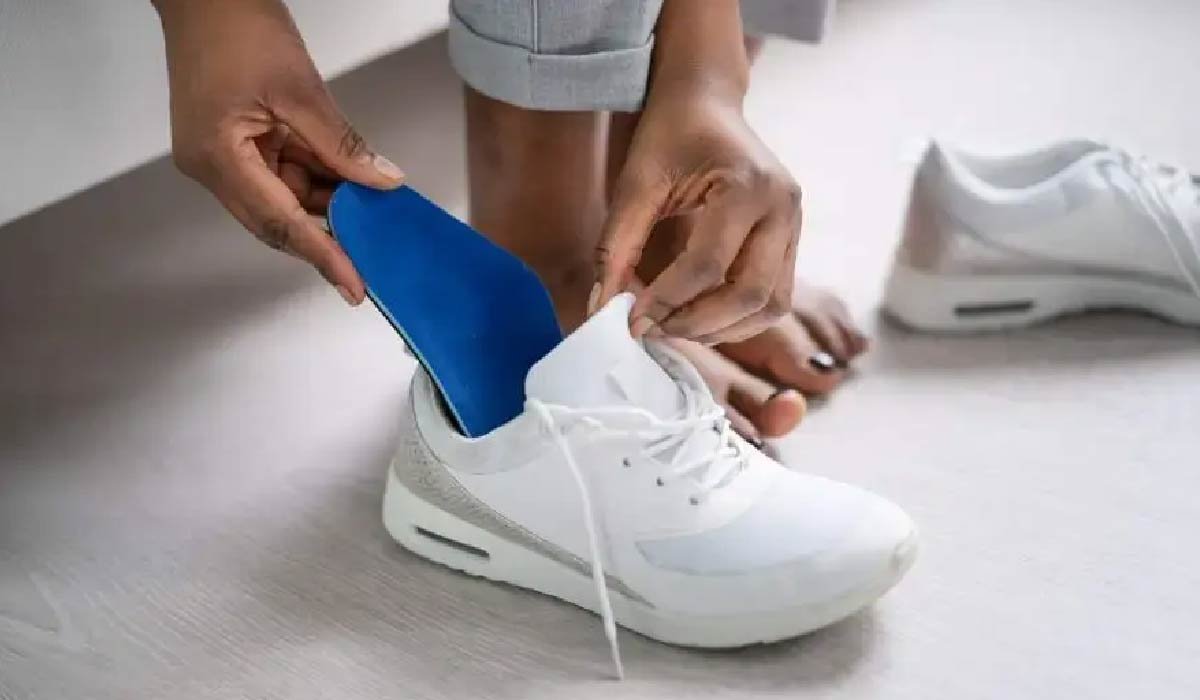
Look inside a typical walking shoe. You’ll usually find a removable footbed, sometimes with a modest raised contour beneath the arch.
Replacing it with a different insert can change the feel considerably.
Some inserts provide additional cushioning. Others have more pronounced arch contours or are designed to influence how the foot moves.
The American Podiatric Medical Association distinguishes between functional orthotics, which are generally intended to influence abnormal movement, and accommodative orthotics, which are often softer and used to redistribute pressure.
Prescription orthoses are made after a clinical assessment. Ordinary shop-bought inserts are different products, even when their packaging uses similar language.
And there’s one practical detail people regularly overlook.
A thick insert takes up room.
Put it inside a shoe that’s already snug, and the upper may begin pressing against your instep or toes.
If you use prescribed orthoses, bring them when shopping for footwear.
What Does Your Walking Routine Tell You?
A person who spends eight hours working behind a counter isn’t necessarily looking for the same qualities as someone who walks a woodland trail every weekend.
The first might appreciate cushioning under the heel and forefoot while standing on hard flooring.
The second may place greater importance on traction, protection from uneven ground, and a secure fit when walking downhill.
Someone commuting through a busy city could want a balance of both.
The American Academy of Orthopaedic Surgeons distinguishes walking shoes from court shoes, trail footwear, and other athletic designs because the movements and surfaces involved aren’t identical.
Think about the places where your feet usually become uncomfortable.
Does the problem begin after hours standing still? Is it worse on uneven paths? Do you notice it during the first few steps each morning?
Those details are more useful than simply announcing that you need supportive shoes.
How to Check a Shoe Before Spending Money
Start with the fit, not the cushioning technology printed on the box.
Stand in both shoes and check whether your toes have room. The sides of the forefoot shouldn’t feel squeezed, and your heel shouldn’t lift repeatedly as you walk.
The American Academy of Orthopaedic Surgeons recommends measuring both feet and trying shoes later in the day, when they’re more likely to reflect their fullest size.
Then consider the sole.
Does the shoe bend comfortably near the ball of your foot? Does the heel feel secure when you turn? Is the cushioning pleasant without making the shoe feel unpredictable?
There’s no need to perform an elaborate scientific experiment in the shop.
A few minutes of walking can reveal whether the shoe presses against a joint, makes your heel slip, or feels awkward underfoot.
For people using orthoses, a removable factory insole can be particularly convenient.
And don’t buy painful footwear on the assumption that it’ll eventually become comfortable after several weeks.
When Foot Pain Needs More Than a Different Shoe
Perhaps you’ve bought three pairs of trainers this year, each promising better cushioning than the last.
Your heel still hurts every morning.
At that point, continuing to shop may be less useful than finding out what’s causing the pain.
Plantar fasciitis, arthritis, tendon disorders, nerve irritation, and other conditions can produce symptoms that ordinary footwear changes won’t necessarily resolve.
A podiatrist can examine foot movement, joint flexibility, painful areas, and walking patterns before recommending treatment.
That assessment might lead to footwear advice, exercises, orthoses, or another approach entirely.
Persistent numbness, unexplained swelling, significant pain, or a rapidly changing foot shape also deserves attention.
For people with diabetes-related nerve damage, pressure-related injuries can sometimes develop without much pain, making appropriate footwear assessment especially important.
Choosing Support Without Compromising Everyday Style
Comfortable footwear has changed considerably over the years.
There’s no shortage of smart leather walking shoes, understated trainers, or casual designs with roomier toe boxes.
Even some orthopedic shoes now resemble ordinary everyday footwear rather than the heavily medical-looking designs people may remember.
But a stylish appearance doesn’t make the construction right for your feet.
A man who needs more room around a bunion may appreciate a softer upper and broader forefoot. Someone with painful big-toe arthritis could benefit from a particular sole design.
Others simply need a good pair of walking trainers in the correct size.
Try not to turn a straightforward fitting problem into an unnecessarily complicated purchase.
Finding the Right Balance for Your Feet
A heavily cushioned shoe might feel wonderful to one person and awkward to another. Arch support can be useful when properly matched to the foot, yet uncomfortable when the contour sits in the wrong place.
Stability has its place, too, particularly when walking involves changing surfaces or when the heel needs a more secure fit.
The difficulty comes from treating any one of those features as the universal answer.
Think about how your feet behave during an ordinary day. Notice where discomfort begins, which shoes make it worse, and whether the problem follows a particular movement.
The right footwear isn’t necessarily the softest, firmest, or most supportive-looking pair.
It’s the pair whose design suits what your feet actually need.
FAQs About Cushioning, Stability and Arch Support
Is more cushioning always better for sore feet?
Not necessarily. A softer sole may help when hard floors leave your heels aching, but excessive softness can feel unsteady to some people. Try walking in the shoes before deciding.
What’s the difference between cushioning and arch support?
Cushioning mainly changes how hard the ground feels underfoot. Arch support is different. It comes from the shape beneath the middle of the foot and can affect how the foot sits and moves inside the shoe.
Do flat feet always need supportive shoes?
No. Plenty of people with low arches walk comfortably without special footwear. Pain, instability, or a changing arch is a better reason to seek advice than appearance alone.
Can high arches cause foot pain?
Yes, especially when most of the pressure ends up under the heel or the front of the foot.But having high arches doesn’t automatically mean you’ll develop problems.
How can I tell whether a shoe is stable?
Walk in it and notice whether your heel stays secure. You can also examine the heel counter and whether the middle of the shoe twists or collapses too easily.
Are orthopedic shoes better than regular trainers?
For some foot conditions, their particular design features may be useful. Someone without those needs might be perfectly comfortable in ordinary, properly fitted walking shoes.
Should I buy custom orthotics for arch pain?
Start by finding out why the arch hurts. Shop-bought inserts help some people, while others need a clinical assessment and more individualised treatment.
Can thick insoles make shoes uncomfortable?
Quite easily. Put a bulky insert inside a snug shoe and your toes or instep may become crowded. A removable factory footbed can help create room.
Do rocker soles help with foot arthritis?
Sometimes, especially when a stiff big-toe joint makes pushing off painful. The shape and suitability of the sole should match the condition rather than being chosen at random.
When should I see a podiatrist about foot support?
Recurring pain despite changing footwear is a good reason. Newly developing numbness, a painful change in arch shape, or trouble walking comfortably also deserves attention.
