


We all know that feeling when you promise yourself to play “just one more” to fix your win rate before bed. Ranking systems have evolved from simple leaderboards into complex psychological loops that keep us glued to our screens for years. It is no longer just about the desire to be better than others, but about the visualization of progress that justifies the time spent. Developers have mastered the art of balancing frustration and reward, making the climb up the ranked ladder feel meaningful even when the process becomes routine. It is this very mechanism that serves as the primary engine sustaining the life of modern multiplayer projects.
Illusion of Progress and Cyclicity
Visual feedback, such as a rank icon changing shape, turns abstract skill improvement into something tangible. Riot Games’ approach to seasonality creates a cycle that prevents stagnation; reaching the top once isn’t enough, as you must constantly prove your worth. Understanding the shifting meta is as vital as aim for climbing out of “Platinum.” Without staying informed, even a good shooter loses strategically, and the ranking system is rarely forgiving.
This constant goal-resetting creates an eternal “carrot on a stick,” making it hard to quit for good. Each season is a clean slate to surpass your previous peak. To avoid stalling, regularly monitoring valorant news becomes a mid-season habit to grasp new rules and adapt. “Soft rank resets” work flawlessly – they devalue past achievements just enough to sting the ego while leaving hope of reclaiming your rightful place.
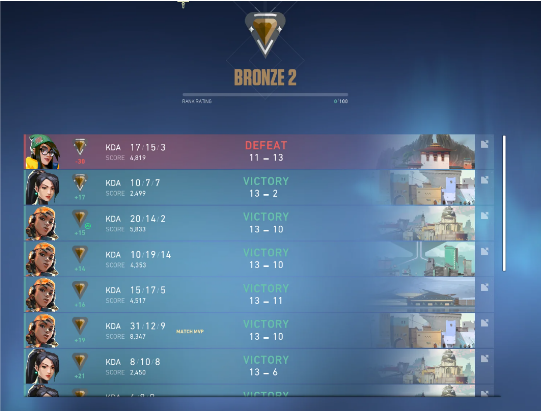
Such cyclicity also solves “ladder anxiety.” If ranks were static, many would stop playing upon reaching “Immortal” to protect their status. Seasonality forcibly pushes you out of your comfort zone, requiring adaptation to new maps and agents. Progress becomes a spiral rather than a straight line, where each turn requires you to be smarter and faster than you were just a few months ago.
Skill Quantification and Social Status
Beyond personal satisfaction, ranks serve as a universal language of status, instantly defining how others perceive you. In a digital space where we don’t see faces, a profile icon replaces social capital. Declaring you are Global Elite or Faceit Level 10 establishes immediate authority, creating a system where tactical opinions only carry weight if you have the corresponding virtual “rank stripes.”
This hierarchy is harsh but fair, pushing you to keep your finger on the pulse of the industry. The meta shifts with every tournament, and yesterday’s tactics quickly become obsolete. I often check the latest cs2 news to see how pro teams adapt, as this experience filters into ranked play almost instantly. Knowing fresh grenade lineups becomes a prerequisite for survival at high levels, where intelligence often outweighs pure mechanical aim.
Social pressure acts as a powerful motivator, sometimes more so than the rewards themselves. The drive to match the group’s skill and avoid being the “weak link” forces you to hit the “find match” button again and again. Fear of letting the team down often proves stronger than fatigue, leading us to spend hours on aim maps or demo reviews just to maintain status within our gaming circle.
Matchmaking Psychology and the “Win Seesaw”
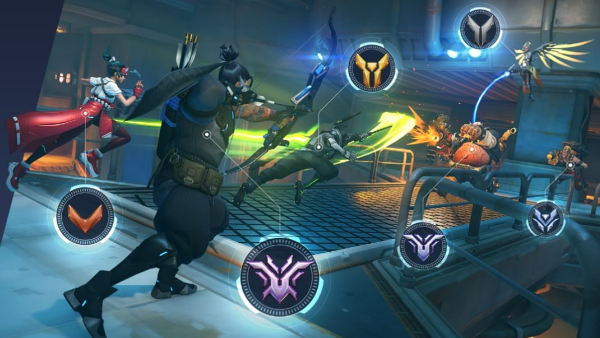
There is a subtle manipulation in how modern algorithms select our opponents. I am convinced that a perfect 50/50 balance is actually boring, which is why games like Overwatch 2 or Call of Duty subject us to emotional seesaws. The alternation between easy victories and crushing defeats keeps us engaged much better than a constant string of intense, even matches, which quickly exhaust the nervous system.
Algorithms have learned to sense the exact moment a player is ready to hit Alt+F4, timely tossing them a “sugar pill.” This is especially noticeable in Apex Legends: after a series of humiliating losses, the system seems to take pity, throwing you into a weak lobby to let you taste dominance again. This is a cold calculation (EOMM) designed to keep us in a state of flow, preventing us from deleting the game in despair.
It is precisely this dynamic that provokes the “just one more game” syndrome, stretching sessions deep into the night. We aren’t chasing the rank numbers so much as the repetition of that dopamine spike from an “ideal game.” This turns competitive gaming into something like a slot machine: we pull the search lever again and again, hoping for a “jackpot” of competent teammates, even when common sense says it’s time for bed.
Rewards and Fear Of Missing Out (FOMO)
Motivation in ranked games is often built not on the desire to become an esports professional, but on the hunt for exclusive rewards. Developers masterfully exploit our urge to collect by tying unique skins and titles to specific ranks. In League of Legends, for instance, the “Victorious” skin line is no longer just a cosmetic item, but a historical artifact proving you were active in a specific year. It’s impossible to obtain otherwise, which gives these virtual items real value in the eyes of the community.
This is where the powerful lever of FOMO – the fear of missing out – comes into play. Strict seasonal timeframes issue an ultimatum: “play now or lose it forever.” I often notice that even when the meta becomes unbearable, the thought of a gap in my collection forces me to push through the exhaustion. This transforms evening leisure into a second job, where you feel obligated to “clock in” and grind out a certain number of wins just to avoid feeling left behind in the future.
Ultimately, the rank grind becomes an end in itself, artificially extending the game’s lifespan. It’s common for the desire to queue for matchmaking to vanish until the next season as soon as a target milestone – be it “Gold” in LoL or a specific rank in Rocket League – is reached and the reward is secured. This proves how dependent we are on external stimuli: instead of playing for the joy of the process, we play for a digital “checkmark,” and developers know exactly that this is what keeps the audience hooked for years.
Conclusion
Ranking systems are a double-edged sword that provides structure to our leisure time while simultaneously exploiting our need for achievement. They transform a hobby into something resembling a career, complete with clear milestones of success and painful setbacks. While such a structure is essential for the longevity of live-service games, it is important to remember that the coveted badge is just a collection of pixels. Ultimately, true value should come from the enjoyment found in the gameplay itself, rather than just the color of the icon next to your nickname.
