


Lithium-ion battery manufacturing is one of the most precision-dependent industrial processes in operation today. As demand for electric vehicles, grid-scale energy storage, and consumer electronics continues to grow, the pressure on battery manufacturers to maintain consistent output quality has intensified considerably. At the heart of that quality lies a process variable that is easy to overlook but impossible to ignore when things go wrong: the physical dimensions of the electrode itself.
Electrode thickness is not simply a geometric specification. It directly determines how much active material is present in each cell, how uniformly that material performs during charge and discharge cycles, and whether the finished cell will meet its rated capacity and safety thresholds. When thickness varies — even slightly — across a coating run, the consequences compound across every downstream stage of production. Understanding what drives those variations, how they are detected, and what happens when they are not is essential for anyone responsible for battery manufacturing operations.
What Electrode Thickness Measurement Actually Involves
Electrode thickness measurement is the continuous or periodic assessment of the total caliper of a coated electrode — the combined thickness of the current collector foil and the active material layer applied to one or both sides. In a production setting, this measurement is taken during or after the coating process, often in real time, to confirm that the wet or dry electrode falls within the specified dimensional range before moving into subsequent stages such as calendering, slitting, or cell assembly.
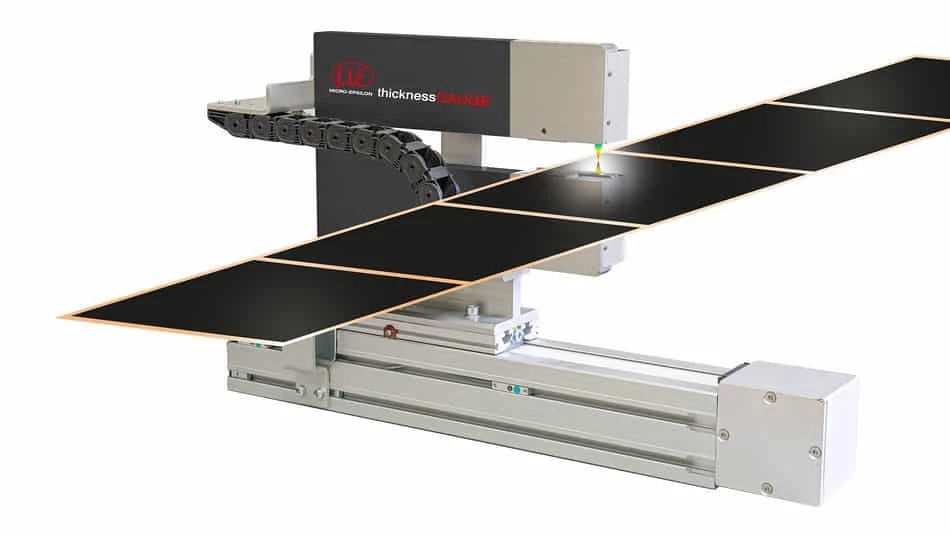
For manufacturers seeking a reliable method for inline or offline inspection, dedicated electrode thickness measurement systems provide non-contact sensing capabilities that allow continuous monitoring without interrupting the coating line. These systems are built specifically for the demands of battery electrode production, where measurement speed, accuracy across varying substrate types, and resistance to environmental interference all matter.
The measurement itself accounts for several material layers simultaneously. A typical electrode consists of a metallic foil — aluminum for cathodes, copper for anodes — coated with a slurry that contains active particles, binders, and conductive additives. Once dried and calendered, the resulting structure must meet tight thickness specifications that influence the cell’s electrochemical behavior and mechanical fitment during winding or stacking.
Why a Single Measurement Point Is Not Sufficient
One of the more persistent misconceptions in electrode production is that spot-checking thickness at a single point or a few locations across the web is adequate quality control. In practice, coating processes are subject to variations in slurry viscosity, line speed, coating head alignment, drying conditions, and substrate tension — all of which can create gradients in coating weight and thickness that do not appear in spot measurements.
Cross-web thickness variation is particularly problematic. A coating that is within specification at the center of the web may be thinner at the edges, or vice versa. If that variation is not detected and corrected, electrode strips cut from different positions across the web will have different active material loadings, resulting in cells with inconsistent capacity — even within the same production batch. Full-width, continuous measurement eliminates this blind spot.
The Relationship Between Thickness and Coating Weight
Thickness and coating weight are closely related but not identical metrics. Coating weight refers to the mass of active material per unit area, while thickness refers to the physical caliper of the dried and calendered electrode. Both matter, and changes in one do not always correspond predictably to changes in the other — particularly after calendering, when the electrode is mechanically compressed and its porosity changes.
Manufacturers typically use thickness measurement in conjunction with other process data to infer coating weight behavior over a production run. Because direct gravimetric measurement of coating weight requires sampling and therefore introduces latency into the feedback loop, thickness measurement — when calibrated appropriately — can serve as a faster, continuous proxy that supports timely process adjustments.
How Electrode Thickness Varies and Why It Matters for Cell Performance
Variation in electrode thickness is not random. It has identifiable causes that trace back to specific points in the coating and drying process. Understanding those causes is the first step toward controlling them. The coating gap setting, slurry rheology, substrate surface energy, oven temperature profile, and web tension all contribute to the final dried thickness of the electrode. When any of these variables shifts outside its intended range, the electrode thickness reflects that shift.
The impact of thickness variation on cell performance is direct. Thicker electrode sections contain more active material and will generate more heat during cycling. Thinner sections will reach their state-of-charge limits faster, causing uneven aging across the cell. In a wound or stacked cell, physical thickness differences also affect the mechanical pressure on the separator, which influences ionic transport and long-term cycle life. According to research published by the National Institute of Standards and Technology, dimensional consistency in battery components is a foundational factor in both performance reliability and safety outcomes for lithium-ion cells.
Calendering and Its Effect on Measurement Strategy
Calendering is the process of pressing the dried electrode through a set of rollers to achieve a target porosity and final thickness. It is a transformative step that significantly changes the electrode’s physical structure, and it introduces its own measurement requirements. An electrode that meets its pre-calendering thickness specification will not necessarily meet its post-calendering specification, because the compression ratio can vary depending on coating uniformity, particle size distribution in the slurry, and roll gap consistency.
Measuring electrode thickness both before and after calendering provides a more complete picture of process behavior. Pre-calendering data identifies coating inconsistencies early enough to adjust the process or flag material for review. Post-calendering data confirms whether the compression step achieved the intended result and whether the final electrode meets the dimensional requirements for cell assembly. Running only one of these measurement points leaves a gap in process visibility that can be difficult to close after the fact.
Edge Effects and Their Disproportionate Impact
Electrode edges — where the coating meets the uncoated border of the current collector foil — are consistently the most variable region of the electrode. Coating beads, meniscus effects, and edge drying conditions all contribute to thickness irregularities in these zones. While edge material is often trimmed during slitting, the presence of severe edge anomalies can indicate process instability that also affects interior regions.
Monitoring edge thickness as a process indicator, rather than simply as a trim-loss calculation, gives process engineers an earlier signal of coating head alignment issues, slurry delivery problems, or substrate handling inconsistencies. It is a diagnostic use of measurement data that goes beyond dimensional compliance and into active process management.
Measurement Technologies Used in Battery Electrode Production
Several non-contact sensing technologies are used to measure electrode thickness in production environments. Each operates on a different physical principle and carries its own trade-offs in terms of sensitivity, substrate compatibility, and response to environmental conditions. Selecting the appropriate technology depends on the electrode type, production line configuration, and the specific variation characteristics that the manufacturer needs to detect and control.
Laser Triangulation and Optical Methods
Laser triangulation measures the position of a surface by projecting a focused beam and detecting its reflection at an angle. When used in a paired configuration — one sensor above, one below the web — it calculates total electrode thickness by summing the two displacement readings. This approach is highly sensitive to surface characteristics, and reflective foil surfaces or particulate contamination on the electrode surface can influence measurement stability. Proper calibration and environmental enclosure are important for maintaining consistent readings in a production setting.
Capacitive and Eddy Current Sensing
Capacitive sensors detect thickness by measuring the capacitance between the sensor and a conductive reference surface — typically the current collector foil. Eddy current sensors operate similarly but use induced electromagnetic fields to detect position relative to a conductive substrate. Both technologies are sensitive to material properties and work most reliably when electrode composition and foil grade remain consistent across production runs. Switching electrode chemistries or foil thicknesses typically requires recalibration of these systems.
X-Ray and Nuclear Measurement Approaches
X-ray transmission and beta backscatter sensors measure coating weight or thickness by detecting the attenuation or reflection of radiation as it passes through or interacts with the material. These approaches are less sensitive to surface characteristics than optical methods and can be highly accurate when properly calibrated. They are more commonly used in applications where coating weight is the primary measurement target, but they can be configured to provide thickness-related data as well. Regulatory and safety considerations associated with radiation sources require additional facility planning and compliance measures.
Integrating Thickness Measurement into a Production Quality System
Measurement data only creates value when it is connected to a decision-making framework. Raw thickness readings from a sensor array must feed into a system that allows process engineers to visualize trends, set alert thresholds, and correlate thickness data with other process variables such as line speed, oven temperature, and slurry delivery rate. Without that integration, measurement becomes a recording exercise rather than a control tool.
Effective integration involves defining control limits based on the electrode specification, establishing response protocols when those limits are approached or exceeded, and retaining data in a format that supports traceability and root cause analysis. Battery manufacturers operating under quality management frameworks such as ISO 9001 or IATF 16949 will find that a well-integrated measurement system simplifies compliance by creating a clear, auditable record of in-process quality conditions.
From Measurement to Process Feedback
The most mature implementations of electrode thickness measurement go beyond monitoring and create closed-loop feedback connections to the coating process. When a thickness drift is detected, the system communicates with the coating line controls to make incremental adjustments — to the coating gap, slurry pump rate, or line speed — before the deviation reaches a level that requires material rejection or manual intervention. This kind of automated feedback reduces reliance on operator response time and creates a more stable process over long production runs.
Achieving reliable closed-loop control requires careful attention to sensor response time, measurement position relative to the coating head, and the latency of the control system itself. A measurement taken far downstream from the coating head introduces a delay between when the deviation occurs and when corrective action takes effect — meaning the line may produce a significant length of out-of-specification material before the system responds. Minimizing this latency through measurement placement and system design is a meaningful engineering consideration.
Conclusion
Electrode thickness measurement is one of those process control disciplines that tends to receive less attention than more visible manufacturing challenges, yet its influence on battery quality is substantial and far-reaching. Thickness consistency determines active material loading, affects cell-to-cell performance uniformity, and shapes the long-term reliability of the battery packs that depend on those cells. When measurement is treated as an active part of the production process — rather than a passive inspection step — it becomes a genuine tool for maintaining quality and reducing waste.
For manufacturers scaling up lithium-ion production or working through quality challenges in existing lines, investing in capable, well-integrated thickness measurement infrastructure is one of the more straightforward and durable improvements available. The complexity of battery chemistry and cell design will continue to grow, but the fundamental requirement for dimensional consistency at the electrode level will remain constant. Getting that right, consistently and early in the process, is worth the attention.
