


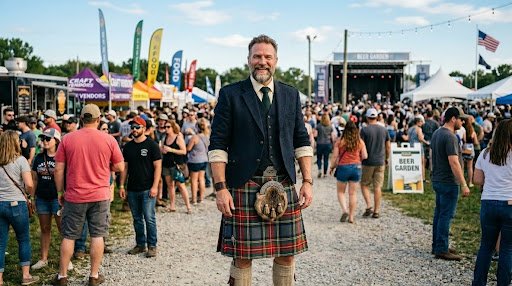
There’s a quiet anxiety that comes with owning a kilt in the United States. You bought it for a reason — maybe a wedding, maybe a heritage event, maybe just because the Scotland plaid pattern caught your eye and you wanted to connect to family roots. But once it’s hanging in your closet, the question becomes: when can I actually wear this without being That Guy?
America’s relationship with kilts is more complicated than Scotland’s. Over there, kilts have an established place in cultural life — formal events expect them, social rules are understood, and nobody bats an eye at a man in a kilt walking through Edinburgh airport.
In the US, the rules are looser, the contexts are fewer, and the social risk feels higher. Wear a kilt to the wrong event in America and you’re conspicuously overdressed. Wear it to the right event and you’re perfectly placed.
Here are seven legitimate, well-established occasions to wear a kilt in the USA — events where Scotland plaid is genuinely appropriate and where you’ll be among other men doing the same.
1. Highland Games and Scottish Festivals
This is the most obvious one, and the easiest place to start.
Highland Games are held in nearly every US state during the warmer months — major events take place in California (Pleasanton, Sacramento), New York (Long Island, Albany), Virginia (Alexandria, Grandfather Mountain), Texas (Salado, San Antonio), and Florida (Dunedin, Orlando), among many others. The Grandfather Mountain Highland Games in North Carolina draws over 30,000 attendees annually.
At a Highland Games event, kilts aren’t just appropriate — they’re expected. You’ll see hundreds, possibly thousands, of men in kilts. Various tartans, various styles. Pipe bands competing. Athletic events featuring caber tosses, hammer throws, and Scottish wrestling. Sheepdog trials. Whisky tastings. Clan tents where you can learn about your family heritage.
If you’re a first-time kilt wearer, Highland Games are the single best place to break in your kilt. You’ll be one of many. Nobody gives a second glance. Older Scottish-Americans will compliment your tartan choice. You’ll get advice from strangers about how to fold your hose properly. The atmosphere is welcoming and informed in a way most other events can’t match.
Find your nearest Highland Games event with a quick search — most regions have at least one within driving distance.
2. Burns Night Suppers (January 25th)
Burns Night commemorates Scottish poet Robert Burns, born January 25, 1759. It’s one of the most consistently observed Scottish holidays in the United States, and it’s celebrated with formal dinners called Burns Suppers.
The standard Burns Supper format includes:
- A piping in of the haggis (Scotland’s national dish)
- The Address to a Haggis (Burns’s famous poem, recited dramatically)
- Traditional Scottish food: haggis, neeps and tatties, cock-a-leekie soup
- Multiple toasts and recitations of Burns’s poetry
- Dancing or ceilidh in some venues
- Whisky tastings, generally extensive
These dinners are held at Scottish-American clubs, country clubs, museums, and private venues across the US. Major cities all have at least one well-attended public Burns Supper, often hosted by the local St. Andrew’s Society or Scottish-American Society.
Wearing a kilt to a Burns Supper isn’t required, but it’s strongly traditional. Most men attending wear them. You’ll fit in seamlessly. This is one of the most enjoyable contexts in which to wear a Scotland plaid kilt — formal enough to justify the full outfit, social enough to enjoy the night.
3. Scottish-American Weddings (Including Yours)
If you’re getting married and you have any Scottish heritage at all, your wedding is one of the few times when wearing a kilt is unambiguously fitting. Many Scottish-Americans who normally wouldn’t wear a kilt on any other occasion choose to wear one on their wedding day as a connection to their roots.
Beyond your own wedding, attending Scottish-themed weddings as a guest is another common context for kilts in America. Some Scottish-American families maintain strong traditions around kilt-wearing at family weddings, baptisms, and funerals — particularly families with recent immigration from Scotland or with active clan society membership.
If you’re invited to a wedding and the dress code mentions “Scottish dress acceptable” or “Highland attire welcome,” that’s an explicit invitation. Take it. The bride and groom chose that wording deliberately.
For your own wedding, a kilt is a particularly powerful choice if:
- You have known Scottish or Northern Irish ancestry
- Your family maintains any Scottish cultural traditions
- Your bride is also incorporating Celtic or Scottish elements
- The venue has a Highland or Scottish character
Photographs of grooms in kilts age remarkably well — better than tuxedos in many cases, because tuxedo styles date themselves more obviously.
4. St. Andrew’s Day Celebrations (November 30th)
St. Andrew is the patron saint of Scotland, and his feast day on November 30th is the second-most-celebrated Scottish holiday in America after Burns Night.
St. Andrew’s Day events take various forms across the US:
- Formal dinners hosted by St. Andrew’s Societies in major cities
- Open public celebrations in cities with strong Scottish-American populations
- Church services at Presbyterian congregations with Scottish heritage
- Cultural events at Scottish heritage centers and museums
The atmosphere is generally less raucous than Burns Night and more formal — these events lean toward dinners, church services, and cultural lectures rather than casual social gatherings.
Wearing a kilt to a St. Andrew’s Day formal event is appropriate and welcomed. The Society of St. Andrew chapters in cities like New York, Chicago, San Francisco, and Washington D.C. host particularly well-attended dinners that draw kilted attendees from across their regions.
5. Tartan Day Events (April 6th)
Tartan Day is uniquely American in its current form. The US Senate officially recognized April 6th as National Tartan Day in 1998, commemorating the date the Declaration of Arbroath was signed in 1320 — the Scottish declaration of independence that influenced America’s own founding documents centuries later.
Tartan Day celebrations include:
- The annual Tartan Day Parade in New York City, one of the largest public Scottish-American events in the world
- Pipe band competitions in various cities
- Cultural festivals at Scottish heritage sites
- Government and civic events recognizing Scottish-American contributions
The New York City Tartan Day Parade alone draws thousands of kilted participants and spectators. It’s an explicitly inclusive event — anyone with even distant Scottish heritage, or simply appreciation for Scottish-American culture, is welcome to march.
For a man with a Scotland plaid kilt who’s looking for occasions to wear a kilt USA-style, Tartan Day events are practically built for that purpose. The cultural justification is explicit and the welcome is universal.
6. Celtic Music Festivals and Concerts
Celtic music has a strong following across the United States, with major festivals and regular concert tours throughout the year. These events draw audiences who genuinely appreciate the cultural context — and many attendees wear kilts.
Notable American Celtic music events:
- The Celtic Classic in Bethlehem, Pennsylvania (one of the largest free Celtic festivals in the country)
- Milwaukee Irish Fest (technically Irish-focused but draws Scottish-American attendees and includes Highland elements)
- Various smaller Celtic festivals at colleges and universities
- Tours by major Celtic bands like Dropkick Murphys, Flogging Molly, The Tannahill Weavers, and others
Concert venues for Celtic music tours regularly see audiences with kilts in attendance. The atmosphere is informal and accepting — kilts are welcomed but not required.
If you’re a Celtic music fan and own a kilt, these events are an underrated context for wearing it. The crowd is enthusiastic about Scottish heritage even if not formally Scottish themselves, and you’ll be in good company.
7. Family Funerals and Memorial Services
This is the most somber context, but worth including because it’s a genuine and traditional reason to wear a kilt in America.
For families with strong Scottish heritage, wearing a kilt to a family funeral is a way of honoring the deceased’s roots and showing the depth of the family’s cultural identity. This is particularly common at funerals of:
- Family elders who themselves wore kilts in life
- Veterans who had Scottish heritage and military service
- Active members of Scottish societies, pipe bands, or clan organizations
- Anyone for whom Scottish identity was important during their life
The appropriate tartan choice here is generally somber — Black Watch is the most common, given its dark and dignified palette. Vibrant tartans like Royal Stewart are usually too celebratory in tone for a funeral.
A man in a kilt at his grandfather’s funeral isn’t being conspicuous. He’s making a quiet statement that the cultural identity his grandfather carried mattered enough to honor publicly in the same garment.
How to Style for American Occasions
A few practical points for kilt wearers in the US specifically:
Match formality carefully. A full traditional kilt outfit with Prince Charlie jacket is appropriate for formal Scottish events but overdressed for Celtic concerts. Calibrate the formality to the event.
The accessory bar is lower in the US. Scottish observers in Edinburgh might judge an incomplete outfit. American observers usually don’t notice the difference between Argyll and Prince Charlie jackets, kilt hose colors, or sporran styles. Don’t stress about achieving full formality.
Lean into questions. Many Americans haven’t seen a kilt up close and will ask polite questions. This is genuine curiosity, not judgment. Engage with it warmly.
Be ready to explain your tartan. Whether or not you have a clan connection, having a brief story about why you chose your specific Scotland plaid pattern is useful conversation material.
Accept that some Americans will assume you’re Irish. It happens. Correct gently if you want to, or just laugh and move on.
Frequently Asked Questions
Can I wear a kilt to a non-Scottish American wedding?
If the dress code is formal and you have a personal reason to wear one (heritage, the bride and groom approve), yes. Otherwise, you may be drawing attention away from the couple. When in doubt, ask the couple directly.
Are kilts appropriate at American Halloween parties?
Best avoided unless your costume is explicitly Scottish-themed. Wearing a real kilt as a “costume” can read as dismissive of the cultural weight of the garment.
Do I need full Highland accessories at every American event?
No. For Highland Games, Burns Night, and weddings, full traditional accessories are appropriate. For Celtic concerts and casual events, simpler styling works fine.
What’s the most universally accepted tartan for an American wearer with no clan connection?
Black Watch — it’s a universal tartan and reads as appropriately respectful at any event without claiming clan heritage you don’t have.
Can I wear a kilt to my American workplace’s holiday party?
Depends on the workplace. Creative industries, smaller companies, and outdoor/trade industries usually accept it. Corporate offices might find it too unusual. Read the room.
Are kilts only for men with Scottish ancestry in America?
No. Universal tartans are open to all wearers. Heritage adds personal meaning but isn’t a requirement to wear a kilt at appropriate events.
A Scotland plaid kilt deserves to be worn, not stored. America offers plenty of legitimate occasions to wear one — you just have to know where to look. Start with these seven, and you’ll quickly find that the man in a kilt at the right event isn’t conspicuous at all. He’s exactly where he’s supposed to be.
