


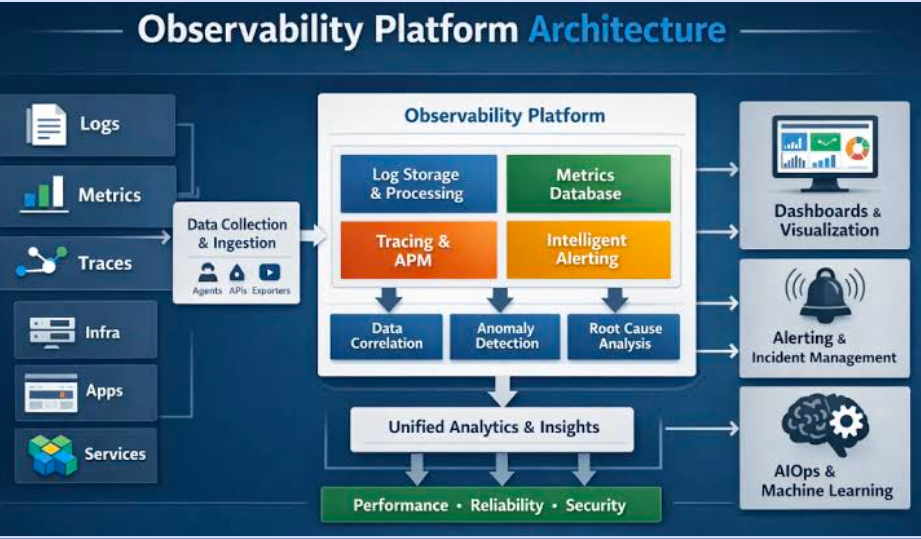
Modern enterprise technology is moving away from basic, passive monitoring dashboards. For years, executive teams evaluated corporate efficiency using static, retrospective data logs that only highlighted problems after they occurred. This reactive model forces organizations to manage business performance through guesswork, leaving core technology ecosystems vulnerable to hidden inefficiencies, misallocated technical debt, and misspent customer acquisition budgets. Because cross-departmental operations have become incredibly complex, organizations can no longer afford to manage individual systems in isolation.
To overcome these obstacles, forward-thinking tech enterprises are embracing systemic operational observability. This paradigm shifts the focus from merely recording transactions to thoroughly understanding the precise pathways through which value travels across an organization. True enterprise optimization is achieved by creating an architecture where operational discovery, technical production, financial management, and scientific marketing validation actively share context. Building this level of transparency allows scaling businesses to uncover structural friction points, streamline engineering throughput, and make major capital distribution decisions based on clear, verifiable proof.
Uncovering Invisible Bottlenecks Within Multi-Platform Operations
Before optimizing any high-level business strategy, a company must first establish a perfectly accurate map of its daily workflows. Within most large organizations, standard business procedures span multiple software programs, legacy platforms, and manual data-entry checkpoints. Because these workflows are scattered across isolated business silos, corporate leadership often lacks visibility into the minor, repetitive operational delays that collectively waste thousands of productive hours each year.
To bring these hidden operational delays to light, operations teams are increasingly relying on advanced process mining software. By automatically reading event logs directly from enterprise applications, these platforms build an interactive, objective blueprint of actual employee workflows. This complete operational transparency allows companies to spot deviations from standard procedures, eliminate manual data bottlenecks, and verify exactly where workflows should be automated to unlock better system efficiency.
Accelerating System Engineering and Application Lifecycles
While operations teams leverage structural blueprints to optimize general company workflows, internal engineering departments face their own complex execution bottlenecks. Scaling technology organizations routinely suffer from massive project backlogs because developers spend the majority of their work hours fixing broken code, managing manual testing protocols, and performing basic database maintenance. To help engineering velocity keep up with evolving business requirements, development architectures must move beyond simple autocomplete code scripts.
The engineering sector is actively resolving this backlog by building smarter environments that support agentic coding methodologies. These advanced platforms function as autonomous technical team members that can read large code repositories, architect complex software features, run automated unit tests, and safely deploy code updates. Delegating repetitive codebase maintenance to autonomous systems minimizes manual errors, drastically shortens feature delivery timelines, and allows developers to focus on higher-level software design.
Securing Capital and Supply Chains Through Empirical Insight
Expanding software delivery channels and improving internal productivity are critical, but these initiatives must be paired with precise control over business expenses and supply networks. Enterprise organizations frequently manage extensive networks of cloud infrastructure providers, third-party software subscriptions, and international vendor agreements. Without centralized tracking and deep financial analysis, keeping up with actual system costs and unmasking hidden spending leaks becomes an impossible administrative challenge.
To maintain perfect financial oversight across complex corporate expenditures, companies integrate specialized procurement analytics software directly into their main database framework. These analytic engines routinely process purchase orders, vendor invoices, and contract data to identify cost-saving opportunities and highlight supplier risks. Merging these granular financial findings with central operational metrics ensures that technology spending directly supports the company’s real-world capacity and performance goals.
Establishing Mathematical Certainty Across Marketing Channels
Just as infrastructure spending requires rigorous validation, an organization’s growth and marketing investments must be held to a strict empirical standard. For decades, marketing teams have relied heavily on multi-touch attribution models that reward the digital platforms that happen to display the final ad before a customer completes a purchase. This surface-level attribution frequently misleads companies into spending heavy budgets on redundant channels that are simply claiming credit for organic sales that would have happened anyway.
Modern growth teams eliminate this marketing waste by implementing highly structured incrementality testing experiments. By comparing user behavior in randomized geographic holdout groups against active ad regions, businesses can isolate and measure the exact revenue lift directly caused by a specific campaign. This continuous, scientific testing protocol empowers financial officers to aggressively reallocate capital away from underperforming channels, maximizing the return on growth investments.
Overcoming the Core Technical Integration Challenge
The true value of modern enterprise software is realized when these individual diagnostic and operational systems are woven into a single, cohesive framework. When system data remains trapped inside isolated applications, the company’s view of its own performance stays fundamentally fragmented. Achieving continuous operational observability requires building open data pipelines that allow workflow discovery tools, engineering metrics, and financial optimization systems to constantly enrich one another.
When these components are deeply integrated, a change in one department instantly provides valuable, actionable context to the others. To give an example, pinpointing an operational bottleneck very clearly lets the automated development layer prepare an integration patch, whereas procurement trackers evaluate the financial benefits of the update. This kind of structural concord turns a hardened tech stack into a versatile ecosystem that can change alongside market pressures.
Evolving Continuous Architectural Iteration Culture
To design a state-of-the-art enterprise stack, one has to disregard the latest, throw-away software buying and make a combined architecture. The organization achieves true business agility by creating data pipelines to integrate software engineering, internal workflow management, and financial optimization platforms in a single loop. Moving to integrated systems leads technology companies that are scaling to do away with their systemic blind spots and build resilient operations.
Above all, companies that give precedence to structural integration rather than to separate point solutions earn a persistent competitive edge. Besides removing operational friction that is enabled by delivering clean and usable data paths across the departments, organizations can verify the growth strategies scientifically, and establish a business growth foundation in a scalable way.
