


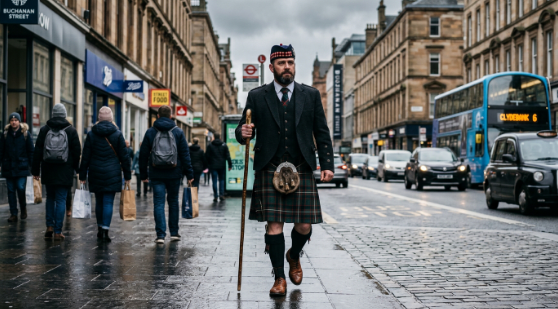
A few months back I made a small bet with myself. I’d been telling friends for years that a real tartan wool kilt was worth twice the price of a cheaper polyester version, and I was tired of repeating myself. So I decided to test it the only way that actually proves anything: wear one for 30 straight days and see what happens.
Not just for special occasions. Not just for photo opportunities. Real, daily, ordinary life — running errands, going to dinners, working from home, attending a wedding, going to a funeral, sitting through a family birthday, walking through rain in Glasgow. Whatever the day brought, the kilt came with it.
By day 7 I was learning things no product page mentions. By day 15 I had a list of differences between authentic tartan wool kilts and the polyester knockoffs marketed as “traditional Scottish kilts.” By day 30 I had a complete picture of what you actually pay for when you spend the extra money — and why every cheaper version I’ve owned ended up forgotten in a closet.
Here’s what 30 days taught me.
What I Was Wearing
The kilt I wore for the test: an 8-yard, 16oz pure wool tartan kilt in a muted Black Watch sett, hand-pleated to the stripe, with a leather-strap waistband and traditional construction throughout. Total cost: around $380, which sits in the mid-tier for authentic kilts.
For comparison, I owned three previous “traditional Scottish kilt” purchases that hadn’t worked out:
- A $65 polyester-acrylic blend bought at a tourist shop years ago
- A $130 5-yard PV (poly-viscose) blend marketed as “Scottish heritage”
- A $180 wool-blend kilt that turned out to be 30% wool, 70% synthetic
All three sat unworn in my closet. The 30-day test was, in part, an attempt to figure out why.
Day 1–7: First Impressions That Set the Tone
The first surprise was weight.
A genuine 8-yard 16oz wool tartan kilt is heavy. Around 4 to 5 pounds of fabric hanging on your hips. The first day, I noticed it constantly. By day 3, the weight had become a feature rather than a bug — it kept the kilt sitting properly, anchored the pleats so they swung correctly when I walked, and gave the whole garment a presence that lighter kilts simply don’t have.
The second surprise was warmth.
Wool kilts are dramatically warmer than they look. Even a single layer of 16oz wool around your hips and thighs adds noticeable insulation. By day 4, when I ducked outside in 50°F weather without a coat, I realized the kilt itself was doing most of the work. The polyester kilts I’d previously owned were essentially decorative — they kept nothing in or out. The wool kilt was clothing.
The third surprise was the smell.
Real wool has a faint, almost imperceptible scent — natural lanolin, slightly earthy, completely pleasant. Polyester kilts smell like nothing, or like the chemical packaging they shipped in. By day 5 I was noticing the wool’s character in a way I’d never noticed a synthetic kilt’s absence of character.
Day 8–15: The Drape Difference Becomes Obvious
This is where the gap between authentic and knockoff really opened up.
A proper tartan wool kilt drapes in three dimensions. The pleats fall in deep parallel columns at the back. The apron flat across the front sits cleanly without bunching. When you walk, the pleats swing as a coordinated unit — a kind of pendulum motion that makes the entire kilt move with you, not against you.
Polyester and PV kilts can’t do this. The fabric is too light, too thin, and too elastic. Pleats stitched into synthetic fabric don’t hang naturally — they crease. They don’t swing — they jiggle. The visual effect, especially in motion, is the difference between a curtain and a flag.
Day 11, walking briskly across a parking lot to meet someone, I caught my reflection in a shop window. The kilt was moving in a way I’d never seen any of my previous kilts move. The pleats were rolling like waves. It was mesmerizing for half a second, then I felt a small sting of regret — I’d worn cheaper kilts to family events for years, and they hadn’t done this.
Day 16–22: Testing Against Real Conditions
The middle of the test threw weather at me.
Cold Day, 35°F, Brisk Wind
Wore the wool kilt with thermal hose underneath. Stayed warm. The wool kilt isn’t windproof exactly, but the weight of the fabric blocks enough wind to keep core warmth intact. A polyester kilt in the same conditions would have been useless.
Light Rain, All Day
Wool naturally repels water for several hours before saturating. The kilt got slightly damp at the bottom hem but didn’t soak through. By the time I got home, it had already started to air-dry. Polyester kilts repel rain too, but they also trap any moisture against the body — sweat, condensation, anything else. The wool breathed through the moisture.
Heavy Rain, Sustained
This was where wool’s limit showed up. After about 90 minutes in heavy rain, the kilt was genuinely wet. Drying it took 36 hours of careful air-drying to avoid shrinkage. Polyester wins this scenario by a clear margin — but it’s a rare scenario in reality.
Hot Day, 78°F and Humid
This was the hardest test. 16oz wool in summer humidity is genuinely uncomfortable. I ended up sweating through the day in a way I hadn’t on any of the cooler days. For climates that get truly hot, a lighter weight wool kilt (11oz) or a different garment entirely is the right answer.
Day 23–30: The Compounding Quality Effect
By the last week, something interesting started happening. The kilt looked better than it had on day 1.
A new wool kilt has a slight stiffness to it from manufacturing. The pleats are sharp but rigid. The fabric hasn’t yet learned the shape of the wearer’s body. Over 30 days of wear, that changed. The pleats started to fall more naturally. The waistband softened slightly to fit my exact shape. The fabric developed a subtle drape memory.
This is the opposite of what happens to synthetic kilts. They start at their best appearance on day 1 and slowly degrade — pilling, losing pleat sharpness, fading. Wool kilts improve through their first 100 wears and stay at peak quality for years.
A 30-year-old wool kilt, well-cared for, often looks better than a 6-month-old polyester one. There’s no equivalent process in synthetic fabrics.
The Comparison That Made It Click
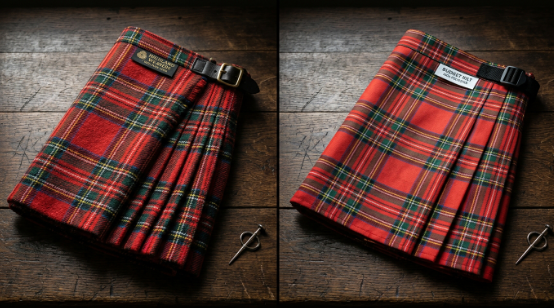
Toward the end of the 30 days, I pulled out my old $130 PV “traditional Scottish kilt” and put them side by side on the bed.
The difference was almost embarrassing.
The PV kilt’s tartan colors looked flat, like printed wallpaper. The wool kilt’s colors had depth — the dark green wasn’t just one shade, it was layers of slightly different greens woven together. The PV kilt’s pleats had visible needle holes where they’d been stitched flat. The wool kilt’s pleats hung freely with no visible stitching at the fold lines.
Picking them up, the wool kilt felt like something. The PV kilt felt like a costume.
I don’t think the PV kilt is going to make it back into rotation. After 30 days in a real wool kilt, going back to a synthetic version felt like trading a cashmere sweater for a polyester polo.
What the Test Actually Proved About “Traditional Scottish Kilts”
Here’s the honest distillation of 30 days:
Authentic Traditional Scottish Kilts Are Wool
Not “wool blend.” Not “wool look.” Pure wool, woven at a real Scottish mill, in a recognizable weight (11oz, 13oz, or 16oz). Anything else is using the words but not the substance.
The Pleats Need to Be Hand-Stitched at the Waistband
Machine-pleated kilts where the pleats are stitched flat don’t move correctly. The whole point of a kilt’s silhouette comes from how the pleats swing. Stitched-flat pleats kill that effect.
The Kilt Should Fit Your Specific Body
A real kilt is sized to your natural waist measurement, your seat measurement, and your kilt length (knee-to-floor). One-size-fits-most kilts can’t do what custom-sized kilts do for fit.
Construction Beats Decoration
A simple Black Watch kilt in proper wool will outperform a fancy clan tartan in cheap fabric every time. Spend on the materials and construction first. The tartan choice is personal, but it should never be the most expensive part of your decision.
Was the Money Worth It?
The cost-per-wear math actually favors the expensive kilt.
The $380 wool kilt got worn 30 times in the first month and continues to get worn 4–6 times a month. Conservatively, that’s 70+ wears in the first year. Cost per wear: under $5.50.
The $65 polyester kilt got worn 2 times in 4 years before getting abandoned. Cost per wear: $32.50.
The $130 PV kilt got worn 4 times in 3 years. Cost per wear: $32.50.
The “expensive” wool kilt is dramatically cheaper per wearing experience because it actually gets worn. Quality drives use. Cheap kilts get bought and abandoned.
This is the lesson I wish someone had told me when I bought my first kilt years ago.
What to Look For When Buying
Based on the test, here’s the checklist I’d give a friend asking what to buy:
Mandatory
- Pure wool fabric (specify the weight: 11oz, 13oz, or 16oz)
- Hand-stitched pleats and waistband
- Sized to your specific measurements
- Length to the middle of your kneecap
- Made by a maker who can name the mill the wool came from
Strongly Recommended
- 5-yard minimum (8-yard for fully traditional)
- Pleat-to-the-stripe or pleat-to-the-sett, not random pleating
- Double leather straps with quality buckles (3 straps for 8-yard)
- Hidden interior canvas reinforcement at the waistband
- Hand-finished hem
Skip
- “PV” or “poly-viscose” fabric
- One-size-fits-most sizing
- Stitched-flat pleats
- Pre-pleated kilts shipped in plastic bags
- Anything under $150 marketed as “traditional”
Frequently Asked Questions
Is a 5-yard wool kilt as good as 8-yard?
For most modern wear, yes. 8-yard is more dramatic and fully traditional, but 5-yard is more affordable and slightly easier for daily wear. Both are authentic if made from real wool with proper construction.
How do I clean a wool tartan kilt?
Dry-clean only, by a cleaner experienced with kilts. Never machine wash. Never tumble dry. Spot-clean small marks with cold water and patience. Store on a proper kilt hanger or fold properly along the pleats.
Will my wool kilt shrink?
Only if exposed to heat or water improperly. Following proper care — dry-clean, no heat — a wool kilt will hold its size for decades.
What’s the weight difference between 11oz, 13oz, and 16oz wool?
11oz is light, suitable for warm climates and summer events. 13oz is medium-weight, the most versatile choice. 16oz is heavyweight, fully traditional, best for cooler climates and formal occasions.
Can I wear a wool tartan kilt in summer?
You can, but in heat over 78°F with humidity, lighter fabrics are more comfortable. An 11oz wool kilt is much more wearable in heat than 16oz.
How long does a quality wool kilt last?
Properly cared for, 30 to 50 years. Many wool kilts are passed down between generations. They’re heirloom-quality garments.
Thirty days in a tartan wool kilt taught me what no buying guide ever did: authentic kilts aren’t just better-looking versions of cheap ones. They’re a fundamentally different garment. Different fabric, different construction, different lifespan, different feeling on the body. Buy one good one, and you’ll never reach for the cheap kilt again.
