


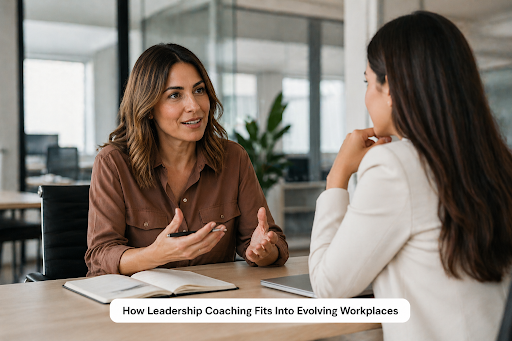
The workplace you were familiar with some years ago? It’s gone. Replaced. Reinvented. And when you close your eyes, you may miss the speed with which it all is changing. Distributed work groups, split-shift, artificial intelligence, evolving employee demands; it’s a lot. The twist of it all, though, is that the change is not as much of a challenge as how leaders react to it.
Here is the truth: what made someone an outstanding leader yesterday may not work today. The regulations are different now, and leadership is no longer a matter of control or authority. It is all about flexibility, emotional intelligence, and lifelong learning.
This is where leadership coaching silently intervenes, not as a luxury but as a necessity. Not only are the most successful workplaces today evolving, but they are also purposefully cultivating leaders who can evolve with them.
Let’s explore how leadership coaching fits into evolving workplaces!
Leadership Coaching Turns Uncertainty Into Clarity
The contemporary workplace is full of uncertainties. Decisions are more rushed, the stakes are greater, and the results are less certain. Even experienced leaders may be overwhelmed without guidance. This is where leadership coaching comes to the rescue, bringing sanity.
Coaching assists leaders in slowing their cognitive processes, enabling them to make smarter decisions through structured conversations and reflection. It questions assumptions, develops judgment, and instills confidence amid uncertainty.
Leaders no longer react impulsively but respond strategically. Over time, this transition completely alters their approach to problems.
Clarity is a force for change in workplaces. The actual leaders are those who drive change in organizations by reducing noise and focusing on what truly matters.
Coaching does not provide them with solutions, but prepares them with the attitude to seek the best.
It Builds Emotional Intelligence for Modern Teams
One factor many people overlook is that today’s teams don’t just want direction. They want understanding. Workers demand leaders who listen, empathize, and communicate effectively. And that’s not always a natural skill.
Leadership coaching is very significant in developing emotional intelligence. It assists leaders in becoming more self-aware, identifying their triggers, and understanding how their actions impact others.
There’s even more! It also equips them with the knowledge to read the room, even in an online environment, and to respond in ways that foster trust rather than tension.
Emotional intelligence is not an option in work environments that involve cross-cultural, cross-time-zone, and cross-personality collaboration. It’s essential. Coaching shifts the task-oriented leadership approach to a people-oriented one, which is what contemporary teams require to succeed.
Leadership Coaching Encourages Adaptability in Fast-Changing Environments
Imagine this: what was a successful strategy last quarter suddenly becomes outdated. This is the truth of changing workplaces. Change isn’t occasional anymore; it’s constant.
Leadership coaching helps leaders come to terms with this reality. They do not oppose change but learn to accept it. Coaches help them reframe challenges as opportunities and explore new ways of doing things without fear of failure.
Leaders grow over time to adopt a growth mindset. They are no longer afraid of change as they begin to see it as part of the process. This change is an advantage not only to the individual but also to the entire team. By leading with adaptability, leaders inspire a culture where innovation is natural rather than imposed.
The ability to turn around quickly can make or break an organization, especially in fast-paced environments. Coaching will help leaders not only keep pace but also stay ahead of the pack.
It Aligns Personal Growth With Organizational Goals
Alignment is one of the biggest challenges in changing workplaces. Organizations are going off track, redefining objectives, and reorganizing teams. Meanwhile, leaders possess personal ambitions and challenges.
This is where leadership coaching comes in. It relates individual growth and organizational achievement in a significant manner. Coaching ensures that leaders are not pulled in various directions by motivating them to understand how their development contributes to the larger picture.
This conformity brings about a feeling of direction. Leaders get more active, more concerned, and more determined to get results. And here comes the interesting part: when leaders feel aligned, their teams experience it as well. It creates a ripple effect that enhances performance throughout the organization.
In a world where priorities are ever-changing, alignment is not a coincidence. It is something that has to be developed, and coaching does just that.
Leadership Coaching Supports Continuous Learning and Innovation
Let’s be honest, standing still is no longer an option. Workplaces are evolving, industries are changing, and new skills are demanded almost every day. Leaders who cease learning quickly fall behind.
Leadership coaching creates a culture of continuous improvement. It helps leaders remain inquisitive, pose more effective questions, and explore new ideas. They no longer just stick to experience but start exploring new ideas and getting rid of old-fashioned thinking.
Such an attitude drives innovation. The leaders are open to experimentation and calculated risks, and they promote creativity in their teams. And in the modern competitive world, being innovative is not an added advantage; it is the way to survive.
Coaching makes learning a habit and not a one-off event. It also ensures leaders are in a continuous state of growth and adaptation, and always prepared for what’s next.
Final Thoughts: Leadership Coaching Is No Longer Optional
The workplace isn’t going back to what it used to be, and honestly, it shouldn’t. Evolution brings opportunity, but only for those prepared to grow with it.
Leadership coaching fits into this new reality as a powerful support system. It helps leaders think clearly in uncertainty, connect deeply with their teams, adapt to constant change, align with organizational goals, and keep learning in a fast-paced world.
Here’s the bottom line: organizations don’t transform on their own. People do. And when leaders grow, everything else follows.
So if you’re looking at the future of work and wondering how to keep up, here’s your answer: invest in leadership development that actually evolves with you. Because in workplaces that never stop changing, the strongest leaders are the ones who never stop growing.
