


Although many BBQ enthusiasts may believe that delicious barbecue is centered around flavor, sauce, or one’s “secret” rub recipe, the reality is that competitive BBQ judges evaluate the quality of barbecue using objective, defined criteria.
These judges do not simply taste the barbecue and declare it “good.” Rather, they objectively evaluate each piece of barbecue in three distinct categories: appearance, taste, and tenderness. That is it. There are no other factors. There are no gimmicks. There are no presentation tricks. And there is certainly no consideration given to how much money you spent on the cut of meat. It is these three factors that determine whether a piece of barbecue is considered exceptional by judges.
The Initial Evaluation Takes Place Prior to the First Bite
Prior to a judge even touching the barbecue, he/she has formed an initial impression. He/She is looking for:
- evenness of color
- proper bark (brisket, ribs)
- moisture-not dry; not dripping
- clean cuts
If the barbecue appears to be dry, it will lose points. If it appears to be sloppy, it will lose points. However, the most important aspect of this is the appearance of a barbecue can only take you so far.
Taste: Balance Is More Important Than Flavor
Most people would argue that the stronger the flavor of the barbecue, the better it is. More seasoning. More smoke. More sauce.
Wrong.
Competitive BBQ judges have been trained to identify balance.
Balance means:
- salt does not overwhelm
- smoke does not overpower
- sauce does not dominate
Each component of the barbecue should complement each of the other components. Each component should not compete with each other.
Tenderness: The Ultimate Decision Maker
This is where the majority of BBQ competitions are won or lost, because tenderness is the most difficult factor to achieve. And the easiest factor to ruin.
What Do Competitive BBQ Judges Look For?
Brisket:
- should slice clean
- should hold its shape
- should pull apart slightly
Ribs:
- clean bite, not falling off the bone; not too tough
- meat should break free from the rib cage cleanly where bitten
Chicken:
- juicy; not dry
- skin should not be rubbery
- bite through texture
Pork:
- soft-but not mushy
- fibers separate cleanly
Do you notice anything? None of these relate to time. None of these relate to looks. All of them relate to texture.
Why So Many Home Cooks Miss This
Home cooks typically base their BBQ cooking decisions upon:
- time
- guesses
- visual cue
And none of these give them information about what is going on internally.
The Real Secret: Temperature Control
Every single one of those judging criteria relates to internal temperature.
Internal temperature is what determines:
too low:
- tough meat
- collagen has not converted
too high:
-
dry meat
- lost moisture
perfect:
- optimal tenderness
- balanced texture
That is what competitive BBQ judges are tasting.
The Difference Between “Done” and “Optimized”
Many pieces of meat can be technically “done.” Technically done is safe to eat. However, not all “done” meat is perfect.
For example:
- chicken at 165° F meas safe
- chicken pulled prematurely and rested means juicy chicken
This is the case for all types of BBQ. Competitive BBQ judges are not concerned about whether a piece of meat is “safe.” They want to optimize.
Why Precision Matters More Than Experience
You could cook BBQ for 20 years and still fail to achieve perfect tenderness, because feeling is inconsistent. Weather affects it. Meat thickness affects it. Heat fluctuation affects it. Temperature is consistent.
Where the TempPro TP03H Fits Into All Of This
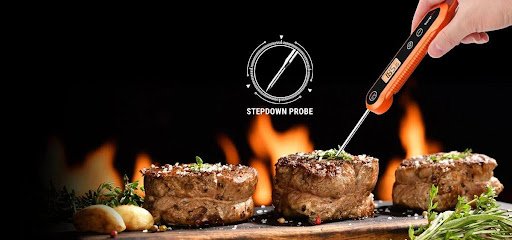
When cooking meat that must meet very specific internal temperatures, guessing is not effective. The TempPro TP03H Instant-Read Meat Thermometer allows for fast, accurate temperature checks without disrupting the cooking process.
Why the TempPro TP03H is Ideal for Real BBQ Cooking
- Fast 3-4 second readings with accuracy of ±0.9°F: Instant feedback without exposing the meat to excessive heat loss.
- 3.9 inch long stainless steel probe: Safely reaches into thick cuts.
- IPX6 Waterproof design: No worries when cleaning.
- Large backlit display: Easy to see whether you’re cooking at night or during daylight.
- Calibration function: Maintains your accuracy over time.
- Foldable and magnetic storage: Always within reach.
The difference here is not about convenience. It is about confidence. You know exactly where your meat is, each and every time you check.
How to Cook Like a BBQ Judge at Home
You do not need a competition setup. You just need to think like a judge.
Step 1: Ignore Time As Your Primary Metric
Use it as a reference point.
Step 2: Track Temperature Early
Do not wait until the end. Monitor the entire cooking process.
Step 3: Determine Target Ranges
- Brisket: 195-205° F
- Ribs: 190-203° F
- Pork Shoulder: 195-205° F
- Chicken: Pull early. Finish with carry-over.
Step 4: Check Tenderness, Not Just Numbers
Temperature brings you close. Your touch confirms it.
Step 5: Properly Rest
Judges do not eat BBQ directly off the grill.
Resting:
- distribute juices
- stabilize texture
If you skip resting, you’ll lose points at home or in a competition.
Common Errors That Will Kill Your Score
- Cook too hot: breaks moisture before converting collagen.
- Pull too early: hasn’t fully transformed.
- Cook “just to be sure”: ruins texture.
- judge by color: completely unreliable.
- don’t use a thermometer: you’re guessing every time.
Why This Changes the Way You Cook
Once you comprehend the way competitive BBQ judges evaluate barbecue, everything changes. You stop chasing time, guesstimating doneness, and overcooking. You begin to monitoring temperature, identifying texture, cooking with Intent.
FAQ about BBQ
Q1. What do BBQ judges look for first?
Appearance, before they even taste the meat.
Q2. What matters more: flavor or tenderness?
Both matter, but tenderness often decides the winner.
Q3. Why isn’t “fall off the bone” always good?
Because it can mean overcooked meat.
Q4. What temperature is best for BBQ meats?
Depends on the cut, but most fall in the 190-205°F range for tenderness.
Q5. Do I need a food thermometer to cook like a pro?
If you want consistent results, it’s recommended to use a digital probe food thermometer while cooking.
The Bottom Line
Competitive BBQ judges are not magical. They are consistent. They evaluate barbecue based on how it appears, tastes and feels. And all three are tied back to control. Once you comprehend that, you will stop cooking blindly.With TempPro TP03H Instant-Read Meat Thermometer, and you will begin cooking intentionally.
