


File name Figure 1: helical-gear-nvh-challenge-solution-comparison-cover.jpg
Introduction
In high-end electric vehicles, precision robotic arms, and high-end appliances, one of the biggest product flaws that persists is related to powertrain issues. The powertrain issues are related to high levels of operational noise and vibrations. Not only is it a “killer” for product experience, but it also equates directly to energy losses, thereby causing low system efficiency. In many cases, even with “standard” helical gear configurations, it has not been possible for companies to achieve high levels of smoothness and quietness, thereby causing their products to become commoditized. The reason for this is that while suppliers are used as “standard parts” only to satisfy basic dimensional drawings, it is understood that micro-geometric accuracy, material stresses inside components, and tooth surface texture are variables that drawings cannot define and that traditional manufacturing cannot systematically manage.
This article will show how modern technology for the precision manufacture of helical gears transforms these intangibles into definite, optimized output qualities through an “integrated design-materials-process-inspection” engineering approach. By actively controlling tooth surface topography, counteracting heat treatment distortion, and using digital pairing techniques, significant improvements in efficiency are achieved, as well as fundamental reductions in noise. The following sections will look in more detail at the four main components of the engineering approach, how they make “quiet” and “efficient” qualities a certainty, rather than a probability.
Why Do “Quiet” Gears Remain Elusive for Many Manufacturers? The Limits of Conventional Machining.
In this section, we will discuss the inherent limitations of conventional gear manufacturing. This will explain why machine accuracy alone cannot guarantee quiet running. We will highlight the gap between static gear dimensioning and dynamic gear meshing.
1. The Hidden Noise Source: Micro-Vibrations and Surface Imperfections
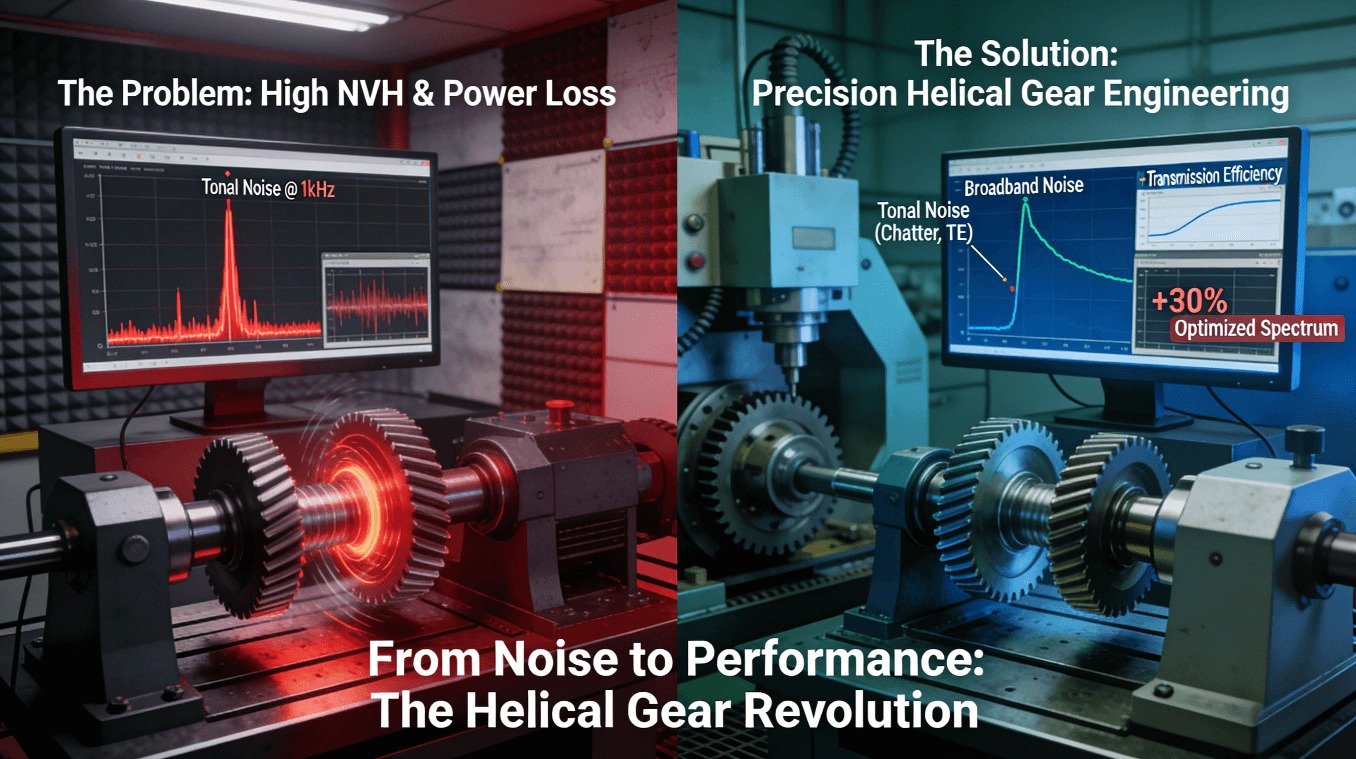
Even the most accurate CNC machines cannot avoid microscopic cutting machine vibrations, known as chatter. This gives the gear tooth flanks a periodic wavy surface texture. This texture is a tonal noise source and directly causes noise during meshing. The gear dimensioning process may be accurate, but this texture is the hidden noise source. Conventional manufacturing cannot avoid this noise source because it involves a dynamic process between machine and workpiece.
2. The Unpredictable Variable: Post-Processing Distortion
A perfectly machined gear blank is only the beginning. The heat treatment process, which is required for hardness and durability, also brings thermo-mechanical stresses that cause unpredictable distortion. The result is the destruction of the perfect contact pattern designed in the machined gear blank. Instead, the distortion brings high-stress contact points, which increase noise, vibration, and wear, despite the fact that the dimensions are still “within print.”
3. Bridging the Gap: From Static Drawing to Dynamic Performance
A gear drawing is a set of rules based on ASME Y14.5 standards for permissible geometric dimensions. However, the drawing does not define the “how” in the creation of the gear. The ultimate goal is the creation of an optimal dynamic meshing behavior. The meshing behavior is a result of the surface finish, stress state, and geometry under load. Bridging the gap between the drawing and the final product requires an engineering methodology that controls the entire process chain instead of the end result. To understand the entire methodology from the principles of the drawing to the creation of the final product, the in-depth technical guide on the manufacturing of helical gears provides a comprehensive analysis.
How Does Advanced Helical Geometry Itself Become a “Natural” Noise Damper?
This section will explain the basic mechanical advantages of helical gear geometry as opposed to spur gears, highlighting how the very nature of the design makes for quieter, more efficient operation.
1. The Mechanics of Smooth Engagement: Gradual Load Transfer
Unlike spur gears, where teeth engage in an abrupt, linear fashion, helical gears are designed so that the teeth are angled relative to the axis of the gear. This provides for a smooth, progressive engagement of the gears as they make contact. This “sliding” action into engagement minimizes the shock loads, which are the main contributors to noise in spur gears.
2. Optimizing Overlap Ratio for Acoustic Performance
Quiet performance of helical gear sets is significantly dependent on the gear’s overlap ratio, which refers to the average number of teeth that are in contact at any given time. Therefore, by ensuring that the gear’s design has an optimum overlap ratio, smooth transmission of torque and better distribution of load across the gear’s teeth are achieved. Consequently, by accurately calculating and controlling the helix angles, face widths, and tooth profiles, designers can create gear sets that have an optimum overlap ratio that effectively reduces transmission errors, which are the major cause of gear noise, thus performing ‘active acoustic design’ at the conceptual design phase.
3. Efficiency Gains Through Superior Contact Mechanics
Besides quiet performance, smooth gear interaction and multiple tooth contact of helical gear sets also result in low friction and pressure on individual gear teeth. Consequently, there is an increase in efficiency since less mechanical energy is lost due to friction and heat. Therefore, due to their capability to carry large loads in a smaller space without losing significant amounts of power to heat and noise, helical gear sets remain the best choice for high-performance gear drives.
Beyond Basic Shape: What Are “Micro-Geometry Corrections” and How Do They Silence Gears?
This section will help to demystify the process of applying advanced micro-geometry corrections to the design of the gear, to ensure that the best possible contact is achieved, despite the inevitable system deflection, in a silent manner.
1. The Principle of Pre-Compensation: “Balancing” the Gear
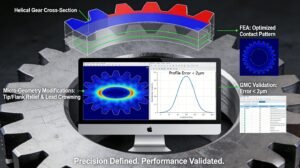
Micro-geometry corrections, such as profile crowning and lead crowning, can be likened to the process of dynamically balancing a tire. This process involves making a small, but precise, “error” in the involute or straight tooth design. This error is used to pre-compensate for the inevitable elastic deflection of the shafts, bearings, and housing that will occur when the system is in use.
2. The Tools of the Trade: Profile and Lead Modifications
- Profile Modification (Tip/Flank Relief): This process requires slightly relieving the material near the tooth tip and/or root. This process compensates for deflection of the mesh and inaccuracies during manufacturing, ensuring that there is no interference at the entry and exit points of the mesh, which is a major cause of impact noise.
- Lead Modification (Crowning/Barreling): This process requires subtly barreling the tooth face width. This process compensates for misalignment and shaft deflection during loading, ensuring that the contact pattern remains within the central region of the tooth face and not at the edges, which may cause noise due to concentrated pressure.
3. From Theory to Practice: The Need for Collaborative Engineering
Optimizing the amount and form of correction requires complex simulation and application expertise. It depends on the particular loading, running speed, and stiffness of the surrounding system. Therefore, to effectively implement these micro-modifications, there is a need to collaborate with a custom gear manufacturer near me that can provide rapid and deep engineering iteration.
From a Silent Sample to a Quiet Batch: How is Consistency Assured in Mass Production?
File name Figure 2: helical-gear-micro-geometry-modifications-fea-gmc-validation.jpg
In this section, we will examine the problem of scaling from a single, expertly crafted quiet sample to tens of thousands of quiet gears, with particular reference to the use of statistical process control, advanced measurement capabilities, and quality management systems.
1. The Prototype Trap: Artisanal vs. Industrialized Quality
It is one thing to design and make a single, perfect quiet sample of a gear. It is quite another to ensure that that same performance is replicated exactly 10,000 times. It is the difference between artisanal quality control and industrialized quality control.
2. Statistical Process Control: The Guardian of the “Acoustic Fingerprint”
Statistical Process Control (SPC) is employed for critical production operations, especially for the last grinding process. Parameters like tooth profile and lead error are measured on a sample basis. This approach prevents process drift, e.g., due to tool wear, before production of parts out of specification. As a result, all gears of a production batch will have the same “acoustic fingerprint.” This is an essential element of modern quality management systems.
3. Traceability and the Closed-Loop System
In an environment where quality is of utmost importance, like in mass production, every batch of gears is associated with an entire set of information, including material documentation, heat treatment, SPC, and finally, gear inspection from a gear measuring center. Traceability of all processes is ensured, allowing for root cause analysis in case of any deviation. This approach is part of the quality management of an automotive supplier who works according to the strict standard IATF 16949. It is part of their philosophy to prevent problems, ensuring consistency in NVH performance as an outcome of the process, rather than as an expectation.
How to Evaluate a Gear Partner’s True Capability: A Checklist Beyond the Machine List
This final section offers a detailed evaluation checklist for selecting a gear manufacturing partner, without focusing on machine tools alone.
- Engineering Dialogue Depth: From Quote to Collaboration: How does the gear supplier interact with you during the Request for Quote process? Do they go beyond discussion of price and start talking about application issues such as target NVH spectra or desired performance? Do they start talking about various micro-geometry options or material selections based on your application conditions? The gear supplier that is a partner, as opposed to a vendor, will want to engage in a dialogue with you
- Data Transparency and Evidence-Based Delivery: It’s easy for any vendor to claim they have “high precision.” The only way to verify that is through data. Ask for sample inspection reports. These should be detailed, including not only pass/fail criteria but also error curves and topography maps for profile and lead. If they are confident in their process, they should be transparent with their data. The ability to deliver and interpret that data is a key indicator of a genuine precision component manufacturer.
- Prototype-to-Production Pathway and Validation Resources: Ask them how they make their prototype. Are they using the same processes as they would for production? This ensures that performance characteristics from that prototype are applicable to production. Ask them about their validation resources. Do they have gear testers or NVH testing partners? The ability to functionally validate noise and efficiency claims is a hallmark of a real engineering solution provider, as opposed to a job shop.
Conclusion
In the highly competitive world of high-end manufacturing, product quietness and efficiency have moved beyond being desirable product features and have become a prerequisite for entering the market and creating a premium brand. With the adoption of cutting-edge helical gear manufacturing technology that combines advanced design tools, materials engineering, and precision machining along with advanced quality control tools, companies can transform their product’s powertrain from a potential failure and noise source to a reliable foundation for product performance and user satisfaction. This is not just a product technology update; this is a strategic update of product value and market competitiveness.
FAQs
Q: What is the minimum order quantity for custom helical gears?
A: The MOQ for custom helical gears can be as low as 1-10 units for prototyping and testing purposes. The MOQ for production quantities usually starts at a minimum of 100-500 units, depending upon the size and intricacy of the product. The MOQ for your project can be best ascertained after consulting with us for your project.
Q: How long does it take to get functional prototypes for a new helical gear design?
A: In the case of a new design that needs engineering review, programming, machining, and heat treatment, a 4, 6 week lead time for the first functional samples is a realistic expectation. It accounts for possible design changes based on initial DFM feedback. The next samples or small scale production runs would be completed quicker.
Q: What is the highest precision grade (e.g., DIN standard) you can achieve for helical gears?
A: In general, for large, scale industrial applications, we provide products that consistently meet the DIN 6, 7 level of precision. For very demanding applications in the aerospace or precision instrumentation fields that require the utmost precision, our grinding, honing, and careful inspection processes can produce up to the DIN 4, 5 level.
Q: How do you ensure noise consistency across thousands of gears in mass production?
A: Maintaining a consistent noise level involves controlling the transmission error spectrum. We use statistical process control on our gear grinding machines and carry out sampling tests on specialized gear testers for each batch. This way, we keep the NVH characteristics within a very narrow, predetermined range.
Q: Can we get a test report on noise and vibration?
A: Yes, for critical applications, we are able to offer a detailed inspection report from a gear measuring center, which includes a topography map of the profile and lead. We are also able to offer a vibration spectrum analysis report from a gear meshing tester. This is available as an additional service to validate the NVH performance against your requirements.
Author Bio
This article is written from a place of deep expertise in the manufacturing of precision transmission components, specifically in addressing the high-demand needs of NVH. As a manufacturing company certified to the highest standards of quality in the industry with ISO 9001, IATF 16949, and AS9100D certification, LS Manufacturing is committed to providing the highest level of gear component solutions from quiet prototype development through high-volume production by deep technical integration. Please submit your transmission needs or gear drawing today and receive a free preliminary “NVH Performance Potential Analysis” report.
