


The concept of the home office has undergone a radical transformation in recent years. We have moved far beyond the traditional setup of a static wooden desk and a basic swivel chair.
Today, the modern workspace is a highly personalized, data-driven environment engineered for maximum efficiency, notes the OKC Management team. This shift represents a transition from passive furniture to active, responsive workstations.
The true core of this evolution lies not in the surface aesthetics, but in the unseen hardware. The integration of advanced mechanics and smart home technology has turned everyday furniture into sophisticated industrial tools.
Understanding this “invisible hardware” is crucial for professionals and homeowners looking to build a workspace that truly supports their physiological needs.
The Core Mechanics: How Smart Desks Actually Work
To truly understand the value of modern ergonomic furniture, one must look beneath the sleek metal and wood casing. A motorized desk is, at its core, a robust robotic appliance.
These workstations rely on industrial-grade mechanical structures engineered to handle significant weight while maintaining micron-level precision. This involves a complex interplay of power delivery, structural support, and kinetic translation.
When we strip away the exterior, we are left with a fascinating display of mechanical engineering. It is this internal architecture that dictates a desk’s stability, longevity, and overall performance.
The Role of Electric Actuators
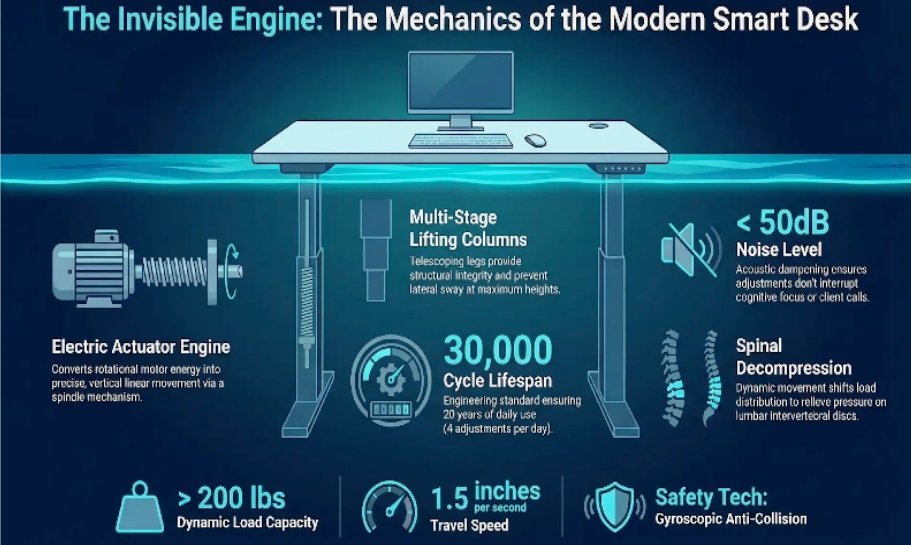
The driving force behind any automated furniture piece is the electric actuator. This component is responsible for converting the rotational motion generated by a motorized engine into precise electric linear movement.
Inside the actuator, a spindle mechanism works in tandem with precision-cut gears. As the motor turns, the gears rotate the spindle, driving a nut along its threaded shaft to create smooth, vertical motion.
This seemingly simple conversion is the foundational physics that allows heavy desk surfaces to rise and fall seamlessly. Without reliable actuators, the dynamic adjustability of modern workspaces would be physically impossible.
Why Lifting Columns Are the Backbone of Ergonomics
While actuators provide the movement, the lifting columns provide the essential structural integrity. These telescoping metal legs house the actuators and guide the electric linear movement while preventing lateral sway.
Heavy computing equipment and multiple monitors demand a foundation that will not wobble at maximum heights. This is where multi-stage column designs become structurally vital.
When evaluating the core mechanics of height-adjustable desks, quiet operation and long-term reliability are non-negotiable. According to industrial manufacturing standards, high-quality Hoodland are subjected to rigorous quality assurance—often enduring over 30,000 operational cycles and maintaining noise levels below 50dB.
This level of engineering ensures that the furniture provides seamless, stable, and distraction-free adjustments in a quiet home office environment.
Technical Specs to Look For in Motorized Furniture
For consumers and DIY enthusiasts undertaking a home decor or renovation project, evaluating a smart desk requires looking past the marketing brochures.
Focusing on the hidden technical metrics is the only way to ensure the hardware will survive years of daily use. You must assess the machinery based on industrial performance standards.
Here are the critical hardware specifications to scrutinize when building an ergonomic workstation:
- Dynamic Load Capacity: The total weight the desk can lift while in motion, which should exceed 200 lbs for professional setups.
- Travel Speed: Measured in inches per second; a rate of 1.5″/sec ensures fast transitions without jarring the equipment.
- Anti-Collision Sensors: Gyroscopic technology that detects resistance and halts movement to prevent hardware damage.
Noise Reduction and Acoustic Comfort
In a focused home office environment, acoustic management is a critical engineering challenge. High-quality motorized systems are designed with acoustic dampening materials inside the column housings.
Manufacturers must enforce strict decibel limits to prevent the desk from becoming a distraction. A premium motor operates with a low-frequency hum that blends into ambient room noise.
Maintaining noise levels below 50dB ensures that adjusting your posture does not interrupt cognitive focus, client calls, or deep-work sessions.
Cycle Lifespan and Reliability Testing
Industrial machinery is rated by its operational lifespan, and ergonomic furniture is no different. Manufacturers utilize rigorous cycle testing to simulate a decade of daily wear and tear.
Reaching the optimal ergonomic threshold requires a motor that won’t degrade after just a few years. Testing protocols often include a 2-hour continuous burn-in test to evaluate thermal resistance.
- 30,000 Cycle Standard: A desk that passes this benchmark can realistically perform four up-and-down adjustments daily for over 20 years.
- Friction Testing: Ensures the internal glides do not wear down, which would otherwise introduce wobble over time.
- Electronic Stress Tests: Verifies that the control box can handle repeated voltage spikes without failing.
Health and Productivity Benefits of Dynamic Workstations
The complex mechanics of lifting columns and actuators ultimately serve a biological purpose. We engineer these environments to combat the physiological degradation caused by static environments.
Human bodies are fundamentally designed for kinetic movement, not prolonged immobility. A dynamic workstation bridges the gap between biological needs and modern professional demands.
Integrating motorized ergonomic furniture into your daily routine does more than just improve your workflow; it actively protects your long-term physical health. Medical research consistently shows that breaking up prolonged periods of sitting can significantly reduce the risk of metabolic syndrome, improve cardiovascular health, and alleviate the chronic lower back pain frequently associated with sedentary lifestyles.
The specific biological advantages of utilizing reliable ergonomic hardware include:
- Enhanced Blood Circulation: Alternating postures prevents blood pooling in the lower extremities and engages core musculature.
- Spinal Decompression: Standing shifts the load distribution, relieving localized pressure on the lumbar intervertebral discs.
- Sustained Cognitive Engagement: Physical movement stimulates blood flow to the brain, directly combating afternoon fatigue.
Key Takeaways
| Area | Key Takeaway | Impact/Data |
| Specs | Demand >200lbs load | 1.5 in/s travel |
| Durability | Verify 30k cycles | 20+ years ROI |
| Acoustics | Keep noise <50dB | Zero distraction |
| Safety | Require gyro sensor | Prevents damage |
| Health ROI | Mandate active desk | Boosts cognition |
Conclusion
The modern home office is no longer just a room with a table; it is a highly engineered, active environment. The transition toward intelligent workstations is driven by sophisticated internal mechanics.
By understanding the industrial hardware—specifically the actuators and lifting columns—professionals can make informed, data-backed decisions.
Investing in hardware that meets strict acoustic and lifecycle standards is an investment in long-term health. Ultimately, a mechanically sound workstation is the foundation of sustainable, productive remote work.
