


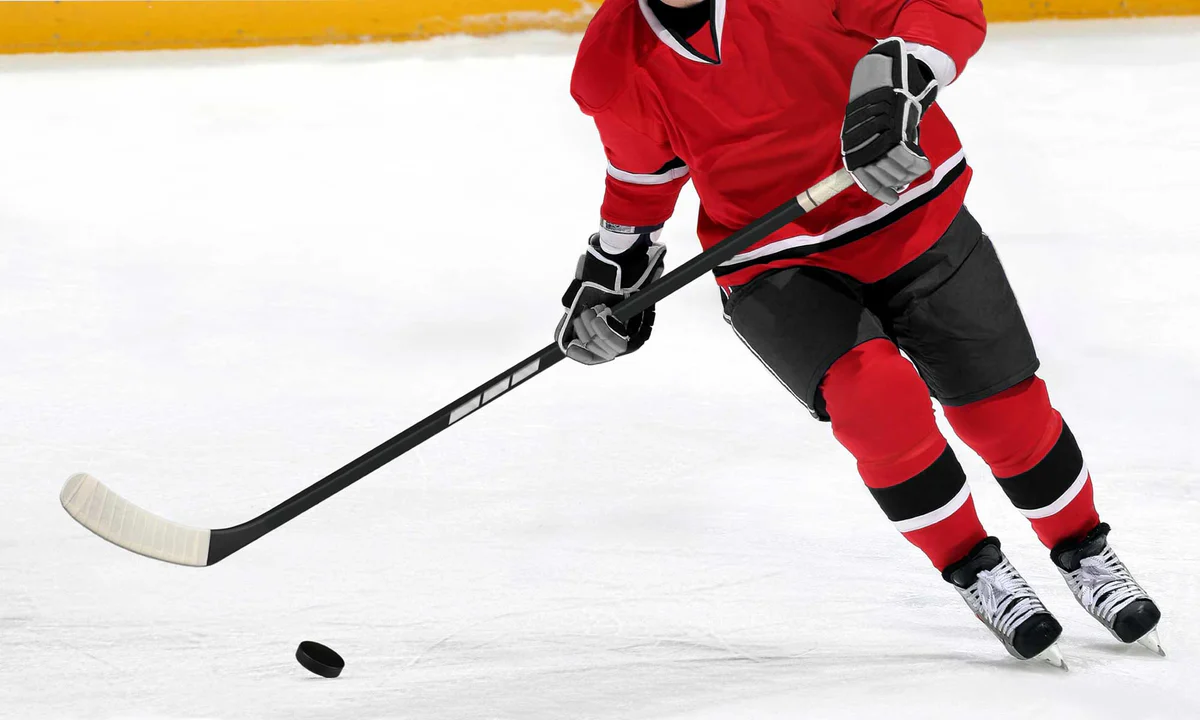
Watch any NHL warm-up, and you will see it: a player leans into a shot, and their stick bends like a recurve bow. The shaft flexes into a terrifying “C” shape before snapping back and launching the puck at 90 miles per hour. It is a visceral display of potential energy turning into kinetic energy.
This visual has driven a massive trend in the amateur hockey world. Players of all ages are dropping their flex ratings lower and lower. The logic seems sound: More bend equals more whip. More whip equals more speed.
But physics is rarely that simple. While a certain amount of flex acts as a force multiplier, there is a point of diminishing returns. For many players, that ultra-whippy stick isn’t acting like a catapult; it’s acting like a wet noodle. Instead of adding velocity to your shot, it might actually be bleeding energy away from the puck.
The Physics of the Spring
To understand why, we have to look at the stick as a spring.
When you load a stick (press it into the ice before hitting the puck), you are storing potential energy in the carbon fiber shaft.
When you release the shot, that energy is unleashed. The shaft snaps back to straight, propelling the puck forward. This is the “Trampoline Effect.”
However, a spring only works if it returns to its original shape at the exact moment the puck leaves the blade. This is called “Timing the Kick.”
If the stick is too stiff, you can’t bend it enough to store energy. You are relying entirely on your own muscle strength. The shot feels dead.
If the stick is too flexible (too “whippy”), it bends too much. It takes too long to snap back. By the time the shaft uncoils, the puck has already left the blade, or your hands have moved past the optimal release point. The stick is “lagging” behind your mechanics. You put 100% of your energy into the load, but the stick only returned 80% of it to the puck. The rest was lost as vibration and heat.
The Accuracy Penalty
The second problem with the “super-whip” trend is accuracy.
Imagine trying to aim a laser pointer attached to the end of a rubber hose. If you move your hand, the tip of the hose wobbles. It doesn’t track perfectly with your movement.
The same thing happens with a hockey stick. When a shaft flexes deeply, the blade face twists. This is called “Torque.”
As you lean into a snapshot, the toe of the blade can open up (point towards the ceiling) or close down (point towards the ice) depending on the torque forces. If the stick is too soft, the shaft cannot resist this twisting motion.
You might aim for the top corner, but because the blade twisted open by two degrees during the load phase, the puck sails three feet over the net. You didn’t miss; your equipment failed to hold its line. The softer the flex, the harder it is to keep the blade face square to the target under heavy load.
The “Loading Window” Trap
Many amateur players choose a low flex (like 65 or 70) because it feels great when they are standing still and leaning on it in the pro shop. It bends easily. It feels “loaded.”
But hockey is played in motion. In a game, you rarely have perfect footing or time to set up a shot. You are often shooting off one foot, or while reaching, or while being checked.
In these dynamic situations, you need a stick that reacts instantly. A stiffer stick (relative to your strength) offers immediate feedback. It responds to the twitch of your wrists. A whippy stick introduces a delay. You have to wait for the shaft to catch up to your hands. In that split second of delay, the goalie has moved, or the defender has lifted your stick.
The Role of Mechanics
Ultimately, the stick is an amplifier of your mechanics. If you have perfect form—if you drive your legs, pull with your top hand, and push with your bottom hand—you can utilize the flex of a stick efficiently.
But if your mechanics are flawed—if you are just “sweeping” the puck with your arms—a flexible stick can mask your bad habits. It gives you the sensation of a hard shot (because the stick feels active) without the actual velocity. You feel the kick, but the radar gun doesn’t lie.
Conclusion
Finding the perfect stick is not about chasing the lowest number on the shaft. It is about matching the stiffness of the tool to the strength and speed of the user. It is a balancing act between the ability to load the shaft (requires flex) and the ability to control the release (requires stiffness).
Before you spend $300 on the latest composite twig, ignore the marketing hype about “explosive release.” Look at your own game. If your shots are fluttering, or if you feel like the puck is “staying” on your blade too long, you might be a victim of the whip.
The only way to know for sure is to stop guessing and start measuring. Advanced hockey stick testing protocols in a lab setting can now map the exact load curve and kick point of a shaft, revealing whether that 75-flex is behaving like a weapon or a toy. Until then, remember: a stick that bends too much is just a very expensive rubber band. Sometimes, a little rigidity is the secret to a lot of power.
