


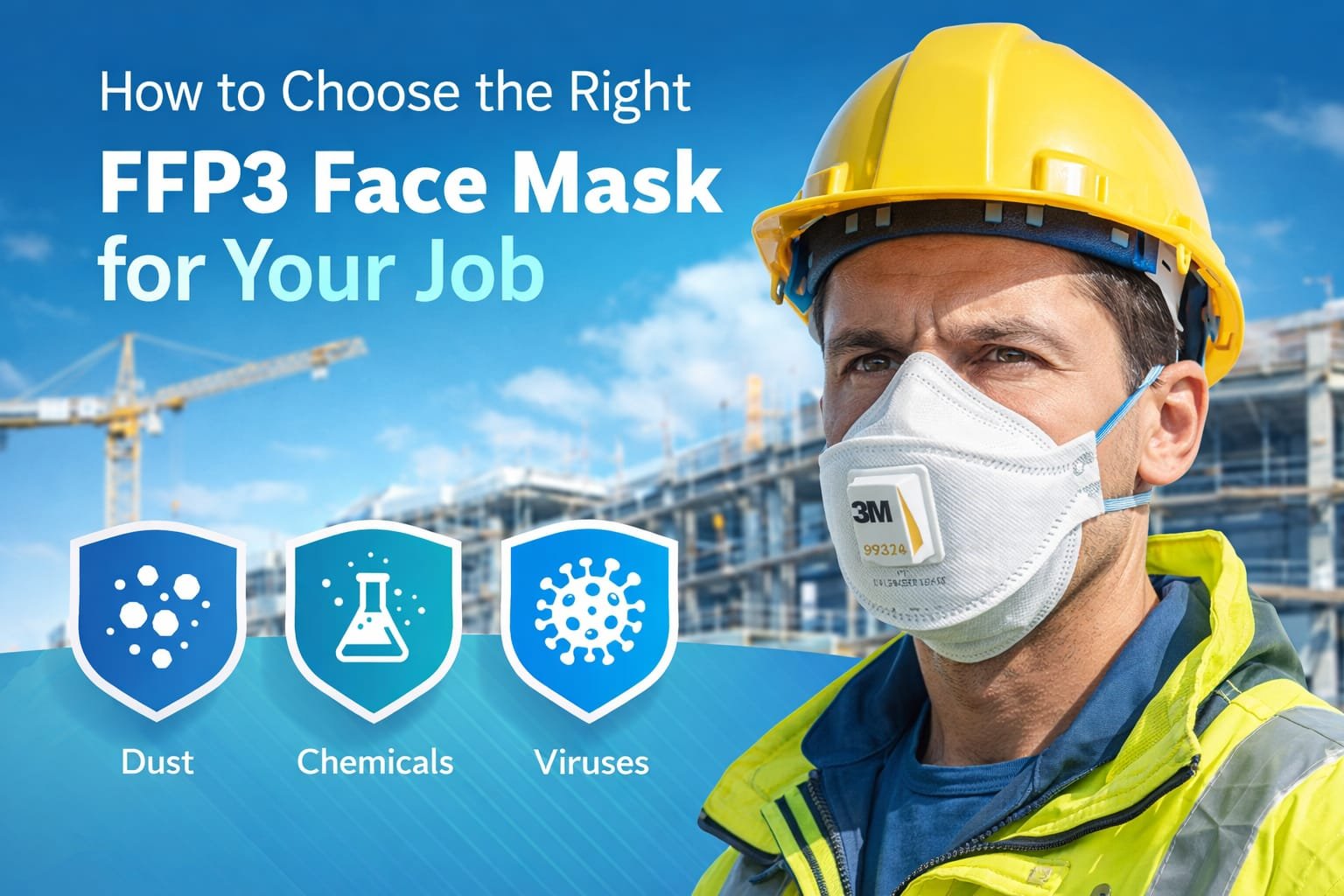
Did you know FPP3 masks have the capability of filtering out 99% of all dangerous particles in the air? Still, thousands of workers use lower-grade masks in risky situations. In the case of your job with fine dust, poisonous substances, or prolonged working hours, the inadequate selection of your mask can be life-threatening. This guide tells you what an FFP3 mask is, when you should wear one, and how to find the most suitable one to use at work.
What is an FFP3 Mask and what industries require it
FFP3 masks provide high-protection respiratory face mask that help to stay protected against fine and dangerous airborne particles. It also provides better filtration among the disposable respirators. It is capable of filtering up to 99% of airborne particles. FFP3 disposable dust masks follow EN 149 standard and have a CE mark. This indicates FFP3 masks follow safety and performance standards.
Works and Industries That Require FFP3 Masks
- Construction and demolition work
- Mining and quarrying
- Metal grinding and welding
- Pharmaceutical and chemical handling
- Healthcare and laboratory environments
- Waste management and asbestos removal
What are the Types of FFP3 Masks
| Type of FFP3 Mask | Meaning & Best For | Pros | Cons |
| Disposable FFP3 Masks | Single use masks are produced using efficient filters. It is ideal when it comes to short-term projects, occasional use, or when there is visitor safety in high-risk zones. | It requires no maintenance, is lightweight, and is easy to use. | It is not suitable for daily use, has a higher long-term cost, and limited comfort |
| Reusable FFP3 Respirators | Durable masks that have a changeable FFP3 filter. Best suited to everyday use and extended working hours in a hazardous workplace. | It is cost-effective, long term, provides a better fit, and is durable | It requires recleaning, filter replacement, and results in higher initial costs. |
| FFP3 Masks With Valve | One-way valve masks that release exhaled air. It is most appropriate in physically intensive tasks and temperatures. | It allows easier breathing, less heat buildup, and provides more comfort | It does not filter exhaled air, not suitable for healthcare workers. |
| FFP3 Masks Without Valve | It filters both inhaled and exhaled air. It is best for healthcare, labs, and clean environments. | It protects the wearer and meets strict safety rules | A little more difficult to breathe and becomes hot when used in the long run. |
| Cup-Shaped FFP3 Masks | Rigid, pre-formed shape that holds structure. Best for workers needing a stable fit and space around the face. | Maintains shape, good seal,and easy to wear | Bulky, less portable |
| Foldable (Flat) FFP3 Masks | Flat-fold design for easy storage. It is best for workers who need frequent mask changes. | It is lightweight and easy to carry | Less rigid, fit may vary |
| FFP3 Half-Face Respirators with Cartridges | Reusable respirators using certified FFP3 cartridges. Half face masks are best for industrial and extreme-risk environments. | Very high protection, long service life | Bulky, needs training and maintenance, higher cost |
Key Factors to Consider When Choosing an FFP3 Mask
- FFP3 dust mask exists in both reusable and disposable maskstypes to apply to various work requirements. Single use FFP3 masks can be used in quick and easy jobs.
- The right FFP3 mask cannot only be a matter of rules of safety but also appropriate fit, comfort, and suitable protection at work.
- FFP3 respirators are stronger, have replaceable filters, and can be used on a daily basis or in prolonged working hours.
- FFP3 disposable dust masks may have an exhalation valve based on the comfort requirements.
- APRN non-valve FFP3 masks are important in clean environments and healthcare settings because they can filter both inspired and expired air.
- The nose, mouth, and chin should be fitted in a proper fit and a tight seal in order to avoid entry of unfiltered air.
- Nose clips can be adjusted to make it accurate, and head straps are effective than ear loops.
- The right size of the mask enhances comfort and safety.
- The mask with a high level of filtration must enable easy breathing, like an FFP3 mask.
- The workers must be made to feel comfortable so that they put on the mask the entire time the task is being done.
- Designs made with light and soft inner layers minimize skin irritation when used over a long period.
- The FFP3 disposable mask should comply with the FFP3 standard of EN 149 with a CE mark. Protection of certified masks is tested, and uncertified masks may be dangerous to health.
- The FFP3 dust mask is made to fit well with other PPE like safety goggles, helmets, and auditory safeguards. The wrong construction of masks may contradict other protective devices and diminish the protective measures.
- The level of dust, toxic substances, heat, humidity, and exposure time are work environment factors that should be put into consideration.
- There may be a need to use a more comfortable FFP3 respirator or a reusable FFP3 respirator in high-risk or prolonged work.
How FFP3 Masks Are Different from Other Respirators
| Feature | FFP3 Masks | FFP2 Masks | FFP1 Masks | Half / Full Face Respirators |
| Filtration Level | Up to 99% | Up to 94% | Up to 80% | Very high (with correct filters) |
| Protection Level | Very high | Medium to high | Low | Very high |
| Best For | Toxic dust, asbestos, silica, fine particles | Construction dust, welding fumes | Nuisance dust | Chemical, industrial, extreme exposure |
| Comfort & Ease | Easy to use | Easy to use | Very easy | Requires training |
| Reusable Option | Limited | Limited | Limited | Fully reusable |
| Maintenance Required | Minimal | Minimal | Minimal | High |
| Certification | EN 149 (FFP3) | EN 149 (FFP2) | EN 149 (FFP1) | EN 136 / EN 140 |
Conclusion
FFP3 face mask offers the greatest safety against airborne hazardous particles and are thus needed in high-risk settings. The type of mask to select, its proper fit, and proper usage are the main aspects of being safe at work. Workers and employers can minimize health risks and ensure safer working conditions by learning about the use of an FFP3 mask, when and how to wear it.
FAQs
How do I know right FFP3 mask?
The FFP3 mask fits well around the nose, mouth, and chin. The mask is to remain in position as you move or speak, and you must not experience the air leaking out of the mask as you breathe. Nose clips are adjustable, and the head straps are secure so as to get a good fit.
When should I choose an FFP3 mask instead of an FFP2 mask?
FFP3 mask is used in high-risk areas. These contain small or poisonous particles such as asbestos, silica dust, metal fumes, or dangerous biological particles. FFP3 masks come with better filters than FFP2 masks. It can be used at high or elevated levels of exposure.
Is it possible to use an FFP3 face mask with facial hair?
An FFP3 mask can not be properly sealed around the skin due to facial hair. Hairs or stubble can also decrease the efficiency of the mask. To adequately protect, the face must be shaved at the point where the mask is to be sealed, or an appropriate alternative respirator must be used.
What is the duration of use of an FFP3 face mask?
FFP3 disposable masks are normally used in one task or shift and are to be changed in case they are torn, wet, or hard to breathe. Reusable FFP3 masks have a longer lifespan but have to be cleaned frequently, and the filters have to be replaced frequently, as it is recommended by the manufacturer.
How do I know if an FFP3 mask fits correctly?
An FFP3 mask fits well when it forms a tight seal around the nose, mouth, and chin without any air leakage. The mask ought to be firmly placed over your face, the nose clip must be put so as to fit into position, and the straps must ensure the mask will not slide out. Inhaling the mask might pull slightly in, and you are not supposed to feel the escaping air around the edges. The mask must be well-fitted to ensure total protection.
