


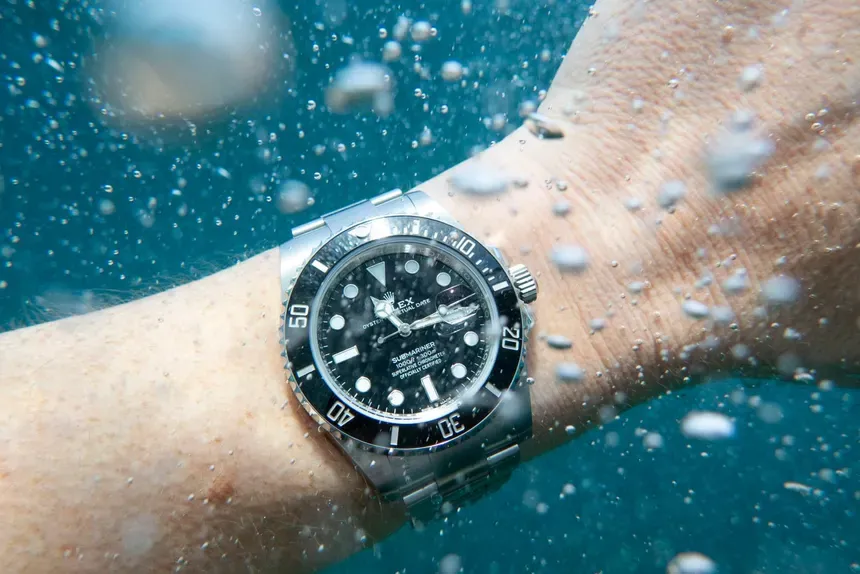
Why This Question Keeps Coming Up
It’s a fair question. Rolex built its reputation on waterproof watches — the Oyster case was a genuine breakthrough in 1926, and the Submariner became the dive watch benchmark. So when someone looks at a super clone that copies the case, the crown, the bezel, everything down to the engravings, they naturally assume it might copy the water resistance too.
It doesn’t.
Not really. Not the way a genuine Rolex does. And pretending otherwise is how people end up with moisture under the crystal and a dead movement. This isn’t about gatekeeping — it’s about physics and quality control.
What Real Water Resistance Actually Requires
Water resistance isn’t a single feature. It’s a system.
A genuine Rolex has multiple gaskets — caseback gasket, crown gaskets, crystal gasket — each made to exact specifications and replaced during every service. The crown screws down against a tube that’s machined to tight tolerances. The crystal is pressed in with a specific amount of pressure.
Then there’s the testing. Rolex pressure-tests every single watch before it leaves the factory. They use three different machines: a dry test, a wet test, and a condensation test. Submariners get tested to 300 meters. Sea-Dwellers to 1,220 meters (and the Deepsea goes further). That’s not marketing — it’s certification.
A super clone doesn’t go through any of that.
The gaskets are aftermarket or generic. The crown tube might not be machined to the same standard. The crystal might be sapphire, but the fitment varies from batch to batch. And crucially, no one is pressure-testing each watch before it ships.
What Most Super Clone Builds Can Realistically Handle
Here’s the honest answer: most super clones are fine for handwashing, light rain, and accidental splashes. The crown screws down on good builds — VSF and Clean Factory (before the July 2025 raid) both used proper screw-down crowns with functional gaskets. Some dealers claim 30-50 meters of water resistance. A few even claim 100 meters.
But “claim” is doing a lot of work there.
A watch that’s water-resistant to 50 meters on paper isn’t necessarily safe to swim with. The rating assumes ideal conditions — perfect gasket seating, no temperature changes, no crown movement underwater. In practice, even genuine watches with 50m ratings aren’t recommended for swimming. Rolex itself says 100m is the minimum for swimming.
So a super clone with a claimed 50m rating? That’s a watch you keep dry.
The Difference Between “Fine in the Shower” and “Fine Underwater”
This is where people get into trouble.
Wearing a super clone in the shower seems low-risk. Warm water, mild pressure from the showerhead, you’re not going deep. But soap breaks down gasket lubricant over time. Temperature changes make the case expand and contract differently than the crystal. Steam is smaller than water molecules — it can get past seals that liquid water can’t.
The shower doesn’t instantly kill a watch. It kills it slowly.
Pool water is worse. Chlorine degrades rubber gaskets faster than fresh water. Salt water is even worse — if it gets in, it corrodes the movement from the inside. And pressure changes from diving (even shallow dives) stress the case in ways that a static pressure test doesn’t simulate.
The genuine Rolex is built for all of that. The super clone is built to look like it is.
A Practical Rule of Thumb
Here’s a simple way to think about it: treat a super clone like a vintage watch with unknown service history. You don’t take a 1960s Submariner swimming unless it’s been recently pressure-tested and had its gaskets replaced. Same logic applies here.
If you absolutely must get a super clone wet, have it pressure-tested by a watchmaker first. They’ll put it in a dry pressure chamber, pressurize it, and check if the case holds. It costs maybe $50-100 and it’s the only way to know for sure. Without that test, you’re gambling.
And honestly? Most people buying super clones aren’t taking them diving. They’re wearing them to the office, to dinner, out with friends. The water resistance question matters more as a tell than as a practical concern — if a seller claims “100m waterproof” without mentioning gaskets or testing, that’s a red flag. That’s someone who doesn’t know what they’re talking about, or worse, someone who does and is lying anyway.
A super clone Rolex can handle a splash. It can handle rain. It might even handle a quick rinse under the tap if the crown is fully screwed down. But swimming? Diving? Showering every day? That’s where the gap between “looks like a Rolex” and “is a Rolex” shows up. And water finds that gap every single time.
Super Clone Rolex: Where to Actually Start Looking
The Problem with “Where to Buy”
Ask “where to buy a super clone Rolex” in any watch forum and you’ll get three kinds of responses. Dead links. Scam warnings. And cryptic references to private dealers that you need to “do your own research” to find.
It’s not gatekeeping for the sake of it. The replica market operates in a legal gray area — sellers get shut down, payment processors drop them, and forums scrub direct references to stay online. So the information is fragmented, unreliable, and often outdated.
This guide doesn’t name specific stores. It gives you the framework to vet any source you find, so you can separate a legitimate super clone dealer from someone who’ll take your money and send you a $50 shitter.
Factory Sourcing Matters More Than the Seller
Here’s the first thing to understand: almost no one selling super clones makes them. They’re dealers, not factories. The factories are the real players — Clean Factory (until it was raided in July 2025), VSF, ZF, AR, Noob (mostly dead but still referenced). VSF is currently the top-tier default for most Rolex references.
A good dealer sources from these factories. A bad dealer slaps “super clone” on anything and hopes you don’t know the difference.
So when you’re evaluating a source, the first question isn’t “is this site legit?” It’s “what factory do they carry?” If they can’t or won’t tell you the factory, walk away. If they claim “1:1” without naming a factory, they’re selling you a story, not a watch.
The factory determines the movement, the steel, the crystal, the bezel. VSF uses clone movements like the VS3235 (72-hour power reserve, 28,800bph, decorated to look like the genuine 3235). They use 904L steel, which is the same grade Rolex uses. They use sapphire crystal with AR coating, ceramic bezels, solid end links. These are the specs that separate a super clone from a cheap replica.
But even VSF has variation. Different batches have different QC. Different references get different treatment. The Submariner is generally excellent. The GMT has known issues with the bezel action. The Daytona is a whole different conversation.
QC Photos Are Non-Negotiable
This is the single biggest red flag in the market: a dealer who won’t provide QC photos.
QC (quality control) photos are pictures of the actual watch you’re buying, taken before it ships. They show the dial alignment, the bezel, the rehaut engraving, the date wheel, the SEL gaps. A good dealer sends these automatically. A bad dealer sends stock photos or no photos at all.
Here’s what to look for in QC photos:
Dial alignment. The 12 o’clock marker should line up with the Rolex crown on the dial and the coronet on the rehaut. The date should be centered in the window. The cyclops should magnify properly (genuine Rolex is 2.5x, super clones vary).
Rehaut engraving. Rolex started laser-etching the rehaut (the inner bezel ring) in the early 2000s. Super clones attempt to copy it, but the depth and sharpness are often off. In QC photos, look for uneven spacing or shallow engraving.
SEL gaps. Solid End Links should sit flush against the lugs with minimal gap. If you can see light through the gap, that’s a tell.
Movement shot. If the watch has a display caseback (some references do, some don’t), ask for a photo of the movement. A genuine clone movement like the VS3235 has specific finishing and engraving that cheaper clones lack.
Timegrapher reading. A good dealer will include a timegrapher photo showing the watch’s accuracy, amplitude, and beat error. You want something in the +/- 5-10 seconds per day range with amplitude above 250.
If a dealer won’t provide these, don’t buy. It’s that simple.
Movement Transparency Separates Professionals from Scammers
Here’s something most beginners miss: the movement matters more than the case.
A super clone case can look perfect. The dial can be indistinguishable from arm’s length. But the movement is where the corners get cut.
The best super clones use clone movements — VS3235, VS3135, DD4130, etc. These are direct copies of the genuine Rolex calibers, with the same beat rate (28,800bph), similar power reserves, and decorated rotors and bridges that mimic the genuine finishing.
But they’re not the same as genuine movements. The materials are different. The tolerances are looser. The lubrication is inconsistent. Over time, they’re more prone to issues — amplitude drop, power reserve loss, broken mainsprings.
The cheaper option is a decorated ETA clone — a 2824 or 2836 movement with a Rolex-style rotor glued on top. These are reliable in their own right (the 2824 is a proven workhorse), but they don’t sweep the same way, they don’t have the same power reserve, and they’re a dead giveaway to anyone who opens the caseback.
A good dealer tells you which movement is in the watch. A bad dealer says “automatic” and leaves it at that. If you’re buying a super clone, you should know exactly which movement you’re getting and what its reputation is.
The Community Vetting Process
The best way to find a reliable source isn’t through Google — it’s through forums.
Reddit’s r/RepTime and the RWI (Replica rolex Watch Info) forums are where the community does its vetting. Dealers get reviewed. QC photos get analyzed. Scammers get called out. The information is messy and sometimes contradictory, but it’s the only real source of truth in this market.
The process looks like this:
- Find a dealer who’s been consistently reviewed over at least six months.
- Check recent reviews — factories change, batches change, and a dealer who was good last year might not be good now.
- Ask for QC photos and post them in the forum for a second opinion if you’re unsure.
- Pay with a method that offers some protection (though even that’s limited in this space).
This isn’t a perfect system. Forums get shut down. Dealers get exposed as scammers after months of positive reviews. But it’s the system that exists, and it’s the only one that works.
A Final Word on Expectations
Super clone Rolex watches are impressive pieces of manufacturing. The best ones use 904L steel, sapphire crystal, ceramic bezels, and decorated clone movements that run at 28,800bph. They look right, they feel right, and from arm’s length, they fool most people.
But they’re not genuine Rolexes. They don’t have the same resale value, the same warranty, the same service network, or the same long-term durability. A super clone is a gamble — some run for years without issue, others fail within months. The difference is often luck, not quality control.
The key is knowing what you’re buying, who you’re buying it from, and what you’re actually getting for your money. That starts with factory knowledge, continues with QC photos, and ends with realistic expectations.
If a source won’t give you those, they’re not worth your time. There are good dealers out there — you just have to know how to find them.
