


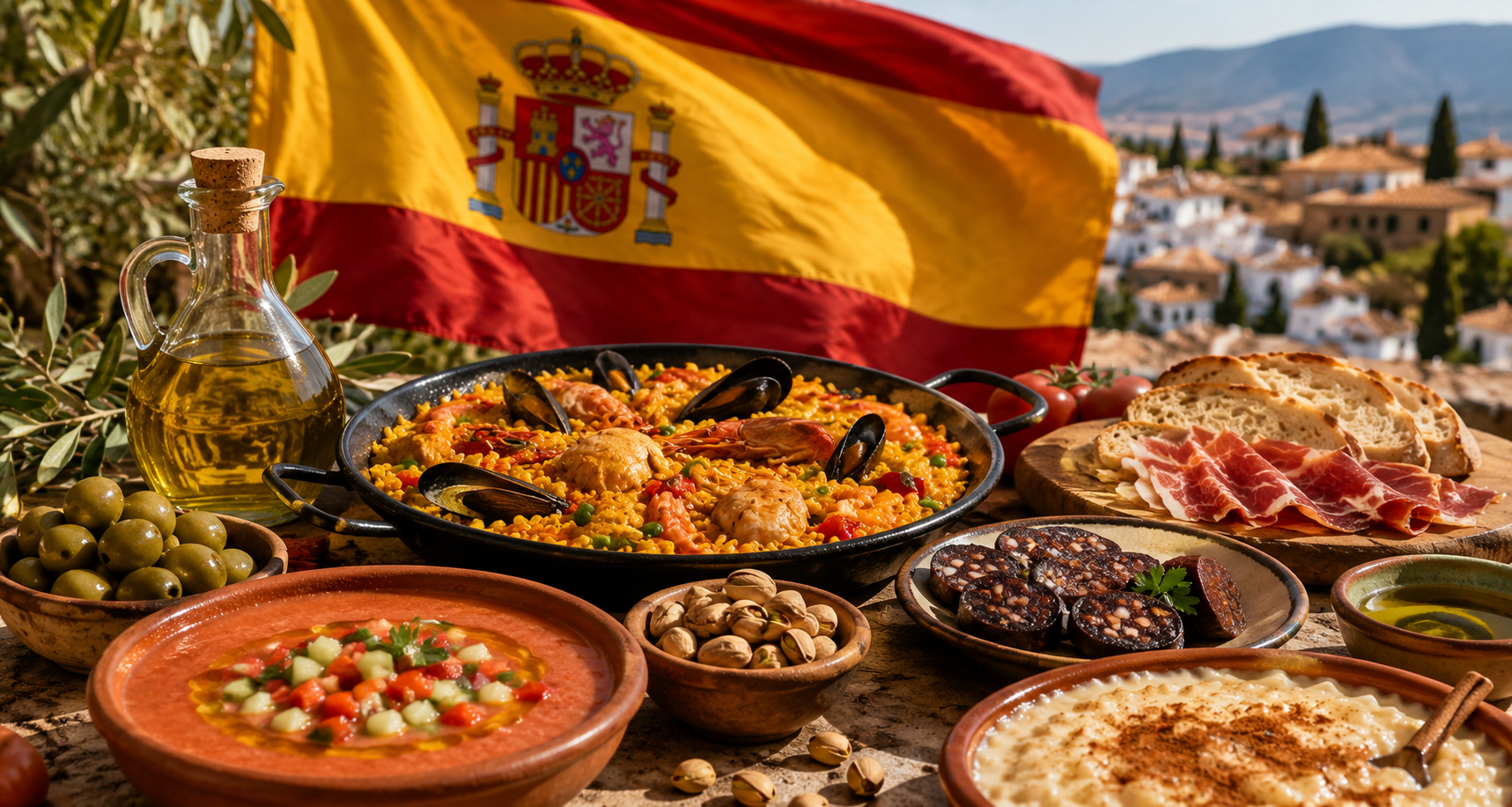
The appetite for genuine Spanish food in Britain has never been stronger. But finding the real thing outside of Spain is a different matter entirely.
There is a particular moment that many British travellers recognise. You are sitting at a terrace bar somewhere in Andalusia or the Basque Country, eating jamón that has been sliced to order, drinking a glass of something cold, and you think: I need to be able to get this at home. You come back to the UK, you try the supermarket version, and something is lost in translation. The flavour is close but not quite right. The texture is different. The whole experience is a pale echo of the original.
That gap — between the Spanish food people encounter on holiday or while living in Spain, and what is available in British shops — is what has quietly driven one of the more interesting shifts in UK food culture over the past decade.
How Spanish Food Found Its Place in British Kitchens
Spanish gastronomy occupies a particular place in the British food imagination. Unlike French cuisine, which can feel formal and technically demanding, or Italian food, which has been so thoroughly absorbed into British cooking that it barely registers as foreign anymore, Spanish food retains a quality of occasion. It is associated with warm evenings, good company, unhurried eating. Tapas culture translated well to British social habits — the sharing, the grazing, the excuse to order more things rather than commit to one.
The numbers reflect this. Spanish restaurants have expanded significantly in British cities over the past fifteen years. Ingredients that were specialist purchases a decade ago — pimentón, Manchego, chorizo, padrón peppers — now appear in mainstream supermarkets. Spanish wine, once overlooked in favour of French and Italian bottles, has built a serious following. Sherry, long dismissed as something your grandmother drank, has undergone a complete critical rehabilitation.
For Spanish expatriates living in the UK — a community that has grown considerably, particularly in London and other major cities — the demand is different but just as strong. It is not about novelty or aspiration. It is about continuity: the olive oil that tastes like home, the particular brand of tinned fish that has been on the family table since childhood, the turron at Christmas that no British substitute can replace.
The Supermarket Problem
The growth of Spanish food in UK supermarkets is, in one sense, a success story. It means exposure, availability, accessibility. But it comes with a significant caveat: what is sold under Spanish labels in British supermarkets is often not quite the thing it claims to be.
Some of this is a matter of production. Items manufactured for the mass export market are frequently made to different specifications than those produced for domestic consumption in Spain — adjusted for shelf life, cost, or perceived British taste preferences. A chorizo sliced in a UK factory from pork sourced outside Spain is technically chorizo, but it is not the same product as one made in Salamanca or León according to traditional methods.
Some of it is a matter of category confusion. The word Manchego, for instance, refers to a protected designation of origin cheese made exclusively from Manchega sheep’s milk in the La Mancha region. But supermarket shelves regularly carry products labelled in ways that suggest Manchego without being the genuine article. The same applies to jamón — the spectrum from cheap sliced ham to genuine Ibérico de bellota is enormous, and the labelling does not always make it clear where on that spectrum a given product sits.
For consumers who know Spanish food well — who have spent time in Spain, or who grew up eating it — these substitutions are immediately apparent. The taste is different. The aroma is different. The experience of eating is different. It is not snobbery to notice this. It is just accuracy.
What Authentic Actually Means
The word authentic gets used loosely in food writing, to the point where it risks losing meaning. In the context of Spanish food, it has a fairly specific set of implications.
It means products made in Spain, by producers who have been making them for generations, using methods and ingredients that are tied to particular regions. Olive oil from Jaén, where the density of olive groves is unlike anywhere else in the world. Pimentón de la Vera, smoked over oak in the valleys of Extremadura in a process that gives it a flavour no other paprika can replicate. Anchovies from Cantabria, preserved in salt and olive oil using techniques that date back centuries. Cava from the Penedès, made by the traditional method from local grape varieties.
These are products with geography built into them. They taste the way they taste because of where they are made and how — the soil, the climate, the breed of animal, the specific microculture of a cave or a curing room. That specificity is what gets lost when production moves or methods change.
It also means traceability. Knowing that the jamón you are buying comes from a specific farm, that the pigs were raised in a particular way, that the curing time meets the standards required for the designation on the label. This kind of transparency is standard among serious Spanish producers. It is less common among products manufactured primarily for volume export.
The Case for Specialist Retailers
The alternative to supermarket Spanish food — and the reason an increasing number of consumers are looking for it — is sourcing from specialists who import directly from Spanish producers and maintain genuine relationships with the people making the food.
This model has existed for a long time in the UK, but it has become significantly more accessible in recent years. Online ordering and reliable temperature-controlled delivery have made it possible to receive products that would previously have required a trip to a specialist delicatessen in a major city, or a suitcase with extra space on the way back from Spain.
Specialist retailers bring a different kind of curation to the process. Rather than stocking whatever sells at volume, they tend to select based on provenance and quality — which means the range is often smaller but considerably more considered. A good specialist will know the producer behind every product on their list, will be able to tell you which harvest the olive oil comes from, and will stock the genuine Denominación de Origen version of a product rather than an approximation.
For British consumers, this represents a meaningful upgrade in what is available without leaving the country. For Spanish expatriates, it represents something closer to home. Services offering Spanish food delivered across Europe have made it possible for people across the continent to access the kind of quality that was previously only available if you lived near the right shops or happened to be flying through Madrid.
The Products Worth Seeking Out
Not everything needs to come from a specialist. Plenty of Spanish ingredients have been successfully mainstreamed — tinned tomatoes, basic olive oils, everyday wines — and the supermarket versions are perfectly adequate for their purpose.
But there are categories where the difference between the mass-market product and the genuine article is significant enough to matter, and where the extra effort of sourcing well pays off clearly in the eating.
Cured meats are the obvious starting point. The range from basic chorizo to Jamón Ibérico de bellota is not merely one of price — it is a difference in kind. Genuine Ibérico products, from pigs raised on acorns in the dehesa woodlands of Extremadura and Andalusia, have a flavour profile — nutty, complex, with a particular quality of fat — that has no equivalent elsewhere. Buying well here is worth it.
Tinned and preserved fish represent one of the most underrated categories of Spanish food. Galicia in particular has a tradition of seafood preservation — octopus, mussels, clams, razor clams, sardines — that treats the tin not as a compromise but as a culinary choice. The best producers use top-quality raw ingredients and olive oil, and the results are extraordinary by any standard.
Cheese is another area where provenance matters considerably. Beyond Manchego, Spain has a remarkable range of regional cheeses — Idiazábal from the Basque Country, Tetilla from Galicia, Cabrales from Asturias — that rarely make it into mainstream UK retail but are worth seeking out.
And then there are the pantry staples that quietly transform everyday cooking: a genuine pimentón de la Vera rather than a generic smoked paprika, a first cold-press olive oil from a small Andalusian producer rather than a commodity blend, a saffron from La Mancha rather than an anonymous product of uncertain origin.
Is It Worth It?
The question in the headline deserves a direct answer.
For occasional cooking, for weeknight meals where convenience matters more than precision — probably not. The supermarket will do.
But for anyone who has eaten well in Spain and wants to recreate something of that at home, or for Spanish expatriates who want their kitchen to feel familiar, or for food enthusiasts who take pleasure in knowing exactly where something comes from and how it was made — yes, genuinely, it is worth it. The difference in quality between a carefully sourced Spanish product and its mass-market equivalent is not marginal. It is substantial. And in many categories, the price premium is smaller than you might expect.
The UK’s access to authentic Spanish food has improved considerably in recent years. The infrastructure is there. The producers are there. It is largely a matter of knowing where to look.
