


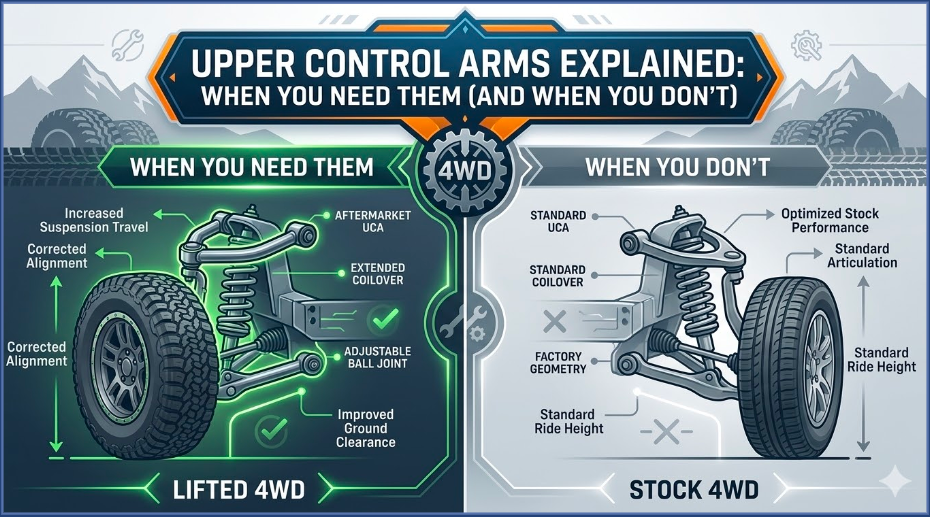
“Do I need upper control arms?” is one of those suspension questions that usually shows up right after a lift goes in and the steering starts feeling a bit off, the alignment shop starts muttering about caster, or the front tyres begin wearing in a way that makes your wallet twitch.
The short answer is simple. Sometimes yes, sometimes no. Upper control arms are not an automatic add-on for every IFS 4WD, but once lift height, alignment range, and tyre clearance start pushing beyond what the factory arm can comfortably handle, they go from “nice extra” to “stop messing around and fit them.”
A specialist off-road accessories supplier frames them exactly that way, describing them as parts that help maintain proper suspension geometry after lifting, prevent uneven tyre wear, and improve articulation.
What Upper Control Arms Actually Do
Factory upper control arms are built around stock ride height and stock alignment targets. Once the front suspension is lifted, the arm angle changes, the ball joint angle changes, and the available alignment adjustment can start shrinking. That is where aftermarket UCAs earn their keep.
In practical terms, they are there to help with:
- Caster correction
- Camber adjustment range
- Ball joint positioning on lifted vehicles
- Tyre clearance at the rear of the guard
- Better travel and articulation on some setups
That is not marketing fluff. Pro-Forge arms are designed to give adequate adjustment after a lift so the vehicle can achieve proper camber and caster settings up to a 3-inch lift. It also notes that keeping caster available helps the tyres sit correctly for improved guard clearance.
Other UCA describe indexed or improved ball joint positioning for levelled and lifted applications and increased wheel travel over stock arms.
The Simple Rule of Thumb Most People Actually Need
Here is the no-drama version.
You probably do not need upper control arms if:
- The vehicle is at stock height
- The lift is mild and the alignment comes back into spec cleanly
- Steering feel is normal
- Tyre wear is even
- There is no guard rubbing caused by poor caster position
You probably do need upper control arms if:
- The front is lifted more than about 50 mm
- The alignment shop cannot get enough positive caster back in
- The steering feels light, vague, or doesn’t self-centre properly
- The front tyres sit too far back in the wheel arch
- You are getting tyre wear that points to geometry issues
- The ball joint angle is clearly working at the wrong end of its range
That rule lines up with the suspension kit. One 3-inch lift kit says upper control arms are a must-have when lifting above 50 mm to help keep caster in line with OEM specs and reduce tyre wear. Other lift kits make the same point a little differently, noting that once you are chasing 3 inches or more, Pro-Forge upper control arms are required.
Why Caster Matters More Than Most People Think
People hear caster correction and zone out because it sounds like alignment-shop jargon. But caster is what helps the steering track properly and return to centre after a turn. If caster falls away after a lift, the vehicle can start feeling nervous or wander more than it used to, especially on country roads or with bigger tyres.
There is another side effect too. With poor alignment after lift, the tyre often sits farther back in the wheel arch than it should. That is when the back edge of the front guard liner starts getting chewed, especially during turns or compression.
Signs Your Factory Arms Are No Longer Happy
This is usually where the answer becomes obvious.
Watch for these signs after a lift:
- The alignment shop says it is “close enough” but not ideal
- Steering feels twitchy or vague on the highway
- The wheel does not self-centre properly after a corner
- The tyres scrub the rear of the guard with larger rubber
- You are seeing uneven front tyre wear
- The front end feels like it lost some composure after the lift
That is the real-world version of suspension geometry trouble. It is not always dramatic. Sometimes it just feels a bit ordinary. But ordinary gets expensive when tyres wear badly or the vehicle stops feeling settled at speed.
A trusted Australian 4WD accessories supplier describes upper control arms as parts that maintain geometry and help avoid uneven tyre wear after lifting, which is exactly why these symptoms matter.
When You Can Leave Them Alone
Not every touring build or daily driver needs aftermarket UCAs. That is worth saying clearly, because suspension parts get oversold all the time.
If your IFS vehicle has:
- Stock-height suspension
- A light front-end lift
- Clean alignment numbers
- No rubbing issues
- No odd steering behaviour
then factory arms may be perfectly fine.
There are even UCA listings on the site that note compatibility with stock-height vehicles and levelling kits, which is another reminder that upper control arms are not only for huge lifts.
They are a tool for when alignment range, ball joint angle, or travel requirements justify them. Not every vehicle reaches that point.
When They Make Solid Sense
Now the other side of it.
Upper control arms make much more sense when the vehicle has:
- A proper front lift
- Added front-end weight from a bar, winch, or accessories
- Larger tyres that need better clearance
- Touring use where stable highway manners matter
- A setup that is being pushed toward the upper end of factory alignment tolerance
That is where related parts start linking together. A suspension setup with 2 inch lift kits, 3 inch lift kits, shocks and struts, and upper control arms only works properly when the geometry side is handled as seriously as the spring and shock side. The suspension and lift-kit listings make that link pretty clear by treating UCAs as part of the geometry solution after lifting, not just another shiny extra.
UCAs Do Not Fix a Bad Suspension Plan
This is a trap worth avoiding.
A set of upper control arms will not magically fix:
- The wrong spring rate
- A poor wheel alignment done in a rush
- Cheap tyres rubbing because offset got silly
- Worn suspension bushes
- A lift height that was chosen on ego rather than use case
They are one part of the answer, not the whole answer. If the front suspension has been lifted, the shocks are tired, and the rest of the setup is half guessed, UCAs can help the geometry but they cannot rescue the entire build by themselves.
That is why related pieces like spare parts and components matter too when the front end has a few keys and a few bad decisions behind it.
A Practical Buying Check Before You Spend Money
Before ordering anything, ask these questions:
- How much lift is actually in the front
- Can the current setup achieve proper alignment after lift
- Is caster low or hard to recover
- Are the tyres sitting too far back in the arch
- Is there rubbing that points to geometry, not just tyre size
- Does the steering still feel planted and predictable
If most of those answers point the wrong way, the question “do I need upper control arms” is usually already answered.
Build the Front End Properly the First Time
Upper control arms are not compulsory for every lifted 4WD, and they are not snake oil either. They matter when lift height starts stealing alignment range, when caster correction becomes necessary, and when the front end stops feeling like it should. Leave them out on the wrong setup and you can end up chasing steering feel, tyre wear, and clearance problems that should have been sorted from day one.
That is where a trusted Australian 4WD accessories supplier becomes useful in a very unglamorous way. Not by throwing extra parts at the cart, but by helping match upper control arms, lift kits, and the rest of the suspension setup to the actual height and use of the vehicle so the front end drives properly, aligns properly, and stays out of its own way.
