


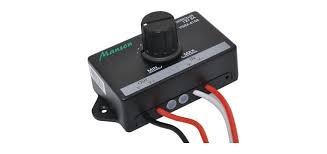
Twelve-volt power systems are widely used because they strike a balance between safety, availability, and functional capability. Motors, fans, pumps, heaters, lighting circuits, and experimental electronics often rely on 12V supply rails paired with relatively high current. While voltage remains modest, the way power is controlled has a significant effect on reliability, efficiency, and component lifespan.
Many overheating issues, unstable loads, and premature failures in low-voltage systems can be traced back to inappropriate power control choices rather than faulty components. Selecting the right PWM controller is therefore not a matter of convenience, but of aligning control behavior with how motors and loads actually behave under real operating conditions.
This guide focuses on how to think through the selection of a 12V, 8-amp PWM controller for practical use, emphasizing thermal stability, control behavior, and long-term reliability rather than headline specifications.
What a PWM controller does in a low-voltage system
A PWM controller regulates power delivery by rapidly switching the supply on and off, controlling the average power delivered to a load through duty cycle adjustment. Instead of reducing voltage directly, PWM varies how long power is applied within each cycle.
A 12v 8amp Pwm Controller guide becomes relevant when loads require proportional control rather than binary on–off behavior. Motors rarely need full power continuously, heaters benefit from gradual regulation, and electronic loads often respond poorly to abrupt transitions. PWM allows power to be matched more closely to actual demand.
Why PWM is preferred over simple switching
PWM control avoids several common failure modes.
- Reduces repeated inrush current events
- Limits thermal shock in components
- Improves efficiency under partial load
These advantages matter more as systems run longer and operate closer to their design limits.
Understanding current requirements beyond nominal ratings
Selecting an 8-amp controller does not mean the system will never exceed 8 amps. Motors and inductive loads draw significantly higher current during startup, stall conditions, or sudden load changes. A controller must tolerate these transient conditions without overheating or entering unstable behavior.
Why average current is not enough
Designs often fail when only steady-state current is considered.
- Motors draw high startup current
- Loads vary under mechanical resistance
- Transients stress switching devices
A suitable controller manages these variations without accumulating excessive heat.
Matching PWM behavior to motor characteristics
Motors respond to PWM differently depending on type. Brushed DC motors, for example, are generally tolerant of PWM but generate electrical noise and torque ripple if control is poorly matched. PWM frequency and switching behavior influence smoothness, heating, and audible noise.
Practical motor-related considerations
- Low PWM frequency increases torque ripple
- High frequency increases switching losses
- Inadequate filtering affects motor life
Controller selection must consider how power modulation interacts with motor physics.
Thermal behavior as a primary selection factor
Heat is the dominant limiting factor in most low-voltage power controllers. Switching devices dissipate heat during every transition, and conduction losses scale with current. Even efficient designs accumulate heat over extended operation.
Controllers rated for 8 amps must be evaluated on how they manage heat, not just whether they meet electrical limits.
Indicators of robust thermal design
- Adequate heat sinking or thermal paths
- Conservative component spacing
- Stable operation under sustained load
Thermal margins determine whether a controller ages predictably or fails unexpectedly.
Duty cycle stability and control resolution
PWM controllers vary in how smoothly they adjust duty cycle. Poor resolution leads to abrupt changes in output behavior, causing mechanical stress in motors or oscillation in thermal loads.
Stable duty cycle control is essential for predictable operation.
Why resolution matters in practice
- Smooth motor speed changes reduce wear
- Controlled heating avoids overshoot
- Loads respond more consistently
Controllers that offer coarse control introduce instability rather than solving it.
Load type and inductive effects
Inductive loads such as motors and solenoids store energy when energized and release it when switched off. This behavior generates voltage spikes that must be handled safely by the controller.
A controller suitable for inductive loads includes appropriate suppression paths and switching components designed for inductive stress.
Risks of ignoring inductive behavior
- Switching device breakdown
- Increased electromagnetic noise
- Accelerated component aging
Controller selection must reflect the electrical nature of the load, not just its current draw.
Power loss distribution and efficiency
PWM control improves efficiency compared to linear regulation, but losses still exist. These losses are concentrated in specific components, especially switching transistors and drivers. Efficient designs distribute losses rather than allowing them to concentrate in a single point.
Why efficiency numbers can mislead
High efficiency does not guarantee reliability.
- Heat may concentrate locally
- Smaller components run hotter
- Failure becomes localized
Thermal distribution matters as much as total loss.
Enclosure and mounting considerations
A PWM controller’s environment affects its performance. Controllers mounted in sealed enclosures, near heat sources, or without airflow experience higher operating temperatures than bench tests suggest.
Selection should account for real mounting conditions.
Common environmental oversights
- Assuming ambient air temperature is stable
- Ignoring nearby heat-generating components
- Enclosing controllers without ventilation
A controller that performs well in open air may struggle in confined installations.
Control input behavior and usability
Some PWM controllers are designed for manual adjustment, while others expect signal-based input from sensors or control circuits. Selecting the wrong interface complicates integration and increases error risk.
Practical control considerations
- Smoothness of adjustment
- Repeatability of settings
- Resistance to electrical noise
Usability directly affects reliability in field applications.
Protection features and fault tolerance
While PWM controllers are not protection devices, robust designs include safeguards that prevent damage under abnormal conditions. These features reduce the likelihood of catastrophic failure when conditions deviate from expectations.
Useful protective behaviors
- Thermal shutdown or limiting
- Short-circuit tolerance
- Controlled startup behavior
These features improve resilience rather than masking design issues.
Why testing under real conditions matters
Many controllers perform adequately in short tests but fail under sustained operation. Thermal equilibrium may take hours to reach, and intermittent issues often appear only after extended use.
What extended testing reveals
- Gradual temperature rise trends
- Stability under variable load
- Interaction with surrounding components
Testing is the only reliable way to validate selection assumptions.
Common selection mistakes to avoid
Several recurring errors lead to premature failure.
- Selecting based solely on current rating
- Ignoring startup and transient behavior
- Treating thermal design as secondary
Avoiding these mistakes reduces downstream troubleshooting and redesign.
PWM control in engineering context
PWM is a foundational technique in modern power electronics. By switching power rapidly and controlling duty cycle, systems achieve efficient regulation without excessive dissipation. A general explanation of PWM principles and their role in power electronics is outlined in Wikipedia’s overview of pulse-width modulation, which explains how duty cycle affects average power delivery and system behavior.
Understanding these fundamentals clarifies why controller design quality matters beyond simple ratings.
Aligning controller choice with system intent
A well-selected PWM controller aligns with how the system is meant to operate.
- Continuous versus intermittent load
- Precision control versus coarse adjustment
- Compact packaging versus open mounting
Selection should reflect operational reality rather than ideal conditions.
When higher margins are justified
In many projects, selecting a controller with additional headroom improves reliability more than optimizing cost or size. Extra margin reduces thermal stress and accommodates unexpected load behavior.
Situations where margin pays off
- Long duty cycles
- Variable or unpredictable loads
- Elevated ambient temperatures
Margins buy stability, not excess capacity.
Long-term reliability over short-term success
Many projects fail not at startup, but months into operation. Heat, cycling, and material fatigue accumulate quietly. Controller selection plays a central role in how these forces are managed.
Reliable systems are designed for longevity, not just functionality.
Closing perspective: selection defines system behavior
Choosing a 12V 8-amp PWM controller is not a minor detail in a low-voltage project. It defines how power is delivered, how heat is generated, and how components age over time. Motors and loads respond not just to how much power they receive, but to how that power is controlled.
A controller that matches load behavior, manages heat effectively, and maintains stable control under real conditions supports predictable operation and long service life. One that merely meets electrical ratings may work briefly, then fail quietly. In low-voltage power systems, thoughtful control selection is the difference between a project that functions and one that endures.
