


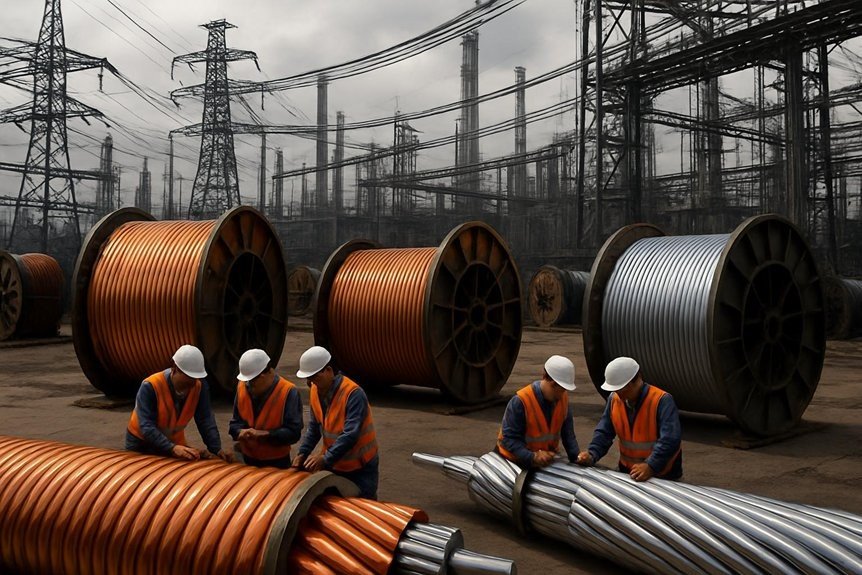
Prysmian Group engineers power transmission cable systems that move electricity from generation sources to national grids. The process involves more than simply laying cable. Voltage ratings, thermal performance, insulation integrity, and subsea installation tolerances all determine whether a system succeeds or fails at grid scale. Understanding how Prysmian addresses each of these challenges reveals why the company holds a distinct position in the energy transmission market.
Prysmian’s Core Power Transmission Technologies: HVDC, HVAC, and Beyond
Prysmian Group engineers and manufactures high-voltage direct current (HVDC) and high-voltage alternating current (HVAC) cable systems designed for bulk power transmission across terrestrial and subsea environments. These systems support voltage ratings exceeding 600 kV and facilitate low-loss energy transfer over extended distances.
HVDC technology, in particular, enables efficient interconnection between asynchronous grids and supports smart grid integration by providing controllable, bidirectional power flow. Prysmian’s cable infrastructure also interfaces with energy storage solutions, enabling grid operators to balance generation variability with consumption demands.
Extruded cross-linked polyethylene (XLPE) insulation and fluid-filled designs constitute the primary cable architectures deployed across both HVDC and HVAC configurations. Conductor materials, thermal ratings, and installation methodologies are engineered to satisfy project-specific load requirements, regulatory compliance standards, and long-term operational reliability objectives.
How Prysmian Connects Offshore Wind Farms to the Grid
Offshore wind integration requires three distinct cable segments: an inter-array network linking individual turbines, an offshore export cable transmitting aggregated power to a handover point, and an onshore transmission cable delivering that power to the grid connection facility.
Prysmian’s offshore wind farm integration approach addresses each segment through purpose-engineered cable systems rated for subsea installation, dynamic loading, and corrosive marine environments.
Export cables typically operate at 66kV to 400kV, utilizing XLPE insulation for thermal efficiency across extended submarine routes.
Prysmian’s grid connectivity solutions incorporate dynamic cable sections accommodating platform movement, static burial sections minimizing seabed disturbance, and landfall junctions managing mechanical stress at the shoreline interface.
This segmented engineering methodology guarantees continuous, low-loss power transmission from turbine arrays through to onshore substations.
The Real Projects Where Prysmian’s Power Transmission Is Proven
The engineering frameworks that govern Prysmian’s offshore and onshore cable integration are validated not through specification sheets alone, but through documented deployment across major infrastructure projects worldwide. Project case studies spanning interconnectors, offshore wind export systems, and urban grid reinforcement demonstrate consistent performance under varied load and environmental conditions.
The Western Link HVDC interconnector between Scotland and Wales, the BorWin submarine cable systems in the North Sea, and the Italy-Montenegro interconnector represent deployments where operational data confirms design intent. Customer testimonials from transmission system operators and project developers further substantiate Prysmian’s technical claims, providing third-party verification of installation reliability, thermal performance, and fault response.
Collectively, these documented outcomes establish a performance record grounded in measurable field results rather than theoretical projection.
How Prysmian Cables Perform in Subsea and Underground Conditions
Subsea and underground deployment environments impose fundamentally different mechanical, thermal, and electrochemical stresses on power transmission cables, and Prysmian’s engineering responses to each condition reflect distinct design priorities. Subsea cables face cable installation challenges including dynamic loading, hydrostatic pressure, and marine organism exposure, addressed through armored polyethylene sheaths and corrosion-resistant metallic barriers.
Underground systems encounter thermal dissipation constraints and soil chemistry variability, requiring precise insulation grading and moisture-blocking layers. Environmental protection concerns in both contexts demand multi-layered jacketing systems that resist chemical ingress while maintaining dielectric integrity across operational lifespans exceeding thirty years. Prysmian’s XLPE-insulated designs accommodate both deployment conditions, with conductor configurations and sheathing materials selected based on site-specific electrochemical, mechanical, and thermal modeling prior to manufacturing and installation.
Why Prysmian Leads the Next Generation of Power Transmission
As grid modernization accelerates globally, Prysmian’s competitive position derives from vertically integrated manufacturing capabilities, proprietary material science, and a project execution infrastructure spanning submarine, underground, and overhead transmission segments.
Industry leading manufacturing facilities across three continents enable consistent quality control from compound synthesis through cable laying operations. Innovative cable design methodologies, including advanced insulation systems and optimized conductor geometries, allow Prysmian to engineer solutions addressing increasingly demanding voltage ratings and thermal performance thresholds.
Strategic investment in digital monitoring technologies further differentiates the group’s offering, enabling predictive asset management across installed infrastructure. Prysmian’s accumulated intellectual property portfolio, combined with established submarine installation vessel capacity and extensive engineering expertise, positions the organization to execute technically complex transmission interconnections that few competitors can replicate at equivalent scale or reliability.
