


Last Tuesday, I watched a Netflix series buffer for thirty seconds while simultaneously downloading a massive dataset for analysis. The irony wasn’t lost on me. Here I was, thinking about enterprise network infrastructure while my home WiFi struggled with basic streaming.
But that moment crystallized something important about modern data movement. We’re living in an age where the bottleneck isn’t storage or processing power anymore. It’s the pipes.
The mathematics of modern data flow
Consider this: a single 4K video stream requires about 25 Mbps. Multiply that by a few hundred simultaneous users in an enterprise, add real-time analytics, cloud synchronization, and backup processes, and you’re looking at traffic that would make a highway engineer weep.
Traditional network cards, designed for simpler times, are like trying to push an ocean through a garden hose. They work fine until they don’t. And when they don’t, everything stops.
The calculus changes completely once you factor in machine learning workloads, distributed computing, and the reality that most companies are now running hybrid cloud infrastructures. Data doesn’t just sit politely in one place anymore. It moves. Constantly.
Where speed actually matters
Look, not every application needs blazing network speeds. Your email server probably doesn’t care if packets arrive in 10 milliseconds or 15. But try running distributed AI training across multiple nodes with a sluggish network connection.
You’ll watch your expensive GPUs sit idle, waiting for data that’s crawling through inadequate network infrastructure. It’s like having a Ferrari with bicycle tires.
Database replication tells a similar story. When you’re synchronizing terabytes of transaction data across geographically distributed systems, network throughput directly translates to business continuity. A slow network card doesn’t just slow down your backups. It creates windows of vulnerability where data loss becomes a real risk.
Real-world performance gaps
I talked to a DevOps engineer recently who described their container orchestration nightmare. They had dozens of microservices trying to communicate through what was essentially a network traffic jam. Services would timeout waiting for responses that were stuck in transmission queues.
The solution wasn’t more servers or better load balancing. They upgraded to high-speed network cards and suddenly their entire distributed architecture started humming. Response times dropped by 60%. Database queries that previously took minutes completed in seconds.
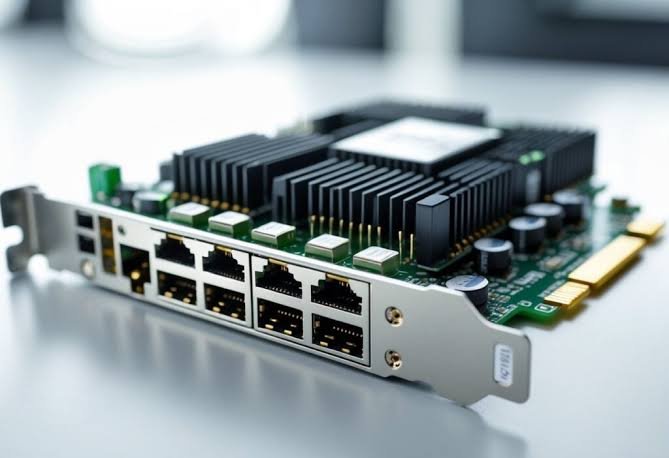
In their specific case, implementing an AMD Pollara 400 network interface card transformed their data pipeline from a constant source of frustration into something that actually worked as designed. Sometimes the hardware really is the limiting factor.
The hidden costs of network bottlenecks
Here’s what companies often miss: slow networks create compound inefficiencies. It’s not just that transfers take longer. Slow transfers trigger timeouts, which trigger retries, which create more network congestion, which slows everything else down.
Applications start behaving unpredictably. Users get frustrated. Developers spend time optimizing code that isn’t the problem. Meanwhile, the actual solution, upgrading network infrastructure, gets pushed down the priority list because it’s not obviously broken.
But networks don’t announce their limitations with error messages. They just… drag.
Beyond raw speed
Throughput is only part of the equation. Modern high-speed network cards bring features that fundamentally change how data moves through your infrastructure.
Hardware-level packet processing offloads work from your CPU. Advanced queueing mechanisms prevent important traffic from getting stuck behind bulk transfers. Error detection happens at the silicon level, reducing the overhead of retransmissions.
These aren’t just nice-to-have features for companies running at scale. They’re the difference between infrastructure that scales gracefully and infrastructure that hits a wall.
The infrastructure reality check
Every conversation about digital transformation eventually comes back to the same fundamental question: can your infrastructure actually handle what you’re asking it to do?
Most companies discover the answer the hard way. Usually during peak traffic, or when trying to deploy that machine learning model that worked perfectly in the test environment but crawls in production.
High-speed network cards aren’t glamorous. They don’t get the attention that flashy new software platforms receive. But they’re the foundation that makes everything else possible. Because in the end, if your data can’t move fast enough, nothing else matters.
