


Manufacturing operations across the United States rely heavily on consistent welding performance to maintain production schedules and quality standards. When welding specifications call for specific wire classifications, understanding the practical differences between international and domestic standards becomes essential for procurement decisions and operational planning.
The choice between wire classifications affects everything from inventory management to welder training protocols. European G4Si1 classification and American ER70S-6 specification represent different approaches to the same fundamental welding requirements, yet their operational characteristics can influence production outcomes in ways that extend far beyond the welding booth.
Production managers and welding supervisors frequently encounter situations where these specifications appear interchangeable on paper but deliver different results in practice. The differences extend beyond simple chemical composition variations to encompass arc characteristics, operator experience, and long-term reliability considerations that impact both immediate productivity and sustained manufacturing performance.
Chemical Composition Standards Drive Performance Characteristics
The fundamental distinction between these wire classifications lies in their governing standards and the resulting chemical composition requirements. G4Si1 welding wire follows European EN ISO 14341 standards, while ER70S-6 adheres to American Welding Society specifications under AWS A5.18. These different regulatory frameworks establish distinct parameters for silicon, manganese, and carbon content that directly influence welding behavior.
European G4Si1 classification typically requires silicon content between 0.80 and 1.20 percent, with manganese levels ranging from 1.40 to 1.85 percent. The American ER70S-6 specification sets silicon content between 0.80 and 1.15 percent, while manganese falls between 1.40 and 1.85 percent. These seemingly minor variations in silicon content create measurable differences in arc stability and penetration characteristics during actual welding operations.
Carbon content limitations also differ between the two standards, affecting mechanical properties in the final weld. G4Si1 maintains carbon content below 0.12 percent, while ER70S-6 keeps carbon under 0.10 percent. This difference influences both weldability and the mechanical properties of completed joints, particularly in applications requiring specific toughness characteristics.
Deoxidation Elements Create Distinct Arc Behaviors
The silicon and manganese levels in both wire types serve as deoxidation elements, but their specific concentrations create different arc characteristics that welders notice immediately. Higher silicon content in some G4Si1 variants produces a more aggressive cleaning action, which can be beneficial when welding materials with surface contamination but may create excessive spatter in clean welding conditions.
Manganese content affects both deoxidation and mechanical properties, but the interaction between silicon and manganese levels determines overall arc behavior. G4Si1 formulations often optimize this balance for European welding practices and base material compositions, while ER70S-6 targets American steel grades and typical industrial welding scenarios.
Mechanical Property Requirements Reflect Different Application Priorities
Tensile strength and yield strength requirements vary between the two classifications, reflecting different priorities in their respective markets. G4Si1 typically delivers tensile strength between 470 and 600 megapascals, while ER70S-6 provides tensile strength from 482 to 655 megapascals. These ranges overlap significantly but target different application requirements and safety factor calculations.
Impact toughness specifications also differ, with European standards often emphasizing low-temperature performance that may not be critical in many American manufacturing applications. Understanding these differences helps procurement teams avoid over-specifying wire properties for specific applications while ensuring adequate performance margins.
Manufacturing Process Variations Affect Wire Consistency
Production methods for G4Si1 and ER70S-6 wires reflect different manufacturing philosophies and quality control approaches. European wire production typically emphasizes tight tolerances on chemical composition and surface finish, while American manufacturing often prioritizes consistent mechanical properties and arc performance across larger production runs.
Wire drawing processes and surface treatments vary between manufacturers in different regions, affecting both storage characteristics and welding performance. G4Si1 wire often receives specific surface treatments designed for European welding equipment and environmental conditions, while ER70S-6 production targets American welding machines and typical shop floor conditions.
Quality control procedures also differ, with European standards emphasizing different testing protocols compared to American practices. These differences can affect batch-to-batch consistency and the types of documentation provided with wire shipments, influencing quality assurance procedures in receiving operations.
Surface Coating and Preservation Methods Impact Shelf Life
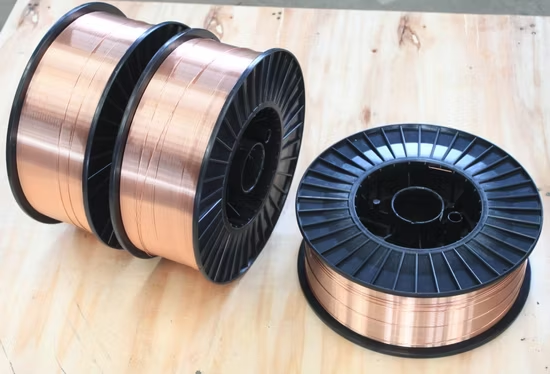
Copper coating thickness and application methods vary between G4Si1 and ER70S-6 wire production, affecting both electrical conductivity and corrosion resistance during storage. European manufacturing often applies thinner, more uniform copper coatings that provide excellent conductivity but may require more controlled storage conditions.
American ER70S-6 production frequently uses slightly thicker copper coatings designed to withstand typical American warehouse conditions and handling practices. This difference affects both contact tip wear rates and the wire’s ability to maintain consistent electrical characteristics over extended storage periods.
Arc Characteristics and Operator Experience Requirements
Welders familiar with one wire classification often notice immediate differences when switching to the other, even when using identical welding equipment and parameters. G4Si1 wire typically produces a slightly different arc sound and visual characteristics compared to ER70S-6, affecting operator confidence and welding rhythm in production environments.
Spatter patterns and cleanup requirements also vary between the two wire types, influencing post-weld processing time and overall productivity. Some G4Si1 formulations produce less spatter in specific voltage ranges, while ER70S-6 may perform better across a wider parameter window, providing more forgiving operation for less experienced welders.
Contact tip life and wire feeding characteristics show measurable differences in many welding systems. The subtle variations in wire surface texture and coating thickness between G4Si1 and ER70S-6 can affect feeding reliability, particularly in longer welding cables or when using older welding equipment with worn drive rolls.
Parameter Window Differences Affect Production Flexibility
Operating parameter ranges for optimal performance vary between G4Si1 and ER70S-6 wire, affecting the flexibility available to welding operators during production runs. G4Si1 wire often requires more precise parameter control to achieve optimal results, while ER70S-6 typically offers broader parameter windows that accommodate normal variations in operator technique.
Voltage and wire feed speed relationships also differ subtly between the two wire types, requiring parameter adjustments when switching between them. These differences become more pronounced in automated welding systems where parameter optimization directly affects production rates and quality consistency.
Cost Factors and Supply Chain Considerations
Procurement costs for G4Si1 and ER70S-6 wire reflect different supply chain structures and manufacturing locations. G4Si1 wire sourced from European manufacturers often carries higher transportation costs and longer lead times for American operations, while domestic ER70S-6 production provides shorter supply chains and more predictable pricing.
Currency fluctuations affect G4Si1 pricing more significantly than ER70S-6 costs, creating budgeting challenges for operations that rely heavily on imported wire. Exchange rate variations can create substantial cost differences over the course of annual purchasing contracts, affecting total manufacturing costs in ways that extend beyond simple per-pound wire pricing.
Minimum order quantities and packaging differences also influence total procurement costs. European G4Si1 suppliers often require larger minimum orders to justify international shipping, while domestic ER70S-6 suppliers typically offer more flexible ordering options that better match production consumption patterns.
Inventory Management Requirements Differ Between Wire Types
Storage requirements for G4Si1 and ER70S-6 wire can vary based on their different surface treatments and packaging methods. Some G4Si1 wire formulations require more controlled storage environments to maintain optimal feeding characteristics, while ER70S-6 wire typically tolerates normal shop floor storage conditions without performance degradation.
Shelf life considerations also differ, affecting inventory rotation procedures and waste management. Understanding these differences helps operations managers optimize wire storage procedures and minimize material waste due to deteriorated surface conditions or feeding problems.
Equipment Compatibility and Setup Requirements
Welding equipment settings require subtle adjustments when switching between G4Si1 and ER70S-6 wire, even when the wires have similar diameter and basic specifications. Drive roll pressure settings may need modification to accommodate differences in wire surface characteristics and feeding behavior between the two types.
Contact tip selection and replacement schedules often change when switching between wire types due to their different electrical and thermal characteristics. The copper coating thickness and wire surface finish variations between G4Si1 and ER70S-6 can affect contact tip wear patterns and electrical conductivity over extended welding periods.
Gas flow requirements and shielding gas optimization may also require adjustment when changing between wire classifications. The different arc characteristics and spatter patterns of each wire type can influence the optimal gas flow rates and mixture compositions for specific applications.
Maintenance Schedule Modifications May Be Required
Preventive maintenance schedules for welding equipment may require adjustment when switching between G4Si1 and ER70S-6 wire due to their different wear characteristics on system components. Liner replacement intervals, drive roll maintenance, and contact tip change frequencies can all be affected by the subtle differences between wire types.
Wire feeder calibration procedures may also need modification to maintain consistent feeding performance across different wire classifications. Understanding these requirements helps maintenance teams prevent feeding problems and maintain consistent welding performance throughout production runs.
Quality Control and Documentation Differences
Certification documentation and traceability requirements differ between G4Si1 and ER70S-6 wire due to their different governing standards and typical application requirements. European G4Si1 certification often includes different test results and documentation formats compared to American ER70S-6 certificates, affecting quality assurance procedures and record-keeping requirements.
Mill test certificates and chemical analysis reports follow different formats and include different information depending on the wire classification and manufacturing location. According to the American Welding Society, documentation requirements for welding consumables must align with specific industry standards and application requirements to ensure proper traceability and quality control.
Batch tracking and lot identification systems also vary between suppliers of different wire classifications, affecting inventory management and quality control procedures. Understanding these differences helps operations teams maintain proper documentation and traceability for quality assurance and customer requirements.
Testing Protocol Variations Affect Acceptance Procedures
Incoming inspection procedures may require modification when switching between G4Si1 and ER70S-6 wire due to their different certification standards and testing protocols. The specific tests performed and reported for each wire type can vary, requiring adjustments to acceptance criteria and inspection procedures.
Mechanical testing requirements and acceptance standards also differ between the two wire classifications, affecting quality control procedures and acceptance testing protocols. Understanding these differences helps quality assurance teams develop appropriate inspection procedures for each wire type.
Application-Specific Performance Considerations
Specific welding applications may favor one wire classification over the other based on their distinct performance characteristics and mechanical properties. Structural welding applications often benefit from the broader parameter windows and consistent performance of ER70S-6 wire, while precision welding applications may require the tighter composition tolerances available in some G4Si1 formulations.
Base material compatibility also varies between the two wire types, with each classification optimized for different steel compositions and preparation standards. European G4Si1 wire often performs optimally with European steel grades and surface preparation standards, while ER70S-6 targets American steel compositions and typical industrial preparation practices.
Environmental conditions and service requirements can also influence wire selection decisions. Applications requiring specific mechanical properties or environmental resistance may benefit from the particular characteristics of one wire type over the other, regardless of basic compatibility considerations.
Long-Term Performance Variations Affect Service Life
Weld metal properties and service performance can show subtle differences between G4Si1 and ER70S-6 wire over extended periods, affecting maintenance schedules and component life cycles. Understanding these long-term performance characteristics helps engineering teams select appropriate wire classifications for specific service requirements.
Corrosion resistance and environmental stability may also vary between the two wire types based on their different chemical compositions and mechanical properties. These differences can influence total cost of ownership calculations for critical applications where component longevity affects overall system reliability.
Conclusion
The choice between G4Si1 and ER70S-6 welding wire involves multiple factors that extend beyond basic technical specifications to encompass supply chain logistics, operator training, equipment compatibility, and long-term performance requirements. Understanding these seven critical differences enables manufacturing operations to make informed decisions that align with their specific operational needs and performance expectations.
Successful implementation of either wire classification requires careful consideration of the complete operational impact, from procurement and storage through welding performance and final service requirements. The differences between these wire types, while subtle, can significantly affect overall manufacturing efficiency and product quality when properly understood and managed.
Manufacturing teams benefit most when they evaluate wire selection decisions within the context of their complete welding operation, considering how each wire classification interacts with their specific equipment, procedures, and performance requirements. This comprehensive approach ensures optimal results regardless of which wire classification best serves their operational needs.
