


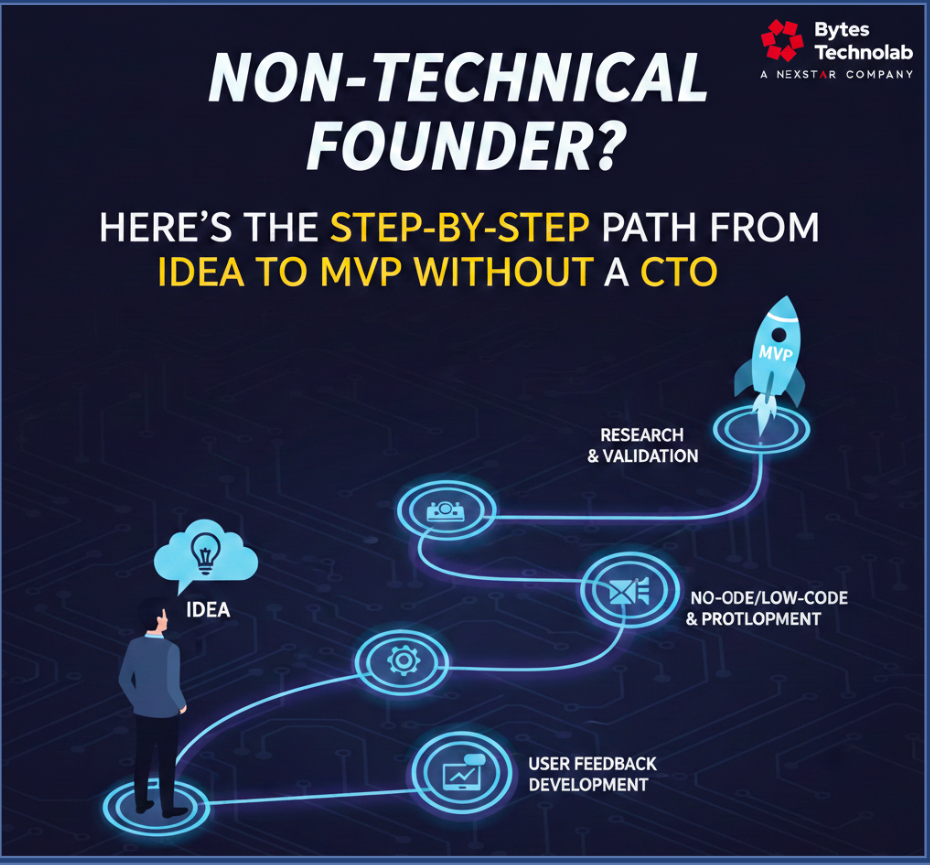
You have great product ideas.You understand the problem. You know the UK market needs it.
There is one problem that lies in your way, however: you, a non-tech founder, lack someone to work as your CTO.
That condition happens more often than you may think. Many of the successful U K. startups were founded by people from business, sales, marketing, or operations with no engineering record. What this means is that you don’t even have to code or hire a CTO full-time to build an MVP.
In this guide, we shall follow a structured step-by-step path from idea to MVP with the right processes, partners, and decisions.
Step 1: Validate the Idea Before You Build Anything
Before a single penny is spent on a development, make sure to find proof of your idea solving real problems, especially in the UK market.
Start by asking:
- Who is the target user?
- What problem are they actively trying to solve?
- How are they solving it today?
Establish direct communication with possible users. Get an overview of the UK competition. Take a look at what people feel about pricing and buying behavior. This preliminary market search will naturally set the direction of the product idea and thus reduce risk at the back end.
Now, a lot of founders draw inputs from teams sought out for Product Strategy Consulting to clearly define use cases, target segments, and MVP scope.
Step 2: Turn Your Idea into a Clear Product Vision
Post-validation, the next step is making the product into something that developers can build.
The need is not getting technical specs. The need is clarity.
What to focus on:
- Core functionalities (What must definitely be in version one)
- User journeys (How the user travels through the product)
- Business goals (sign-ups, free trials, or subscriptions)
This phase is a part of the product design and development. This process structures the idea into the real product concept. A clear vision of the product helps the company avoid overboarding projects and thus manage costs better.
Step 3: Use Prototyping to Visualise the Product
If you are a founder who is not technical, it is hard to imagine how your product will look or work just from text.
That is where prototyping services can be of help.
A clickable prototype lets you:
- View and use the product flow visually.
- Share the prototype with users to get early feedback.
- Pitch to your investors or stakeholders with confidence.
Prototypes are much cheaper compared to full builds and will help you find usability issues early on.
Step 4: Validate with a Proof of Concept (PoC)
Many UK startups opt into PoC development services before going into building full-fledged MVPs.
Proof of concept answers the key question: Does this thing really work, technically, and business-wise?
If your product has the following:
- Integrations with existing systems
- Complex workflows
- AI or data-driven features
Hence, PoC reduces technical uncertainty and helps establish confidence in an idea, without the commitment of having a full product developed.
Step 5: Choose the Right MVP Development Partner
If you are a founding person with limited technology knowledge, your first important step is selecting the right development partner.
When considering the option of hiring an in-house CTO, entrepreneurs often collaborate with an MVP development company that has expertise in startup settings.
Look for partners offering:
- End-to-end mvp development services
- Clear communication (non-technical explanations matter)
- Experience with UK startups and markets
- Flexible engagement models
A good partner shall be expected to act on guidance as your technical advisor, helping with making intelligent choices with respect to speed, cost, and quality.
Step 6: Build Only What the MVP Needs
An MVP is not a full product. The product represents its most basic form, which provides value to users through their actual experience with the product.
The MVP development process for startups operates differently than enterprise software development.
Your MVP should:
- Solve one core problem well
- Be stable and secure
- Collect user feedback and data
Unnecessary features should be avoided. The primary focus should be on learning instead of achieving perfection. Experienced teams offering product development services help founders prioritise features that matter most.
Step 7: Use Product Engineering for Scalability
The development of an MVP requires careful construction because it represents a complete product.
Professional product engineering services ensure:
- Clean architecture
- Scalable foundations
- Security and compliance (important for UK businesses)
Your MVP can develop into a complete product because it needs no complete development from the beginning again.
Step 8: Consider AI Where It Truly Adds Value
The founders believe they must implement AI technology because it has become popular. The founders make a wrong decision about their business.
AI-driven product development should only be used if it:
- Improves decision-making
- Automates repetitive tasks
- Enhances user experience meaningfully
The UK startups in their operations can use AI technology to achieve success in analytics and recommendations and customer support. The technology works best when it meets the actual requirements of users.
Step 9: Plan for Iteration and Product Modernisation
Now comes the real learning when your MVP is live and starts getting into actual usability.
You will have to:
- Improve features based on feedback
- Optimise performance
- Update outdated components over time
This is the most important aspect where Product Modernization Services aid startups to stay competitive while keeping the existing users undisturbed.
Why Non-Technical Founders Don’t Need a CTO at the Start
The costs of hiring a full-time CTO before achieving product-market fit create financial and operational dangers for businesses.
Non-technical founders who collaborate with Bytes Technolab as their trustworthy partner acquire access to:
- Strategy, design, and engineering expertise
- Structured MVP execution
- Long-term product support
The approach enables you to concentrate on customer acquisition, business expansion and fundraising activities because experts take care of all technical requirements.
Final Thoughts
The current startup ecosystem does not disadvantage founders who lack technical skills.
With the correct process, together with clear thinking and experienced partners, will enable you to develop your minimum viable product from your initial concept without the need for programming or a chief technology officer.
The team should prioritize validation and clarity together with intelligent execution. The technology will follow.
