


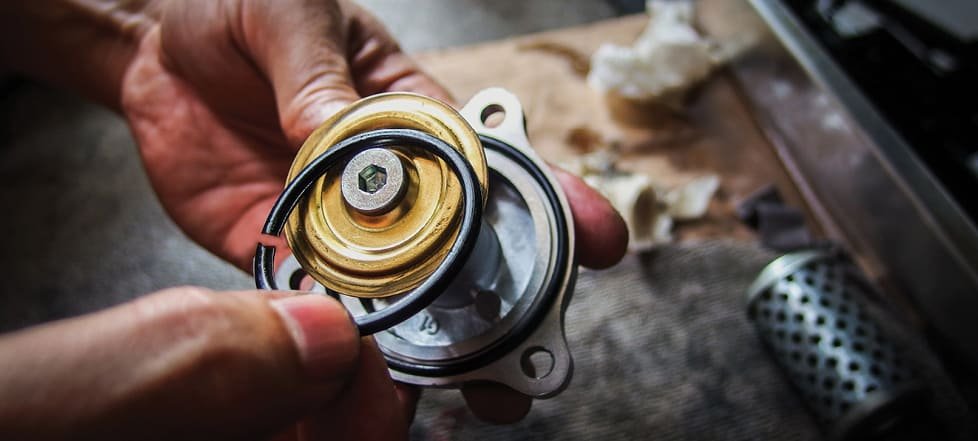
In industrial systems, sealing components rarely receive attention unless something goes wrong. Pumps, valves, compressors, and hydraulic assemblies are designed around precise operating assumptions, yet a single mismatched O-ring material can undermine those assumptions entirely. When sealing fails, the consequences are not limited to leaks. They extend into downtime, contamination, equipment damage, and safety exposure.
Material selection errors are especially common in environments involving heat, chemicals, pressure cycling, or aggressive fluids. O-rings may look interchangeable at rest, but their behavior changes dramatically once exposed to real operating conditions. The following failures illustrate how choosing the wrong O-ring material creates risks that compound over time, often in ways that are difficult to diagnose until damage is already underway.
O-ring material choice as a system reliability factor
An O-ring functions as a controlled deformation element. It must compress predictably, maintain elasticity, resist chemical attack, and recover its shape repeatedly over its service life. Material properties determine how well it performs these tasks under specific conditions.
For engineers and maintenance teams evaluating viton o-ring supply options, the decision is less about availability and more about matching material behavior to operating reality. When this match is wrong, sealing failures tend to appear in patterns rather than as isolated incidents.
Why material mismatch often goes unnoticed at first
Material-related failures develop gradually.
- Initial sealing appears adequate
- Degradation occurs internally or microscopically
- Performance declines under repeated exposure
By the time leaks become visible, material damage is often advanced.
1. Thermal hardening that leads to seal cracking
Some elastomers lose flexibility when exposed to sustained heat. Instead of maintaining elasticity, the material hardens and becomes brittle. Once this happens, the O-ring can no longer conform to mating surfaces, especially during thermal cycling.
Cracks typically form during cool-down periods when hardened material is unable to accommodate contraction.
How thermal hardening affects system performance
Loss of elasticity reduces sealing margin.
- Compression set increases
- Microgaps form under load
- Seal failure becomes progressive
Replacing the seal without changing material often leads to repeat failure.
2. Chemical swelling that distorts sealing geometry
Certain O-ring materials absorb process fluids, causing them to swell beyond their intended dimensions. While swelling may initially improve sealing, it ultimately distorts geometry and increases friction or extrusion risk.
Chemical compatibility issues are common in systems involving fuels, solvents, or aggressive lubricants.
Why swelling creates hidden damage
Dimensional change alters load distribution.
- Excessive compression increases wear
- Seal movement becomes restricted
- Groove damage may occur
Once swelling subsides, permanent deformation often remains.
3. Compression set under continuous load
Compression set occurs when an O-ring fails to recover its original shape after prolonged compression. Materials with poor compression resistance gradually flatten, reducing contact pressure against sealing surfaces.
This failure mode is especially common in static seals subjected to constant load.
Operational consequences of compression set
Reduced contact pressure compromises sealing.
- Leaks appear during pressure changes
- Seal effectiveness declines over time
- Replacement intervals shorten
Material selection directly influences compression set resistance.
4. Abrasion and wear in dynamic applications
In dynamic systems, O-rings experience relative motion against mating surfaces. Materials not suited for sliding contact wear rapidly, producing particles that further accelerate damage.
Abrasion is often mistaken for installation error when it is actually a material limitation.
Why wear-driven failures escalate quickly
Wear generates secondary effects.
- Particles contaminate fluids
- Surface roughness increases friction
- Seal life shortens exponentially
Dynamic sealing requires materials designed to tolerate motion.
5. Loss of sealing force at low temperatures
Low-temperature environments can stiffen certain elastomers, reducing their ability to maintain contact pressure. Even moderate cooling can push materials beyond their effective operating range.
This issue often appears in outdoor, refrigerated, or intermittently operated equipment.
Effects of low-temperature stiffness
Stiff seals fail to respond to pressure changes.
- Leakage during startup
- Delayed sealing recovery
- Inconsistent performance
Material flexibility across temperature ranges is critical.
6. Permeation leading to gradual leakage
Some materials allow gases or fluids to permeate slowly through their structure. While not an immediate failure, permeation leads to gradual loss of containment, particularly in pressurized systems.
This failure mode is subtle and often misdiagnosed.
Why permeation is difficult to detect
Permeation occurs uniformly.
- No visible seal damage
- Leak rates increase slowly
- Pressure loss appears intermittent
Material permeability varies widely across elastomer types.
7. Rapid degradation under ozone or UV exposure
O-rings exposed to ozone or ultraviolet light can develop surface cracking even when not under load. Outdoor installations or equipment near electrical sources are particularly vulnerable.
Material resistance to environmental exposure is often overlooked.
Structural impact of surface cracking
Cracks compromise sealing continuity.
- Stress concentrates at crack tips
- Elastic recovery declines
- Seal failure accelerates under load
Environmental resistance is essential for long-term reliability.
8. Extrusion under pressure cycling
When pressure fluctuates, poorly suited materials may extrude into clearances between components. Over time, this extrusion damages the seal and mating surfaces.
Extrusion often occurs in systems lacking proper backup rings.
Why extrusion damages more than the seal
Material displacement alters geometry.
- Seal edges tear or shear
- Groove dimensions change
- Replacement seals fit improperly
Material strength under pressure is a key selection factor.
9. Incompatibility with cleaning or flushing agents
Many industrial systems undergo periodic cleaning or flushing. Materials compatible with process fluids may degrade when exposed to cleaning agents, causing unexpected failures shortly after maintenance.
This issue is common in food, chemical, and pharmaceutical equipment.
Maintenance-related failure patterns
Failures appear after routine service.
- Seals fail sooner than expected
- Damage is uneven or localized
- Root cause is often misattributed
Material compatibility must consider all fluids encountered.
10. Premature aging that shortens service life
Some elastomers age rapidly even under nominal conditions. Oxidation, plasticizer loss, or internal crosslinking changes material properties over time, reducing service life.
Premature aging increases maintenance frequency and operational risk.
Why aging matters in critical systems
Aging reduces predictability.
- Seal behavior becomes inconsistent
- Inspection intervals shorten
- Failure risk increases unexpectedly
Material stability over time is as important as initial performance.
Why sealing failures rarely stay isolated
O-ring failures often trigger secondary damage. Leaks contaminate lubricants, corrosion accelerates, and component wear increases. What begins as a small sealing issue can cascade into broader equipment failure.
This compounding behavior explains why material choice is a reliability decision, not a procurement one.
The cost of treating symptoms instead of causes
Replacing failed seals without reassessing material repeats the cycle.
- Downtime increases
- Spare usage rises
- Root causes persist
Material correction is often the most effective long-term fix.
Material behavior in context
Elastomer behavior depends on chemistry, structure, and environment. Different materials respond differently to heat, chemicals, pressure, and time. A general overview of elastomer performance and properties is available in Wikipedia’s explanation of elastomers, which outlines how elasticity, resistance, and degradation mechanisms vary across material types.
Understanding these fundamentals supports better selection decisions.
Aligning material choice with operating reality
Effective O-ring selection starts with accurate understanding of conditions.
- Temperature range, not just maximum
- Full list of fluids, including cleaners
- Static versus dynamic movement
- Pressure patterns over time
Matching material properties to these realities reduces failure risk.
Why standardized solutions often fall short
Standard O-ring materials are designed for general use, not specialized environments. In demanding applications, standard choices often operate near their limits, leaving little margin for variability.
Purpose-aligned materials provide stability where standard options cannot.
Reframing O-ring selection as reliability engineering
O-rings may be small components, but their influence on system reliability is disproportionate. Treating material selection as an engineering decision rather than a routine purchase reduces unplanned downtime and maintenance disruption.
Reliable sealing starts with material behavior, not appearance.
Closing perspective: material choice defines sealing outcomes
Industrial sealing failures are rarely random. In most cases, they trace back to material behavior that was mismatched to operating conditions. Heat, chemicals, motion, pressure, and time expose these mismatches gradually, until failure becomes unavoidable.
Choosing the right O-ring material is not about avoiding every possible failure mode. It is about understanding which risks matter most in a given system and selecting materials that remain stable under those specific conditions. When material behavior aligns with operating reality, seals perform quietly and reliably, allowing equipment to do the same.
