


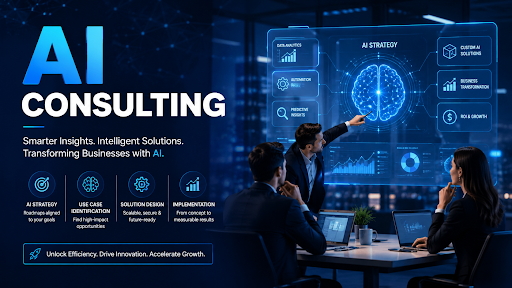
Finance leaders are under growing pressure to improve productivity, strengthen forecasting, manage risk and provide faster insights to the business. At the same time, many organizations struggle to move AI initiatives beyond experimentation because of fragmented data, legacy systems, unclear priorities and governance concerns. AI Consulting helps organizations address these challenges by connecting AI investments with clearly defined finance and enterprise priorities.
Generative AI in Finance expands this opportunity by automating knowledge-intensive activities, improving access to financial information and helping finance professionals analyze and communicate business performance. Combined with machine learning, predictive analytics and intelligent automation, generative AI can help finance organizations become more efficient, forward-looking and strategically focused.
This article explores the role of AI Consulting in finance transformation, the applications and benefits of Generative AI in Finance, implementation priorities and the future of intelligent finance.
What is AI Consulting?
AI Consulting helps organizations identify, prioritize and implement artificial intelligence capabilities aligned with business objectives. It typically involves assessing AI readiness, identifying high-value use cases, evaluating data and technology requirements, establishing governance and developing an implementation roadmap.
For finance organizations, AI Consulting can help leaders determine where artificial intelligence can improve productivity, decision-making and financial performance. This may include evaluating opportunities across financial planning and analysis (FP&A), accounting, reporting, accounts payable, treasury and risk management.
The objective is to move beyond isolated AI experiments toward scalable capabilities that address specific business needs.
What is Generative AI in Finance?
Generative AI in Finance refers to the application of generative artificial intelligence across financial processes and workflows. Unlike traditional automation, which typically follows predefined rules, generative AI can interpret natural language, summarize complex information, generate content and support conversational interaction with enterprise data.
Finance professionals can use it to create initial drafts of management commentary, summarize financial results, explain performance variances and retrieve information from policies or other financial documents.
These capabilities make Generative AI in Finance particularly valuable for activities that combine data analysis, knowledge work and communication.
Why finance organizations need a clear AI strategy
AI technologies are developing quickly, creating pressure on finance leaders to identify opportunities and demonstrate value. Implementing tools without a clear strategy, however, can result in disconnected initiatives, unnecessary costs and limited business impact.
AI Consulting provides a structured approach for evaluating potential use cases based on factors such as business impact, implementation complexity, data readiness, governance requirements and expected return.
For CFOs, this helps answer a critical question: where should limited investment and management attention be directed to create the greatest value?
A clear strategy also helps finance leaders determine which processes should be simplified or standardized before introducing AI.
Core technologies supporting Generative AI in Finance
Generative AI operates alongside several complementary technologies.
Large language models
Large language models enable systems to understand and generate natural language, making it easier for finance professionals to interact with financial information and enterprise knowledge.
Machine learning
Machine learning identifies patterns across historical and operational data to support forecasting, anomaly detection and financial analysis.
Predictive analytics
Predictive analytics helps organizations anticipate revenue, expenses, cash flow and other financial outcomes based on historical data and business drivers.
Intelligent automation
Automation handles repetitive activities such as workflow routing, data processing and reconciliations, while generative AI can support more knowledge-intensive elements of these processes.
Together, these technologies expand the potential scope of Generative AI in Finance beyond content creation toward intelligent financial operations.
Key use cases of Generative AI in Finance
Organizations are exploring Generative AI in Finance across multiple areas of the function.
Financial planning and analysis
Generative AI can summarize forecasts, explain key performance drivers and assist with scenario analysis. This can help FP&A teams spend less time preparing information and more time interpreting business implications.
Management reporting
Finance teams can use generative AI to prepare initial drafts of financial commentary and tailor summaries for executives, business units or other stakeholders.
Accounting
AI can assist with transaction analysis, reconciliation support and accounting documentation while escalating material judgments and exceptions for human review.
Accounts payable
AI can extract and interpret invoice information, summarize exceptions and support approval workflows, reducing manual processing effort.
Treasury
Generative AI can help treasury teams interpret cash flow information, summarize liquidity trends and communicate potential financial implications.
Risk and compliance
AI can analyze large volumes of financial information, summarize policies and highlight transactions or activities that require further investigation.
AI Consulting can help organizations determine which of these use cases should be prioritized based on their specific performance gaps and technology environment.
Business benefits of Generative AI in Finance
When implemented effectively, Generative AI in Finance can improve several dimensions of finance performance.
Greater productivity
Automating repetitive and knowledge-intensive work can release finance capacity for analysis, decision support and business partnering.
Faster financial insights
Generative AI can summarize large volumes of information and explain important performance drivers, enabling finance professionals to respond more quickly to business questions.
Better planning and forecasting
Combined with predictive analytics, AI can help finance teams evaluate scenarios and understand potential financial outcomes.
Improved access to knowledge
Conversational AI can make finance policies, procedures and enterprise information easier for employees to find and understand.
Stronger decision support
AI can help finance teams identify trends and synthesize financial information, supporting more informed resource allocation and performance decisions.
How AI Consulting supports implementation
Successful AI implementation requires organizations to address strategy, data, technology, governance and workforce readiness together.
AI Consulting can support this process by helping organizations:
- Assess current finance performance and AI readiness.
- Identify and prioritize high-value AI opportunities.
- Evaluate data, architecture and integration requirements.
- Develop an AI implementation roadmap.
- Establish governance and human oversight requirements.
- Redesign processes to incorporate AI effectively.
- Define performance measures for tracking business value.
This structured approach helps organizations avoid treating AI as a standalone technology initiative.
Challenges organizations need to address
Generative AI in Finance introduces important risks because finance processes involve sensitive information, regulatory requirements and material business decisions.
AI-generated outputs can be incomplete or incorrect, making validation and human accountability essential. Organizations also need robust access controls to protect confidential financial information.
Fragmented enterprise data can further limit AI effectiveness, while legacy systems may create integration challenges. AI Consulting can help organizations determine which foundational issues should be addressed before advanced capabilities are scaled.
Workforce readiness is another consideration. Finance professionals need to understand how to use AI effectively, assess its outputs and recognize when professional judgment is required.
Best practices for scaling Generative AI in Finance
Organizations should take a disciplined approach to scaling AI across finance:
- Start with clearly defined finance and business problems.
- Prioritize use cases based on value, feasibility and time to value.
- Strengthen data quality and governance before scaling implementation.
- Integrate AI into existing finance workflows rather than creating disconnected tools.
- Maintain human oversight for material judgments and high-risk decisions.
- Establish clear security, privacy and responsible AI controls.
- Measure improvements in productivity, decision quality, cycle times and financial performance.
AI Consulting can provide the framework required to connect these activities within a broader finance transformation strategy.
The future of Generative AI in Finance
The next phase of Generative AI in Finance will increasingly involve AI agents capable of coordinating multistep activities across finance systems. These agents could retrieve information, analyze data, initiate approved workflows and route exceptions to finance professionals.
Finance leaders may also gain more conversational access to enterprise information, allowing them to explore financial performance and business drivers through natural-language interactions.
As these capabilities mature, AI Consulting will increasingly focus on operating model redesign, governance, workforce implications and enterprise-scale AI orchestration rather than individual technology deployments.
Conclusion
Generative AI in Finance is creating opportunities to improve finance productivity, accelerate analysis and strengthen enterprise decision support. But technology alone will not determine whether organizations capture meaningful value.
AI Consulting provides the strategic framework needed to identify the right opportunities, establish the required foundations and integrate AI into finance processes responsibly. Organizations that combine clear priorities, strong data, effective governance and scalable AI capabilities will be better positioned to build finance functions that deliver greater insight, productivity and strategic value.
