


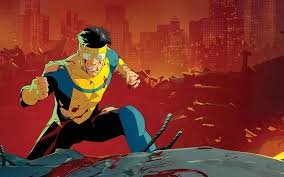
In the crowded landscape of adult animated superhero content, Amazon Prime Video’s Invincible managed to do something that very few shows achieve in their debut season: it created a single recurring visual device so distinctive, so tonally perfect, and so widely discussed that it became inseparable from the show’s identity. The title card appearing at the end of each episode, splashed across the screen in bold lettering that shifts colour and distortion based on the emotional weight of what has just been shown became one of the most talked-about aesthetic choices in recent animated television.
Understanding why this device works so well, what it communicates about the show’s creative philosophy, and why it has resonated so deeply with audiences requires looking at both the design itself and the broader context of how Invincible uses visual language to tell its story. The title card is not just a logo treatment it is a piece of storytelling in its own right.
What makes the Invincible title card distinctive
The basic concept is simple: the show’s title appears on screen at the end of each episode rather than the beginning, as is conventional for most television. But it is the execution that elevates this from a quirky structural choice to a genuinely powerful creative tool. The lettering bold, colourful, and instantly recognisable appears in a state that reflects the events of the episode that has just concluded. In lighter episodes, the card appears clean and vibrant. After episodes of significant violence or emotional devastation, the lettering is splattered, distorted, and damaged.
This responsiveness to narrative context transforms what could have been a purely aesthetic choice into a form of visual commentary. The title card tells you something about what you have just watched it contextualises the experience, punctuates the emotional arc of the episode, and creates a moment of reflection between the story and the credits. It is, in essence, a miniature piece of graphic storytelling appended to each episode.
The design also draws on the visual language of comic books the source material from which Invincible is adapted. Bold lettering, high contrast colours, and the kind of typographic confidence that characterises superhero comic covers all feed into the card’s aesthetic. This creates a visual bridge between the animated series and its print origins, reinforcing the show’s identity as an adaptation while also standing completely on its own terms.
The show’s creative philosophy and tonal complexity
Invincible, created by Robert Kirkman and adapted for television by the same team responsible for The Walking Dead’s comic run, is fundamentally a story about the gap between superhero mythology and the reality of what superhero violence would actually look like. It takes the conventions of the genre seriously the costumes, the powers, the team dynamics, the world-saving missions while simultaneously interrogating what those conventions actually mean when applied to characters with genuine psychology and moral complexity.
This tonal complexity the ability to be genuinely funny and warmly character-driven in one scene and brutally, graphically violent in the next is the show’s defining quality. It is also what makes the title card such an apt piece of design. The card’s variability mirrors the show’s tonal variability. Just as Invincible refuses to stay in one emotional register, the title card refuses to look the same twice. The design and the storytelling are in perfect alignment.
Why audiences connected with the device so strongly
The meme and fan culture dimension
Part of the title card’s cultural impact came from its perfect adaptability to fan creativity. The format bold text on a high-contrast background, with variable states of damage and distortion is immediately legible as a template. Within days of the first season’s release, fans were creating their own versions of the card with custom text, applying the visual language to other shows, games, personal jokes, and cultural references. The design was distinctive enough to be instantly recognisable as “Invincible-style” while being simple enough in its core logic to be recreated and remixed.
This fan creativity, in turn, extended the show’s cultural reach far beyond its direct viewership. People who had not watched a single episode of Invincible encountered its visual aesthetic through memes, fan art, and social media posts. The title card became a cultural signifier that communicated something about the show its tonal ambition, its willingness to be both fun and serious even to people who had no direct experience of it.
The creative tools dimension
The enthusiasm for recreating the card’s aesthetic has driven genuine demand for tools that allow fans and creators to generate their own versions applying the show’s distinctive visual language to custom text and contexts. Resources like this Invincible-style title card creator exist precisely because of this creative enthusiasm giving fans a fast, accessible way to engage with the show’s aesthetic and produce their own versions of one of its most recognisable visual elements.
Title cards and visual identity in animated television
The Invincible title card sits within a broader tradition of animated television using title treatment as a vehicle for creative expression and tonal signalling. Several landmark animated series have used their opening sequences, title cards, and visual branding as opportunities for genuine artistic creativity rather than purely functional identification.
What distinguishes the Invincible approach is the episode-by-episode variability. Most shows, animated or otherwise, maintain visual consistency in their title treatment the logo looks the same in every episode, providing a stable brand anchor. Invincible deliberately breaks this convention, using the title card as a responsive element that changes with the story. This is a significant creative risk: it requires audiences to pay attention to the card each time rather than treating it as familiar wallpaper, and it requires the production team to make a fresh creative decision about each episode’s card rather than applying a template.
The fact that this risk paid off that audiences not only noticed the variability but actively engaged with it, discussed it, and used it as a measure of each episode’s emotional intensity speaks to how well the device was calibrated to the show’s specific audience and creative goals.
Invincible Season 2 and the card’s continued evolution
The second season of Invincible continued to develop the title card tradition, introducing new variations and contexts that expanded the device’s expressive range. Having established viewer expectations through the first season, the creative team could play against those expectations using the card’s state as a source of surprise, irony, or misdirection in addition to its original function as emotional punctuation.
This evolution reflects a broader principle in successful long-form storytelling: devices that work in early seasons need to develop alongside the narrative to remain meaningful rather than becoming predictable. The title card’s ability to evolve while remaining immediately recognisable is a testament to the strength of the original design a sufficiently robust visual foundation can support significant variation without losing coherence.
Fan creativity and the broader ecosystem of media-inspired tools
The appetite for tools that allow fans to engage creatively with their favourite shows and films has grown significantly alongside the rise of fan communities on social media. Platforms like Invincible Title Card Generator address this appetite directly, offering a range of generators and creative tools that span media properties, naming traditions, and creative contexts giving fans and creators fast, accessible ways to engage with the visual and identity languages of the things they love.
What the title card teaches about visual storytelling
The Invincible title card offers a genuinely instructive lesson for anyone interested in visual storytelling, design, or creative direction. It demonstrates that functional elements the title of a show, necessarily present for identification purposes do not have to be purely functional. With sufficient creative ambition and the right alignment between design choices and narrative intent, even a title card can become a piece of storytelling.
It also demonstrates the value of responsiveness in design. A fixed, unchanging visual element communicates stability and brand consistency. A responsive element that shifts with context communicates attentiveness the sense that the design is aware of and engaged with the specific moment it appears in. For a show whose entire premise involves questioning fixed assumptions about superheroes, a responsive title card is not just aesthetically pleasing but thematically appropriate.
These are lessons with applications far beyond animated television. Any designer, creative director, or storyteller working on projects that need to communicate both a stable identity and tonal flexibility can find something useful in the way Invincible solved this particular creative problem loudly, boldly, and with every episode’s worth of blood and impact to show for it.
